Mosley: 'They ruined my life. That's why I'm fighting on'
The former motor-racing boss tells Matthew Bell he is driven by his tabloid humiliation
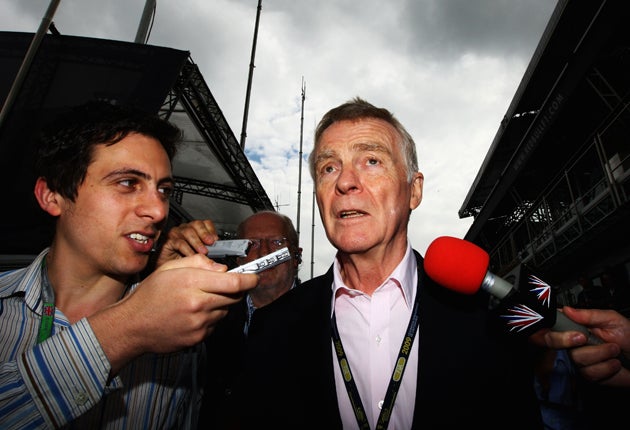
If your taste for sadomasochistic orgies happens to be exposed in a national newspaper, convention dictates you go to ground for a while, resurfacing perhaps when the glare of scandal has faded.
But convention does not preoccupy Max Mosley, the 70-year-old former president of the Federation Internationale de l'Automobile, and son of the fascist leader Sir Oswald and society belle Diana Mitford. Since successfully suing the News of the World for invasion of privacy, after the redtop published photos of him engaged in a five-hour bondage session, he has embarked on a one-man crusade to change the law surrounding the publication of private information.
On Tuesday, he speaks at a debate to be aired on the BBC, for the motion: "The private lives of public figures deserve more protection from the press." Speaking against him is the investigative journalist Tom Bower and former Director of Public Prosecutions Sir Ken Macdonald. But for Mosley this is not just a hobby horse: he has lodged a request with the European Court of Human Rights in Strasbourg asking that, by law, journalists must inform the subject of a story of the private details they intend to print, prior to publication.
"It's really a small and narrow point," he says from his home in Monaco. "All I am asking is that a member of the public should be notified that they are going to be written about before it happens."
Mosley first learnt that the News of the World had exposed details of his sex life – which he practised unbeknown to his wife or family for 45 years – when he saw it on the newsstands. "Once it's out there, you can't get it back," he says. "Your only remedy is to take legal action. But if you go to court then all the private information that you wanted to keep secret will be repeated, perhaps with embellishment. On top of that, it is incredibly expensive, even if you win."
In July 2008, Mr Justice Eady awarded Mosley record damages of £60,000 for breach of privacy, and the News of the World was forced to pay costs of nearly £1m. At the time, the newspaper protested that it was "not for the rich and famous to dictate news agendas", but Mosley points out that, despite winning, "I ended up £30,000 out of pocket. If I had lost, I would have been £1m out of pocket. No rational person would sue in those circumstances. That is a terrible injustice."
Mosley launched his appeal to the European court in 2008, but because of a backlog of cases, it is unlikely to get a hearing until 2011. Opponents say that if he succeeds, journalists will face a surge in injunctions that will stifle their freedom and slow down newspaper production. They envisage a nightmare scenario in which stories would be repeatedly pulled, close to deadline.
Mosley points out that it is already usual for journalists to put stories to their subjects, and it would only have a significant impact on sex stories. He adds: "You are only awarded an injunction if you can satisfy a judge that there is no public interest. The idea that just because you're rich you can go to a judge and they'll award you an injunction is simply not so."
Some may find Mosley an unlikely moral campaigner, and wonder why a rich man like him is dedicating so much time to this issue. It is precisely becuase of his wealth that he feels a duty to lobby for change. "This injustice is being done to normal people all the time, and most are not in a position to do anything about it. For example, there was a couple of swingers who advertised for other people to join them, and were exposed by the News of the World. They were just ordinary people, and afterwards the man committed suicide because he couldn't bear the humiliation. That is appalling."
Despite his role as an activist, Mosley still feels his own humiliation keenly. "It's appallingly embarrassing," he says, "particularly for my family. This was a small and secret part of my life. It's annoying when you have dedicated your life to doing serious work – campaigning for track and road safety – but all you are remembered for is this."
Is he seeking revenge? "No. It's not just about the News of the World. Take the Pakistani cricket story – that's the sort of thing they should be doing, not exposing some poor little couple."
He says that his friends have supported him, and he remains married to his wife of 50 years. By campaigning for change, he feels his image has been slightly repaired, though he is under no illusion as to the scale of the damage. "In a sense it ruins your life," he says. "But you have to refuse to allow that. The only useful thing I can do is to try to stop it happening to other people."
The debate will be held on 7 September at Cadogan Hall, London, and broadcast on BBC World News. www.intelligencesquared/events
Join our commenting forum
Join thought-provoking conversations, follow other Independent readers and see their replies
Comments