The Big Question: Why are regional papers in crisis, and does it matter if they close down?
Why are we asking this now?
Britain's regional newspapers are in unprecedented crisis and there is not one of the media organisations with interests in this sector that has been immune to this catastrophic downturn in the industry's fortunes. This week, Johnston Press, the publisher of such famous titles as The Scotsman and the Yorkshire Post, announced that its advertising had fallen off a cliff in the first two months of this year, down 35 per cent from the same period in 2008. That followed a 16.8 per cent fall in annual advertising revenues in 2008, and a drop of more than £75m (12.4 per cent) in overall revenues. Trinity Mirror, which owns national and regional titles including the Liverpool Echo, has seen advertising revenues fall by 30 per cent in the first two months of 2009. "These are good businesses but they rely on advertising," says Nick Fullager, Trinity Mirror's communications director. "The best sales person in the world can't sell an ad to somebody who is not placing any money on the table."
How is this impacting on their ability to report local news?
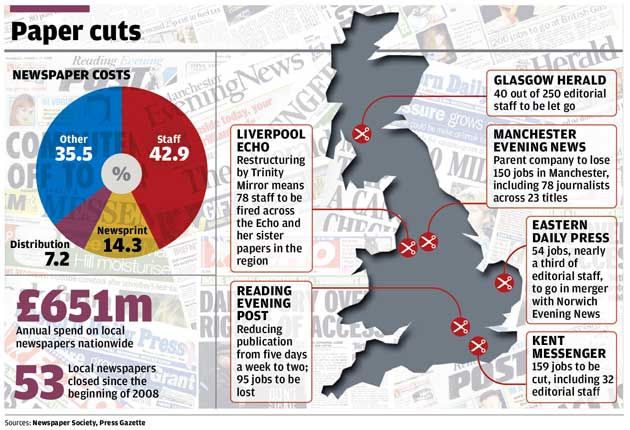
Massively, as staff levels are having to be drastically reduced. Some 60 regional papers have closed in the last year. Guardian Media Group, publisher of the Manchester Evening News, has this week embarked on a bloodbath of job cutting, slashing 150 jobs in the North-west, and closing offices in Accrington, Ashton, Macclesfield, Oldham, Rochdale, Rossendale, Salford and Wilmslow. GMG, which publishes The Guardian national newspaper, also this week cut a further 95 jobs from its titles in Surrey and Berkshire, reducing its flagship paper for the region, the Reading Evening Post, from a five-day to a twice-weekly publication. The National Union of Journalists was outraged: "Instead of supporting the communities the company claims to serve, it is hitting the economy with job cuts. Once again, journalists are paying the price for short-sighted policies of newspaper managements." Northcliffe Media, a division of Daily Mail & General Trust, is reducing sub-editing posts across its titles – which include the Nottingham Evening Post – putting a reported 116 jobs at risk. Smaller groups, such as the Midlands-based Observer Standard Media Group, have also been badly hit, calling in administrators this week and threatening 150 jobs.
What are the causes of the crisis?
It's a double whammy. The economic downturn certainly. But according to John Fry, chief executive of Johnston Press, the impact of the recession has been compounded by the ongoing structural changes in the industry that have resulted from increased use of the internet. Those changes in consumer behaviour have seen classified advertising, integral to the business model of the regional press, migrate online. Local newspapers are especially dependent on advertising in the jobs, homes and motoring sectors. Property ads are down by 21 per cent year-on-year, with motors down by 14 per cent and jobs by 11 per cent. Local newspapers have also felt the need to set up their own websites and have lost print readers as a result. "Our estimate," says Mr Fry, "is that our advertising revenues in 2008 are 18 per cent less than they would have been without the structural changes."
Is the Government doing anything to help?
Well, not really. At national level the Newspaper Society has been disappointed that while the Government has expressed support for a vibrant local press, it continues to withdraw at an alarming rate public sector advertising, including the requirement to publish certain public notices. At a local level, public officials have been even more hostile, setting up council-run newspapers which are funded by taxpayers and compete directly for both readers and third-party advertising revenues. Examples of this include East End Life, a paper funded by Tower Hamlets Council and covering events in the London borough. "Is that a good thing for your local council to be doing?" asks Lynne Anderson of the Newspaper Society. "They should surely be playing a role in helping local businesses, not competing with them."
Have regional newspapers simply had their day?
Not at all. An impressive 82 per cent of UK adults read local newspapers, a level of penetration matched by no other medium except television. Even now there are some 1,300 regional titles, reaching 40 million readers every week, and between them they operate 1,200 websites. Johnston's sites have 6.8 million unique monthly users, with growth of 49 per cent year-on-year. Sean Mahon, marketing director of Northcliffe, admits the advertising market is "pretty horrible" but points out that "we are still reaching millions of readers". Northcliffe has an audience of 7 million for its 100-plus titles, plus a further 4 million of its websites. "Absolutely there's a future for local newspapers."
What role do they play in our society?
By reporting on the workings of local government, the regional press has a more vital democratic function than ever, now that the national media – itself under intense economic pressure – is increasingly restricted to covering events in London. The crisis in commercial broadcasting also means that ITV struggles to devote resources to the provision of local news programming, although it announced yesterday that it was seeking help from the BBC to retain its service. Local papers are the glue that holds together towns and cities. Regional papers report stories from their communities, including coverage of local sports teams, which would be ignored by the national media. They also report on the local economy. Northcliffe Media has established business websites in the East Midlands and the South-west to provide specialist coverage.
What effect is it having so far?
The local newspaper network is the bottom layer of the British news pyramid, from which the BBC and the national press tends to pick up a significant number of its stories. There is discontent at the Press Association that court cases are going uncovered in regional courts because local newspapers have been unable to attend trials. "Your local paper is not just a commercial animal. It's a vital leg in democracy," Kelvin MacKenzie, told readers of his column in The Sun. "Who will tell you what local councils are up to in the future? Not Google. Who will cover magistrates courts, inquests, local crime, the speech days? Not Google."
How bad is the prognosis for regional papers?
As the Newspaper Society points out there are closures and launches of regional titles every year. There have been 10 new launches in the past 12 months. Generally speaking, the weekly titles have fared rather better than the one hundred or so daily titles, whose woes have attracted more attention because they represent some of Britain's biggest cities.
What about online?
The online audience for the local press is growing rapidly, with traffic growing by 25 per cent in 2008 and the total number of unique monthly users reaching 24 million, comparable with the biggest national newspaper websites. After losing jobs ads to specialist recruitment sites, the local press websites are clawing back ground. "There are encouraging signs and some publishers are seeing a good chunk of profits coming from the internet but they have to get through this downturn," says Mrs Anderson. "In the meantime, painful decisions are being made because they're still more reliant on print advertising than online."
Should we care if local newspapers close?
Yes...
* They are an essential component of democracy without which local government will not be held to account
* When regional television news coverage is under pressure, newspapers are the only source of local news
* They provide a documented record of our social history that cannot be replaced by social networking sites
No...
* We still have the BBC, and if there is sufficient demand for local news the internet will eventually provide it
* This is an industry in long-term decline. It should go the way of the coal miner and the cartwright
* Some free newspapers are little more than notice boards for advertisers and carry little news of value
Join our commenting forum
Join thought-provoking conversations, follow other Independent readers and see their replies
Comments
Bookmark popover
Removed from bookmarks