Vince Cable: 'News Corp made veiled threats to attack Lib Dems if BSkyB takeover was blocked'
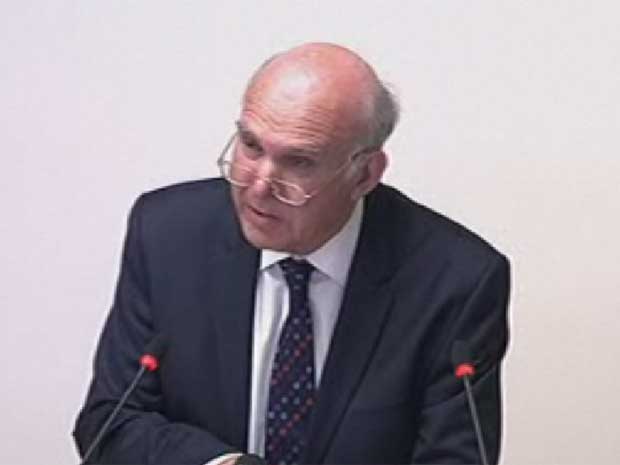
Rupert Murdoch’s media empire made “veiled threats” to attack the Liberal Democrats in its UK newspapers if its controversial £8 billion takeover of BSkyB was blocked, the Business Secretary Vince Cable claimed today.
Mr Cable told the Leveson Inquiry that he felt “under siege” from News Corp and was “seriously disturbed” by what appeared to be a co-ordinated effort to coerce him into accepting the deal.
He blamed the pressure for his unguarded outburst to undercover reporters that he had “declared war” on Mr Murdoch - an outburst led to him being stripped of responsibility for ruling on the bid.
Speaking a day before the Culture Secretary Jeremy Hunt is due to give evidence about his roll in the takeover bid Mr Cable accepted that it was right to remove him from the process. But he insisted that his personal concerns about the influence of Murdoch newspapers would have affected his decision.
“I had heard directly and indirectly from colleagues that there had been veiled threats that if I made the wrong decision from the point of view of the company, my party would be - I think somebody used the phrase ‘done over’ in News International press,” Mr Cable told Lord Justice Leveson.
“I took those things seriously, I was very concerned.”
Mr Cable said that he believed that the threats emerged "in conversation" between Lib Dem colleagues and News Corp lobbyist Frédéric Michel, adding “but I can't be absolutely certain”.
Pressed by Robert Jay QC, counsel to the inquiry, if Michel's name was “expressly mentioned to you” Mr Cable said that “it was at that stage, yes indeed”.
Setting out the context of his “war” remark to two journalists posing as constituents – Mr Cable said he was already “tense and emotional” because of dealing with angry protesters.
He added that reports that News Corp representatives were “either trying to influence my views or seeking material which might be used to challenge any adverse ruling I might make” only inflamed his mood.
“My references to a 'War on Murdoch' were making the point, no doubt rather hyperbolically, that I had no intention of being intimidated,” he said.
Mr Cable agreed that he had personal concerns about the mounting influence of the Murdoch empire, but insisted that they had not in any way affected his decision.
“In my opinion as a politician, I believed that the Murdochs' influence, exercised through their newspapers, had become disproportionate,” he told the inquiry.
“This was not a factor in my decision,” he said. “Absolutely not.”
Defending his handling of the bid, he rejected News International complaints about his refusal to meet him to hear News International's arguments in favour of the takeover.
Asked about the issue by the lawyer acting for News International and News Corp, he said it “could have looked like bias” if he had not also held meetings with the many organisations lined up in opposition to the takeover.
He said News Corp had been able to express its case “fully and forcefully” through official channels, he suggested.
He also firmly rejected claims by Mr Michel that he had stated that there would “not be a policy issue” with regard to the takeover in the course of a conference call.
Shown an email from Mr Michel reporting back on the conversation, Mr Cable said: “I almost certainly did not say that and I am confident that I didn't say it.”
He added that officials listening in would have “taken me to task if I had said it”.
Giving evidence after Mr Cable Ken Clarke, the Justice Secretary, told the Leveson Inquiry politicians were influenced by a “noisier and noisier” press, claiming newspapers could “drive weak governments like sheep”.
“There certainly are cases... where policy decisions are taken primarily because people, the politicians and ministers responsible, are fearful of the media reaction,” he said.
“What editors are mainly interested in is exerting influence on non-media type political issues.
“They can certainly drive a weak government like a flock of sheep before them sometimes, in some areas.”
He added that he believed would-be MPs were deterred from standing for office by the potential intrusion into their private lives.
“A lot of people are drawn away from politics because they don't want to accept the level of exposure,” he said.
Join our commenting forum
Join thought-provoking conversations, follow other Independent readers and see their replies
Comments
Bookmark popover
Removed from bookmarks