Will Standpoint fall at the first hurdle?
The right-wing magazine has had a tough first six months. Amol Rajan meets its founder
Bill Buckley, the grand old man of American conservatism who died this year, knew the value to a magazine of a memorable tag line. His National Review, he said, founded in 1955 (when he was 29) "stands athwart history, yelling Stop!"
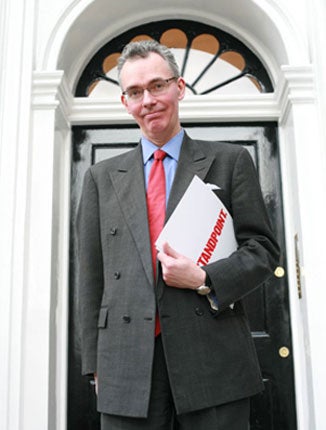
Daniel Johnson, who has the air of a classics don, is in many respects a modern English incarnation of the phrase and its originator.
The editor of Standpoint, a high-brow monthly launched in June, resists the comparison. Yet the first half of his magazine's title is itself a nod to the American's lasting influence on both sides of the Atlantic.
Almost four years in the making (Johnson was also writing a book on chess and the Cold War), Standpoint was launched to defend and celebrate Western civilisation from its apparently multiplying enemies. Every edition has high-profile writers, usually from the right (Niall Ferguson, Michael Burleigh, Melanie Phillips) but decorated with members of the left commentariat (Andrew Marr, Nick Cohen). They are paid "market rates" – meaning, at times, thousands of pounds per article.
Beautifully presented and intellectually aggressive, on seeing its first edition one former editor of a national broadsheet described it to The Independent as "a neocon rag". "The neoconservative strain of thought has not been given a fair crack of the whip over here", Johnson says.
But there are limits, he protests, to the view that Standpoint is a centre-right version of the centre-left Prospect, which has acquired new backers and is beginning to flourish in its 14th year. "David Goodhart [editor of Prospect] is a friend of mine... but one has the feeling that Prospect doesn't quite cover the waterfront. It doesn't take culture as seriously as we do."
"Our priority is to explore issues from a broader vantage point, and avoid the sense of being a small coterie of similar-thinking people."
Standpoint's first six months have been marked by unforeseen problems – and a global financial crisis. Magazines can't feed people: they are luxury products. Subscriptions fall in recessions. Advertising yields have collapsed, so Standpoint's ads pages (currently 13 out of 84) will go up in the New Year to compensate.
There have been major problems with personnel. Publisher Simon Tiffin left because of irreconcilable differences within the office. "We made a few mistakes early on," says Johnson. "Like hiring the wrong people." Former deputy editor Jonathan Foreman, meanwhile, continues to work for the magazine as a writer-at-large.
But there are several reasons, and one in particular, to think that Standpoint has an exceptional position within the industry, and may be more immune to the recession. Funded and published by the Social Affairs Unit (SAU), a think tank, the magazine exists only because of a shipping magnate and metals trader named Alan Bekhor, who helped set up the SAU. In April, the Sunday Times Rich List claimed the 49-year-old is worth at least £120m.
The basement of Bekhor's apartment in London's Manchester Square provides Standpoint with its offices. Bekhor has given Johnson an informal financial guarantee for at least one year, and probably two.
Bekhor is a Tory donor and man of the right who also helps to fund the New Culture Forum and Forum for European Philosophy. Like Johnson, he brings extensive social capital. Board members include shadow children's secretary Michael Gove, VS Naipaul, Lord Lawson, Frank Field, and Tom Stoppard. Louis Amis, son of Martin, is one of three full-time staff.
Johnson, a former Telegraph stalwart who also served as literary editor and comment editor on The Times, is himself the son of historian and journalist Paul and brother of Luke, the chairman of Channel 4 and former chairman of Pizza Express.
He is coy about circulation figures (not available from the ABC, which Standpoint hasn't joined), and says that early sales would have been badly hit by distribution problems that are now largely resolved. The magazine's first edition sold only around 3,000 copies on news stands, amid huge publicity (including a helpful Daily Mail front page, carrying the remarks of Bishop of Rochester Michael Nazir-Ali). There are thought to be a meagre thousand subscriptions – from which most future circulation growth will have to come.
Magazines of the right in Britain were well served before the arrival of Standpoint. Sales of The Spectator have risen by nearly a fifth since the journal was acquired by the Barclay brothers in 2004. The Salisbury Review, a quarterly magazine, retains steady circulation in its 26th year, despite operating on a shoestring budget.
So Standpoint "had to occupy new ground", says Johnson, who suddenly comes over all Gordon Brown. "Serious times for call serious publications, at least for serious people."
So far, so good. Standpoint conveys confidence and moral purpose, and carries some of the best writing on sale in Britain. But should Bekhor's generosity diminish in the near future, or subscriptions fail to pick up, a crowded market may soon stand athwart Johnson, yelling Stop!
Join our commenting forum
Join thought-provoking conversations, follow other Independent readers and see their replies
Comments