Annie Nightingale: The first lady of Radio 1
Forty years ago, men ruled the airwaves. Then along came Annie Nightingale to prove that she could put a fresh spin on being a DJ. Ian Burrell meets her
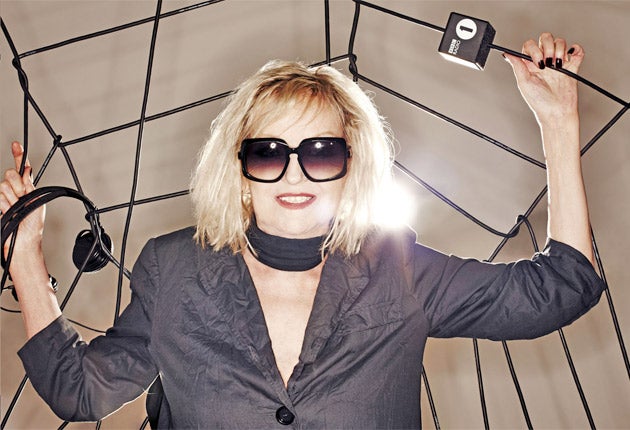
Radio 1, your boys took one hell of a beating. Emperor Rosko, Tony Blackburn, Fluff Freeman, Ed Stewart, Pete Murray and the rest of the all-male presenting team that launched Radio 1 in 1967, have one-by-one parted company with the network. But Annie Nightingale is still there.
Little Annie who joined the station three years after its inception, stepping into a bastion of chauvinism, where station chiefs would publicly assert that "Disc jockeys are husband-substitutes," and producers would hold dinner parties at which they would amuse guests by playing audition tapes sent to Radio 1 by women who had the temerity to wish to be presenters.
Four decades later, Nightingale takes off her sunglasses to reflect on her career. She has watched up-close the whole story of British popular music and yet, musically, she always prefers to face the future. Tune in to her Friday show and you'll hear innovative current artists, such as Chase & Status, Magnetic Man and Caspa. "I've always been into the underground and giving someone their first play on Radio 1," she says. "It's grippingly interesting, the way British music particularly twists and turns all the time."
Nightingale has built a large following overseas – particularly in the United States, Australia and Japan – and become a fixture on the festival scene. Her set at Glastonbury has become famous as the curtain-raiser to the whole event, this year causing chaos as 20,000 people converged on a tent with a capacity of 800. She attributes her success in becoming Britain's first female national radio DJ to her "You'll do, nipper" strategy, which translates as doing everything necessary to be in the right place when a big break comes along. By the time she reached Radio 1 she had networked relentlessly and built a broad CV, presenting the television pop show That's For Me, and writing columns for Honey magazine and the Daily Sketch.
That didn't cut any ice with the "chauvinist brutes" at Radio 1, as she described them in her autobiography Wicked Speed. In a hotel in Soho, central London, she recalls: "It was pretty impossible, they were just sexist, saying, 'We don't want any women, their voices wouldn't carry.' It's laughable now, but it wasn't then."
Her depth of musical knowledge was little help in operating a studio in an unforgiving environment. "The technical side of it was very intimidating, and all these blokes were just waiting for me to make a mistake. I was very nervous and with live radio they just threw you in at the deep end." Faced with the "huge great" mixing desk she made "some bad mistakes" and says that if she were helping a young protégé now she would tell them: "Ignore all those buttons, all you need to know is this one and this one."
But Nightingale has devoted her career to the station and she is proud of its current output. "Radio 1 is really on it now," she says. "It wasn't always like that." That's a reference to the late Eighties, when the station was "pretty uncool" and failed to appreciate the importance of the rave scene. In truth, Radio 1 was no more out of touch than the British music industry, the state of which almost drove Nightingale to give up her job. "There was a period in the Eighties when Stock, Aitken, Waterman ruled the earth, when I thought 'I don't really know if I can carry on doing what I'm doing.' Acid House came along and that was brilliant. I have a great belief in the British underground to always find a way through the cracks in the pavements."
She complains that music industry accountants occasionally wrest control of the creative process and introduce excessive caution. "Who wants safe and bland? Let's have excitement and danger and all that stuff – I still want that." Her principle concern now is the quality of a two-hour mix tape she is preparing as a celebration of her 40th anniversary on Radio 1. "I know I'm going to be defined by it and I cannot get it wrong," she says. The anniversary is also being marked by a two-hour Radio 1 documentary on Thursday and a programme on BBC4.
She's not normally one to reminisce. "I don't want to live in some nostalgic past. The X Factor is all karaoke, they are singing old songs. What's the point of that? People think, 'I've got to sing like that if I want to be successful,' but that's not the case. We are proving that with artists like [grime rapper] Tinie Tempah. It's very important that we are encouraging real creativity."
Nightingale says there was "less competition" in radio when she started, but that means less partying. "I don't see people DJ-ing completely out of their minds now," she says. "You can't go on mad benders, because you've got a laptop and the last thing you want to do is wander off and lose that."
At 68, Annie Nightingale now works for a station that employs female presenters across the schedule. She has opened the door for the likes of Jo Whiley, Edith Bowman, Annie Mac and Fearne Cotton. And she has as much energy and enthusiasm for new music as any one of them. "I love the buzz," she says.
A Night With Annie Nightingale is on BBC Radio 1, Thursday 9 September, 7-9pm.
Join our commenting forum
Join thought-provoking conversations, follow other Independent readers and see their replies
Comments