Brown paves way for spending cuts
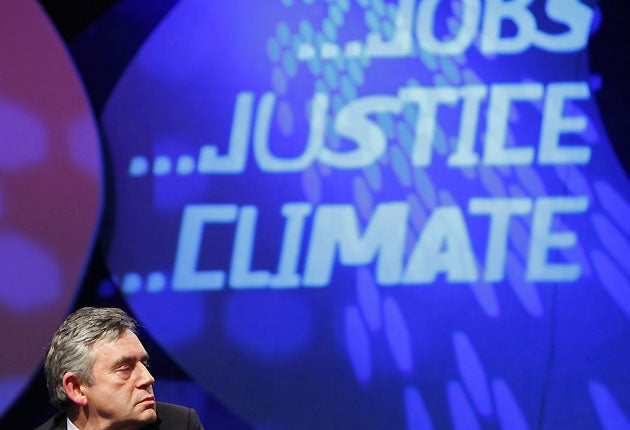
Gordon Brown today said for the first time that Labour will be ready to impose cuts in spending once the recession is over.
But the Prime Minister insisted, in a high-profile speech to the TUC, that he would protect frontline public services and accused the Conservatives of planning "across the board public spending cuts" to fund tax breaks for the rich.
Mr Brown's announcement marks a significant shift in Labour strategy after months in which he has sought to characterise the upcoming general election as a choice between Labour investment and Conservative cuts.
Speaking to the TUC annual congress in Liverpool, Mr Brown said: "Labour will cut costs, cut inefficiencies, cut unnecessary programmes and cut lower priority budgets.
"But when our plans are published in the coming months people will see that Labour will not support cuts in the vital frontline services on which people depend."
He added: "The choice is between Labour who will not put the recovery at risk, protect and improve your frontline services first and make the right choices for low- and middle-income families in the country.
"And a Conservative Party which would reduce public services at the very time they are needed most, make across-the-board public spending cuts to pay for tax cuts for the wealthiest few, and make different choices about public services because they have different values.
"These would be the wrong choices at the wrong time for the wrong reasons because they have the wrong priorities for Britain."
Mr Brown had previously stressed the role of growth, asset sales and efficiency improvements in achieving Chancellor Alistair Darling's target of halving the £175 billion deficit within four years of the end of the recession.
The PM's reluctance to discuss the need for spending reductions has led to press reports that the word "cuts" had become a taboo at 10 Downing Street. But his spokesman this morning played down the significance of Mr Brown's use of the word, insisting he had made clear many times over the past few months that "tough choices" would be required in the coming period.
The Prime Minister gave no indication in today's speech of which "lower-priority" areas of Government activity might be the targets for cuts.
Mr Brown told his audience of trade unionists that it was necessary to plan to bring Britain's debt down "as the recovery happens" to ensure "sustainable public finances".
That would involve plans, already announced, to raise National Insurance by 0.5 per cent from 2011 and impose a 50p top rate of income tax on high earners.
And he acknowledged that it will also have to involve reductions in spending.
"We are doing the right thing to make sure that for the future as we move into a full recovery we will invest and grow within sustainable public finances - cutting costs where we can, ensuring efficiency where it's needed, agreeing realistic public sector pay settlements throughout, selling off the unproductive assets we don't need to pay for the services we do need," said Mr Brown.
Speaking on the first anniversary of the collapse of Lehman Brothers, which ushered in the most critical phase of the global financial downturn, Mr Brown said that his Government's interventions had helped prevent a Great Depression on the scale of the 1930s.
But he said that "the road to recovery is still fragile" and warned that Conservative policies could pitch Britain back into recession.
"There is a fundamental difference between the parties as to how to come through this recession and avoid it being deeper, longer and more damaging," said Mr Brown.
"And we still have big choices to make. The choice of whether we continue to act to help families and businesses or whether we listen to the Tories and withdraw support from families and businesses, cut public services now, and refuse to invest in Britain's future.
"So once again the country now has a decision to make, about whether we continue the support that is necessary to sustain the recovery, or we cut away the support now."
Mr Brown said that Labour's approach to spending reductions would be "guided by our values of fairness and responsibility".
He announced plans to save £500 million over the coming three years by reforming a Whitehall early retirement scheme which provides senior mandarins with as much as six times their annual pay.
By contrast, he characterised Conservative money-saving plans as "callous and cold-hearted", evoking memories of the mass unemployment of the 1980s and the home repossessions of the early 1990s under previous Tory administrations.
Conservative plans to scrap a guarantee of work experience or education for all school-leavers and to withdraw help for home-owners were "the wrong choice for Britain", he said.
Mr Brown said Britain's response to the recession - taking stakes in failing banks and offering insurance to guarantee deposits - had been followed by other countries around the world.
And he said the Government's actions, taken in the face of Conservative opposition, had saved up to 500,000 jobs, helped thousands of people to stay in their homes and given tax breaks to 22 million.
"At no time in our history have we, the British people, done so much to support our homeowners, businesses and the unemployed," said the PM. "This didn't happen by default, but by our decisions."
And he added: "We faced the Tories down, and we have been shown to have done the right thing by hard-working British families.
"But I tell you that we still have a choice to make: the recovery is not automatic and the road to recovery is still fragile.
"It is being hard won by Government making the right choices and could be quickly wrecked by government making the wrong choices.
"People's livelihoods and homes and savings are still hanging in the balance, and so today I say to the British people: don't allow anyone to put the recovery at risk."
Mr Brown also issued an appeal for solidarity from restive union leaders, who have used this week's conference to warn that public spending cuts could be met with strike action.
Reminding them of the impotence of the labour movement during a previous recession under Margaret Thatcher's Conservative administration, he said: "In the 1980s we marched for jobs, we rallied for jobs, we petitioned for jobs, but because we were not in power, we couldn't create jobs without a government committed to jobs.
"And so I ask you - the people who remember - to campaign with us as government to say that we will not allow a new generation of young people to become a lost generation. We won't let that happen - never again."
Join our commenting forum
Join thought-provoking conversations, follow other Independent readers and see their replies
Comments