'Lack of contraception meant I had to wait to be a war reporter'
TV journalist of the year Alex Crawford on how she balances motherhood and the front line
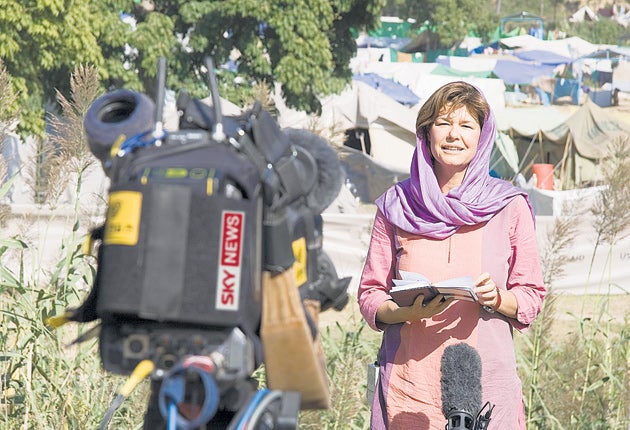
'The Taliban want you. They saw you coming in and they want to take you." It's five years since I became a foreign correspondent and, I have to admit, those words make me shudder. Actually, shudder is not quite the word, but this is a family newspaper.
I am in Logar Province in eastern Afghanistan, an area known for its criminal gangs and Taliban activities. I'm here to find out about the insurgents' bomb-making facilities, and visiting factories in four provinces. The gangs here yearn to find foreigners that they can kidnap and sell on for big bucks to the different Taliban groups. The Taliban, in turn, use us as bargaining chips to demand the release of Taliban prisoners.
The militant in front of me looks hard. Not a man you'd want to cross. "We're talking to them," he says. "We've told them you are our guests and you are ours." It could have been the interpretation. It could have been a "lost in translation" moment, but right now all I can think is: "They're fighting over who gets the foreigner prize." My Afghan friend who has travelled with me is clearly thinking along the same lines and immediately asks for a prayer mat so he can, very publicly, pay his respects to Allah.
Several phone calls later to the contact who arranged this meeting, the mood – and the story – seems to have changed. The militant group I'm with, although rivals of the Taliban, have only days earlier struck a deal with them, thanks to which I won't be handed over. We're offered green tea but we don't hang around, even though our mouths are bone dry.
When I get back to my hotel in Kabul, some three hours later, I am shaking. Not for the first time, I think: "Too close. That was too close." I am reminded of the conversation I had with my eldest daughter, Frankie (aged 12), the night before I left for Afghanistan. "It won't be dangerous will it, Mummy? You will be all right?"
The conversations with my children before I set off on a trip usually begin with an interrogation about the length of the trip followed by tough questioning about why it has to be that long, why it has to be that place (ie, danger spots like Afghanistan, Pakistan or Sri Lanka), followed usually by an emotional meltdown about why I have to work at all. These are questions many working mothers are familiar with. They're tough to answer.
I have four children – Nat, aged 14, Frankie, Madeleine, aged 10, and seven-year-old Flo – and a very long-suffering partner, Richard, who is also a journalist. Because of this, there is grudging acceptance in our house that I have to go to places most people would never dream of going, nor ever want to.
There are risks. There are dangers. Working where you stand a genuine risk of getting kidnapped or killed is not viewed as normal by most people. But then, reporters have different DNA. They are programmed to be curious: to go where no one else will go, to ask questions no one else will ask, to give a voice to those no one else will listen to. It's hard to explain how intoxicating, how interesting and how utterly addictive it can be.
My children and partner moved to live in New Delhi when I was made Asia correspondent for Sky News in 2005, having worked for Sky since its launch in 1989. My children now go to a school beside children from 56 different nations and many religions. They live in a city where there is unspeakable poverty and great wealth, where there are regular power cuts and which is home to the world's largest democracy. They walk past armed guards and razor wire to go to lessons and have terrorist drills in case militants storm the school where they study. And they take it all in their stride. What they may have lost by leaving behind a thorough British education they have gained by having access to so many cultures, traditions, religions and experiences.
I consider myself a bit of a slow starter. I'm 47 now but I cannot remember ever not wanting to be a foreign correspondent. Lack of opportunity, lack of jobs and definitely lack of contraception meant I had to wait. But I realised recently trekking in Wardak Province in Afghanistan that perhaps age does have its advantages. I was wearing a burqa to protect my modesty, stumbling every few steps.
When I peeked out from under my garment, the hooded militant taking us to our meeting spot glanced round and saw me. A conversation ensued in Pashto with my Afghan interpreter Faisal who then turned to me and said; "It's OK. He says you're an old lady. You can take off the burqa." You know you're getting old when even the militants start looking young. And yet I feel like I am just at the beginning.
Alex Crawford is Asia correspondent for Sky News
Join our commenting forum
Join thought-provoking conversations, follow other Independent readers and see their replies
Comments