Pilger's law: 'If it's been officially denied, then it’s probably true'
John Pilger, scourge of injustice, is still battling after half a century of campaigns. He's even gunning for Tony Blair.
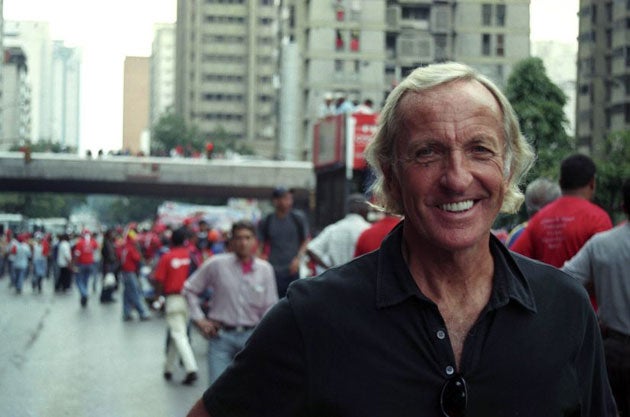
Cross the threshold of John Pilger's south London home and the deep pile carpet gently gives way beneath the feet. Soothing strains of classical guitar waft through the air and, over mugs of tea, the great polemicist examines the impact of his career, his sentences punctuated by the mewling of a ginger cat.
This scene of domestic calm is not one Pilger's many political opponents, or the millions who follow his work, would associate with the cage-rattling campaigner who has set himself against authority figures from Washington DC to the killing fields of Cambodia.
It is half a century since Pilger started out as a copy boy on the Sydney Sun and he turned 69 last Thursday. But he remains agitated by injustices which he sees at every turn in Britain and abroad. Forty years after he began working for Granada's World in Action, he has been commissioned to make a new film examining the media's portrayal of Britain at war. And in the New Statesman he calls the political establishment to account, most recently railing at the failure of the main parties to debate the Iraq and Afghanistan conflicts at their conferences.
Yet he has also set himself a fresh challenge, one that appears to have filled him with a sense of self-doubt. "I've started...," he announces with a splutter of disbelief, "to write what I hope is my first fiction." The author of a dozen books of journalism, he has yet to offer a sample of this "collection of short stories" to his publisher. "The wonderful thing about writing fiction is that you are released from the tyranny of facts, of having to get everything right, of sourcing everything that matters. Your imagination is released. But you know," he adds, starting to laugh, "there is a bit of clash going on here and I'm not sure that it's a good idea."
After five decades as a crusader for truth, making stuff up doesn't come easily, despite what some of his right-wing critics might claim. "It's a real struggle. I'm constantly drawn back to non fiction because it is so much more interesting and vivid," he says.
If the book does get finished, don't expect to find Pilger wrestling with his emotions – "I'm not interested in navel gazing" – but developing characters he has observed on a journey that has taken him to war zones in Vietnam, East Timor, Palestine and beyond, always examining the roles of western governments in the conflicts.
More than anything now, he wants to conduct a sit-down televised interview with Tony Blair, if only he can persuade the former prime minister to go on camera. "ITV would take that – Blair is somebody I don't believe has ever been interviewed properly," he says. "I've approached the people you are meant to approach and the silence is ear-splitting. No surprise there."
Later this month sees the release of a 16-disc DVD box-set of Pilger's work, spanning 37 years of film-making and 52 documentaries. Though the documentary films were made for ITV, it is a series made for Channel 4 in 1983 he draws attention to. The Outsiders was a series of conversations between Pilger and maverick individuals he admired, many of them journalistic heroes such as Wilfred Burchett of the Daily Express, whom he reveres for having landed "the scoop of the century" in exposing the effects of the atomic attack on Hiroshima.
"I have his wonderful front page," he says, leading the way up to his office via a staircase decorated with framed photographs of his journalistic adventures, family and friends. And there it is, Wilfred Burchett's scoop from 5 September 1945 with the headline "The Atomic Plague", the intro, "I write this as a warning to the world..." and the byline "by Peter Burchett". "The sub got his name wrong. Wilfred forgave him," observes Pilger. "The entire press corps of Japan were embedded and on the day he set out on this perilous journey to Hiroshima, Japan had just been defeated and foreign journalists were being shepherded to see General MacArthur receive a ritualistic sword of defeat. Burchett said, 'To hell with that, that's not the real story,' and headed the other way."
Burchett was demonised for his revelation that deaths at Hiroshima were caused by more than a bomb blast. The New York Times ran a "No Radioactivity in Hiroshima" piece and Burchett was branded a crazy leftie. The treatment echoes that meted out to Pilger following his 1970 film The Quiet Mutiny, which revealed rebellion in US military ranks during the Vietnam War.
That documentary, stemming from articles Pilger had produced for Hugh Cudlipp's Daily Mirror, was denounced by the American government, which complained to the broadcasting authorities. "I had no experience of anything like this, everything seemed to fall down around my shoulders and it was disturbing. But the story that film told became the received wisdom all over the world within a year."
To some in the modern media, Pilger is a figure from a bygone age, his name eliciting the sort of sighs of exasperation that until recently accompanied the notion of nationalisation. But he is convinced that there remains an appetite for left-wing journalism. "The influence of The Independent and Guardian are much greater than you would think. I don't believe the majority of people in Britain have the so-called values of The Daily Telegraph and the Daily Mail and certainly not The Sun. That doesn’t mean to say they flock to read the Guardian and the Independent, clearly they don’t. But on occasion, these newspapers speak up and gesture towards people, or they pretend to. Without them there would be an entirely closed media.”
In the morning, he logs on to the Information Clearing House, a US-based website that provides a digest of left-of-centre journalism, highlighting the work of Noam Chomsky, Robert Fisk and Pilger himself. Such sites ensure a large readership. "The internet has changed so much. In America alone, my New Statesman column reaches millions on the web."
He returned briefly to the Mirror after the September 11 terrorist attacks, when Piers Morgan (who he appears to respect) was editing the paper. "It was a very rewarding 18 months," he says. "I was happy to keep on writing for the Mirror, but Piers was under pressure from the management and American shareholders who objected to the kind of journalism that he was publishing, often written by me. It was a myth that the readers didn't want a serious approach to journalism in a popular newspaper."
When he speaks to journalism students, he is convinced "many start with the same passion I started with" and implores them to "keep your principles as you navigate the system". His watchword remains, 'Never believe anything until it's officially denied,' a favourite expression of reporter Claud Cockburn, father of Independent journalist Patrick Cockburn.
Pilger hopes that his last documentary, The War on Democracy, and his forthcoming one, will encourage colleagues to take a more critical view. "If journalists can look behind the press-release version of events, or push back the screen of what is often propaganda but rarely recognised as such," he says, "then we will produce true journalism, not a form of PR. We ought to be the agents of people, not power."
The DVDs ‘Heroes: The Films of John Pilger 1970-2007’ and ‘Behind the Façade’ are released on 27 October, available from www.networkdvd.co.uk
Join our commenting forum
Join thought-provoking conversations, follow other Independent readers and see their replies
Comments