Swingers, acid trippers, gay cops: Alan Whicker's friends reunited
After 50 years in front of the camera, the globetrotting TV legend has taken to the skies once again. Ian Burrell hears his stories

For free real time breaking news alerts sent straight to your inbox sign up to our breaking news emails
Sign up to our free breaking news emails
Alan Whicker, immaculate as ever in blazer and tie, steps into a room of veteran law enforcement officers from the San Francisco Police Department and receives their ovation as he, at the same time, applauds them. And then he is brought face-to-face with one thick-set officer with cropped hair who he had met 30 years earlier. "Some had changed more than others," observes Whicker, 83, his voiceover losing nothing of its famously dry delivery. "When we first met, Stefan was Stephanie."
Cut to Whicker, 30 years younger but strangely ageless, sat before Stephanie as a rookie cop, telling her: "You were a very aggressive lesbian, wearing Super Dyke T-shirts, you've got much more gentle now you're a cop."
Whicker's World was encouraging British audiences to think about the integration of gay police officers, indeed pre-op transgender police officers, back in 1979, before Channel 4 even existed. In a world when the F-word was almost unknown on television, a fully-clothed Whicker was intermingling with naked swingers, and somehow managing to stay the right side of sleazy. He was the first television interviewer to film a closed order of nuns. He covered gay marriages back in 1973. Louis Theroux, eat your heart out.
Way back in 1967, in his tweed jacket, tie and spectacles, Whicker was hanging out with then very young Grateful Dead as they toked marijuana in their community house, then standing among California hippies as they tripped on acid. "Though illegal, everyone bent on a trip can still take one if he has the fare – today about 30 shillings," he noted. "Who knows what they see now on their kaleidoscopic trip to the unknown dangers of inner space."
This was a time, he now says, when the BBC had a "horror of drugs", holding back Whicker's World's revelations about the new "Stoned Age" until the storm around Mick Jagger's cannabis possession had blown over, then "slipping it out" in the late-night schedule.
These days this most famous of documentary makers is no longer seen as the kind of risk taker who could wreck the career of an ambitious BBC controller. So BBC Two will, from Wednesday evening, be screening a series of four 60-minute retrospectives. Alan Whicker's Journey of a Lifetime will draw from the archive of groundbreaking work from the Sixties and Seventies, but also bring many of the stories up to date as the veteran broadcaster pulls out his passport, packs his attaché case and takes to the skies once more.
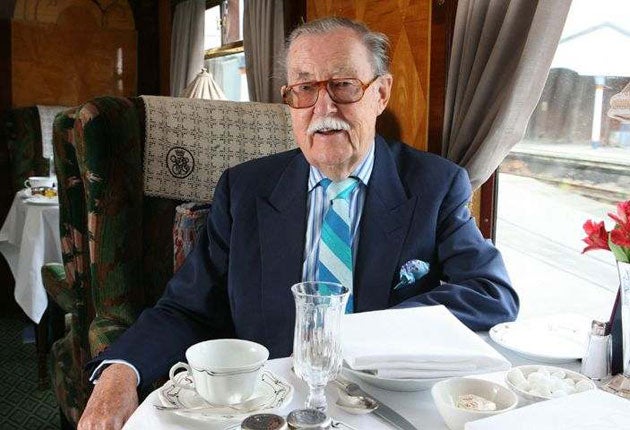
On a visit to London from his home in Jersey, he emphasises, as he always does, that he has no television alter ego. The look – the neat moustache, the blazer or, in tropical climes, a Doug Hayward gabardine suit – could so easily be stylised, as could the speech patterns, heavily lampooned by Monty Python, a language branded by the presenter himself as "Whickeric" (emphasis on the second syllable). But no, he is determinedly the same on screen as off.
"It sounds so boastful but I've never done a programme on anyone that hasn't become a friend who I can't go back and see," he says. "It wouldn't enter my head that I couldn't go back to see the nuns who I adored, or the madame of the whorehouse."
Other journalists venture into a brothel before, in time honoured tradition, making their excuses and leaving. Alan Whicker is different. When he turned his attentions to legal – or tolerated – prostitution in Perth, Western Australia, he made himself at home. "We'd have breakfast at our hotel, then get a car round to the bordello and spend the rest of the day in the brothel," he recalls.
Whicker was accompanied in the brothel, as he is now in the hotel, by Valerie Kleeman, his elegant partner of 40 years, and a key player in the production of some of his most important work. They worked as a double act, charming a Liverpool-born madame, who met them wired up and suspicious, and ended up showing them around Perth. "By the time we'd finished we were going home with her, she was sending me to her facialist, inviting us to Sunday lunch," she says. "She gave us a tour around her main brothel: 'This is the Egyptian room, this is the Jacuzzi – I can get eight in there.' It was rather jolly, like a St Trinian's house party."
Part of Whicker's success has been his ability to tackle controversial issues without prejudice. When he featured the Gay Power movement, one of his team was so disturbed by the subject matter that he cried off with a cold. Whicker, previously a Fleet Street reporter, is made of sterner stuff, curious and instinctively aware of what will fascinate his audience.
He is a veteran of the Anzio landings and the liberation of Italy, experiences that – as well as teaching him broadcasting skills as he covered the advance for the Army's film unit – perhaps instilled in him the courage to venture into unknown territories, and to secure interviews with bloody dictators, such as Haiti's Papa Doc Duvalier.
Whicker, an unashamed bon viveur who enjoys a morning glass of champagne as a daily ritual, has had his scrapes while enjoying the good life. When I'd last met him, during the making of a successful advertising campaign for a travel website, he had accidentally pulled down the curtain fittings in his luxury Cape Town hotel suite, with disastrous consequences. "The entire gubbins came off and hit me on the head," he recalls. "It was a major blow and the blood was filling the suite." Even then, with the cut fortunately above his hairline, Whicker, then 78, stuck firmly to his relentless filming schedule.
He has been fortunate, of course, that much of the world that he explored in his early programmes was virgin territory to an audience more likely to holiday at Camber Sands than Koh Samui. Yet, watching this new series (made by DCD Media's September Films), the often bizarre interviewees he uncovered were much more fascinating than the contrived eccentrics of today's "reality" driven schedules.
The gratitude of many of those featured on Whicker's World is clear from the reunions. Yet there was one organisation that rejected Whicker's advances, much to his chagrin. He was the pioneer of the cop show ("You did it first!" shouts Valerie from the sideline). Aside from the San Francisco police, he worked, years earlier, with the forces in Hong Kong and Singapore. And so he proposed a feature on Scotland Yard, more than a decade before Roger Graef and Charles Stewart's groundbreaking 1982 BBC series Police.
"They turned it down and I couldn't believe it because they knew I wasn't going to rubbish them," he says, the dismay still there to this day. "When I complained bitterly they said, 'Alan, you've got to understand: Thou shalt not create a precedent.' "It would've been the first time that Fleet Street, which was often the enemy of the police, had done what everybody is doing now. It would have been shatteringly good. When I say 'I've never had a refusal' I always forget that because that was a major refusal."
His San Francisco work was used for years by American police academies. It was Scotland Yard's loss.
'Alan Whicker's Journey of a Lifetime' starts 25 March at 9pm on BBC Two
Subscribe to Independent Premium to bookmark this article
Want to bookmark your favourite articles and stories to read or reference later? Start your Independent Premium subscription today.
Join our commenting forum
Join thought-provoking conversations, follow other Independent readers and see their replies