Twenty years on, Murdoch Jr echoes father’s attack on BBC
Rupert’s son uses MacTaggart Lecture to condemn ‘Orwellian’ Corporation
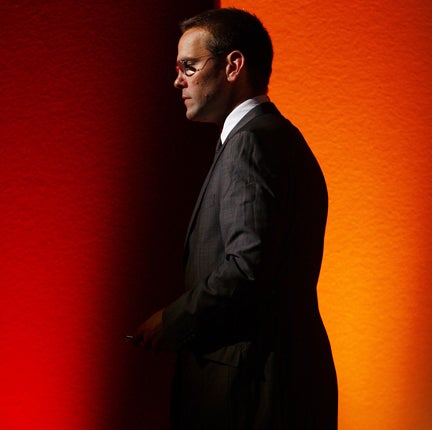
James Murdoch, the heir to his father Rupert's global News Corporation empire, last night accused the BBC of undertaking a "chilling" land-grab of the media that posed a "serious and imminent" threat to the future provision of news in Britain.
Murdoch Jnr, who is News Corp's chairman and chief executive for Europe and Asia, warned that the dominance of the BBC risked creating the type of news media which George Orwell described in the novel 1984. "As Orwell foretold, to let the state enjoy a near-monopoly of information is to guarantee manipulation and distortion," he said.
Delivering the prestigious James MacTaggart Memorial Lecture at the Edinburgh Television Festival, he railed against the "authoritarianism" of the Government and its watchdog Ofcom. He criticised rules designed to uphold impartiality in broadcast news and advocated the system of self-regulation which applied to the press.
The speech, which shocked the television executives, echoed the sentiments of his father, who delivered an outspoken attack on broadcasting establishment in the same venue two decades earlier.
Whereas Murdoch Snr's MacTaggart Lecture of 1989 had predicted the digital future, James Murdoch talked of the "digital present" and compared the media industry's conservatives to the creationists who rejected Charles Darwin's theory of evolution.
In powerful language, he remonstrated against the growth of the BBC's news provision on the internet. "Dumping free, state-sponsored news on the market makes it incredibly difficult for journalism to flourish on the internet," he said. "We seem to have decided as a society to let independence and plurality wither. To let the BBC throttle the news market and then get bigger to compensate."
The criticisms reflected his father's comments earlier this month that News Corp's newspapers must begin charging for their online content, a strategy undermined by the BBC website's presence as a vast source of free news. "It is essential for the future of independent digital journalism that a fair price can be charged for news," James Murdoch said last night. He claimed that "the threat to independent news provision is serious and imminent".
The corporation's governing body, The BBC Trust, had an "abysmal record" in overseeing the organisation's activities, he said, citing examples of the BBC's expansionism. "The scale and scope of its [the BBC's] current activities and future ambitions is chilling. Being funded by a universal hypothecated tax, the BBC feels empowered and obliged to try to offer something for everyone, even in areas well served by the market."
The growth of BBC Radio 2, he said, had damaged the radio industry by taking listeners already well-served by the commercial sector. "Performers like Jonathan Ross were recruited on salaries no commercial competitor could afford, and audiences for Radio 2 have grown steadily as a result," he said. "No doubt the BBC celebrates the fact that it now has well over half of all radio listening. But the consequent impoverishment of the once-successful commercial sector is testament to the corporation's inability to distinguish between what is good for it and what is good for the country."
Broadcasting, Murdoch complained, was constrained by an "authoritarian" degree of intervention by Ofcom. He compared British media regulation unfavourably with systems in Germany, India and France. "The problem with the UK is that it is unhappy in every way: it is the Addams Family of world media."
He contrasted the regulation in broadcasting with the self-regulation of the press, praising British newspapers for being "fearless and independent" and suggesting that the aim of achieving impartiality in broadcast news by balancing opinions was unattainable. "The mere selection of stories and their place in the running order is itself a process full of unacknowledged partiality."
Murdoch, 36, is non-executive chairman of BSkyB, whose Sky News service is subject to tight controls on impartiality, unlike the unashamedly right-wing American channel Fox News, also part of the News Corp portfolio. Twenty years ago, Rupert Murdoch's MacTaggart Lecture was characterised by his claim that television was a business and should not be the preserve of a publicly-supported duopoly of the BBC and ITV. Yesterday his son, ended his own speech with a similar homage to capitalism in the media. "There is an inescapable conclusion that we must reach if we are to have a better society," he said. "The only reliable, durable, and perpetual guarantor of independence is profit."
What Rupert said – and did it come true?
By Chris Green
"The arguments which have recently dominated British broadcasting, such as multi-channel choice versus public service duopoly, will soon sound as if they belong to the Stone Age."
Murdoch saw television as a business and believed it could only thrive in a competitive environment – he was right in predicting that the duopoly of the BBC and ITV would not last.
"[TVs will be] linked by fibre optic cable to a global cornucopia of programming and nearly infinite libraries of data, education and entertainment. All with full interactivity."
Very accurate. He predicted the birth of "on-demand" television – something which has only emerged recently – made fully interactive by the internet.
The BBC will find it hard to justify the "compulsory poll tax that finances it" in "the multi-channel world of the mid-1990s".
Only partially correct. Although the licence fee is far from popular, it still survives and has increased in price.
"Is it really healthy for British society to be served up a diet of television which constantly looks backward?"
This debate still continues. Many argue that broadcasters do not show enough innovation, and are incensed by the number of repeats shown.
Join our commenting forum
Join thought-provoking conversations, follow other Independent readers and see their replies
Comments