A. John Poole: Sculptor, letter-cutter and restorer whose love of architecture informed his monumental works
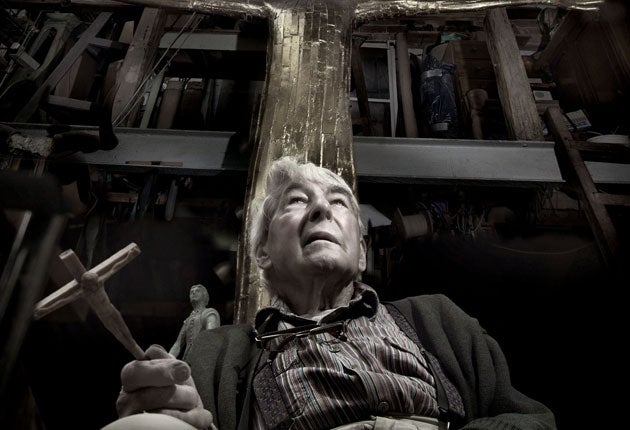
Anthony John Poole was one of the most distinguished and versatile British architectural sculptors, letter-cutters and restorers during the last half-century. His base was the Midlands, which has many of his sculptures, but his fine and often monumental works are to be found much further afield. Britain produced many excellent figurative sculptors during the 20th century whose achievement is now slowly being evaluated. The work of such skilled practitioners as Bainbridge Copnall, Frank Dobson, George Fullard, Richard Garbe, A. H. Gerrard, Dora Gordine, Maurice Lambert and Leon Underwood has for too long been overshadowed by a national near-obsession with a few names such as Barbara Hepworth and Henry Moore.
Several exhibitions in recent years and Liverpool University Press's series of volumes in the "Public Sculpture of Britain" series have done much to heighten awareness of overlooked sculptural delights in our towns and cities, and their makers. Poole and his work are typical, one of the last sculptor-craftsmen upholding the values of traditional practice and technique.
Poole – who worked as A. John Poole – was born in Birmingham in 1926. His father, George, a professional soldier and later a tool setter, and his mother, Jessie, were keen on self-improvement. They encouraged John and his older brother, David, to develop their talents. John's primary school headmaster appreciated his artistic precocity and encouraged him early to sit the entrance examination for the local Moseley Road Junior School of Art, which he joined just after his 12th birthday.
Poole continued his fine art studies, specialising in sculpture, at Birmingham School of Art from 1940-43. There he gained a grounding in the principles of brief responsive design solutions that would prove invaluable when, as a professional, he tackled jobs not only in traditional materials, such as stone and wood, but others such as ciment fondu, resin and stainless steel.
Graduating early, aged 17, Poole refined his letter-cutting skills in the Birmingham design studio that William Bloye had established about 20 years earlier. Bloye, Birmingham School of Art's head of sculpture until his retirement in 1956, had in the early 1920s studied for short periods with Eric Gill. Gill's practice left a lasting impression on his own and Poole's work. Bloye and Poole became close friends.
In December 1944 Poole's training was cut short when he was called up for basic training with the Coldstream Guards, followed by officer training with the King's Shropshire Light Infantry (4th Battalion). As a lieutenant he served in France and in Germany as a liaison officer during the Nuremberg trials. He was subsequently recruited as an officer in the Parachute Regiment 7th (Light Infantry) Battalion, serving in Egypt and Palestine.
In 1946, he married Daphne Buscall, who had been a contemporary at Moseley Road and Birmingham School of Art. After studying ceramics and teaching it, she re-trained in silver and goldsmithing and became a fine jeweller.
While in Palestine, Poole mulled over whether he should study architecture or sculpture on demobilisation. He decided that sculpture would offer greater artistic freedom, but a love of buildings would be reflected in work that was often architectural and on a monumental scale.
In 1948, Poole resumed studies at Birmingham School of Art; he left in 1949 with a National Design Diploma High Merit Award for letter-cutting and stonework. He set up a studio in Bournville, at first mainly doing freelance jobs for Bloye or for stonemason yards such as Wilkinson and Griffiths and W. H. Fraley. Trudging round the cemeteries of Birmingham, carving the names of war dead on family memorials, was back-breaking work, but Poole said that it completed his apprenticeship in the art of letter-cutting. He would also broaden his knowledge with sculptural restoration.
Between 1952 and 1961, when he moved his studio to Bishampton, Worcestershire, Poole supplemented his income by teaching sculpture part-time at Mid-Warwickshire College of Art and Walsall School of Art. One result of the valuable contacts he was making with artists and architects came in 1959 with his first notable commission, The Sower. Placed at the New Central Library in Cannock, Staffordshire, this free-standing, heroic, 7ft figure carved in Belgian granite represented Man "sowing the seeds of knowledge".
Humanity was a strong theme in Poole's sculpture and he carried out much ecclesiastical work. He had a long-standing association with the Church of St Francis of Assisi, Bournville, and the Cadbury family, particularly Sir Adrian Cadbury.
During the 50 years after The Sower, Poole completed some 150 significant works, excluding memorials and commemorative plaques. Thirty of his major commissions were in and around Birmingham, including The Rotunda Relief at Lloyds Bank (1963). It was in jeopardy when the future of the rotunda building itself was in doubt, but was saved as part of the facelift of the Bull Ring and is now Grade II-listed by English Heritage.
Other significant works by Poole include in Liverpool, the St John's Precinct mural (1965); in Leicester, the Crown Court Royal Coat of Arms (1969); the sculptured doors at Brown and Shipley in Birmingham (1975); Lucifer Bringer of Light, exhibited at New College, Oxford (1988); Icarus Falling, a private commission (1997); and Home Front Memorial, Coventry Cathedral (2000). Poole worked up till his death, including his John Donne, another private commission (2009).
Over the years, he gained increasing recognition, being elected an associate of the Royal Society of British Sculptors in 1960, then fellow in 1969. He was warden of the Guild of Memorial Craftsmen, chairman of the Society of Church Craftsmen and honorary fellow of The Royal Birmingham Society of Artists.
He was twice winner of The Otto Beit Medal for excellence in sculpture, in 1969 for the 17ft welded steel The Risen Christ for St Dunstan's Church, King's Heath, Birmingham, and in 1974 for the high altar and ambo at St Helen's Cathedral, Brentwood, Essex. He gained the Diploma of Merit from Universita delle Arti, Salsomaggiori, Italy, in 1981. In 1985 he was first-prize winner in the Saudi National Guard bronze sculpture competition and in 1991 he was awarded joint first prize in the Liverpool Cathedral Great West Door competition.
David Buckman
Anthony John Poole, sculptor and teacher: born Birmingham, 17 December 1926; married 1946 Daphne Buscall (died 2005, two sons both deceased, two daughters); died Bishampton, Worcestershire 2 September 2009.
Join our commenting forum
Join thought-provoking conversations, follow other Independent readers and see their replies
Comments