Alan Watkins: A tribute to a voice without peer
He dabbled in politics, but the elder statesman of political commentary made his distintive mark in a more permanent way, by writing, says colleague and friend Anthony Howard
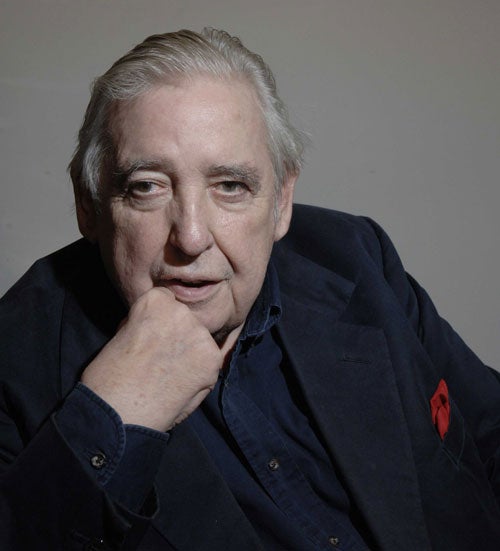
As a prose stylist, Alan Watkins was without a peer among contemporary political commentators. His weekly contributions to this paper, until his last illness, appearing regularly on these pages since 1993, amounted just as much to a literary essay as to a political column. As a writer, he admitted to two pre-eminent influences, the novelists P G Wodehouse and Evelyn Waugh, and he brought to the writing of his weekly column just the same gifts of directness and simplicity that characterised the style of each of his novelist mentors. Among those who pursued his own calling, he never ceased to acknowledge his debt to Hugh Massingham, whose "London Diary" (as it was somewhat misleadingly called) surfaced each week in The Observer between the mid-1940s and the early 1960s. His last article, on leaving the New Statesman to join The Observer in January 1975, was a brilliant piece entitled "Hugh Massingham and the Craft of Political Journalism".
It was typical of Watkins that he saw himself first and foremost as a craftsman (nor did he ever stand any nonsense about journalism being a profession: to him it was always a trade – mostly, to borrow one of his own favourite phrases, "a funny old" one). But it was still a trade in which trouble needed to be taken. That was something that Watkins himself always did, burnishing and polishing what he had written until he was satisfied that it could hold the reader's attention right from the very first paragraph to the last. This thoroughness was probably something he owed to the nature of his Welsh background: the only son and sole child of two Welsh primary school teachers (who took the old News Chronicle on weekdays and The Observer on Sundays) he retained something of that Celtic, but never Calvinist, inheritance all his life.
Like the much younger Neil Kinnock, he was the first member of his family "in a thousand years to attend a university". Watkins in 1952 won a place from Amman Valley Grammar School to Queens' College, Cambridge. In his four years there he read law (taking an LL.M as well as a BA), while also becoming chairman of the University Labour Club and being elected to the committee of the Cambridge Union. His initial ambition was to go the Bar and he qualified as a barrister in 1957 (hence, his more irreverent friends always thought, his occasional "Buzzfuzz" pieces on the law and the constitution).
In the 1950s, though, there was little prospect of any young man making even the barest living in his early years at the Bar. So Watkins, who had married at the age of 22, took an academic job instead, becoming a research assistant at the LSE. It was in this phase of his life that he first dipped his toes into the rougher waters of political journalism, contributing an article to the then Gaitskellite monthly, Socialist Commentary, criticising the way in which the House of Commons had, in his view, exceeded its powers by seeking to discipline a national newspaper editor. That editor, who had been forced to apologise at the Bar of the House for "a contempt of Parlament" (sic), was the young John Junor. Perhaps not surprisingly, the piece appealed to him sufficiently for him to offer the then 26-year-old Watkins a job on The Sunday Express. Whether Junor realised it or not, he had set Watkins on his course for life.
Five years on The Sunday Express – including a six-month spell as that paper's New York correspondent and a rather longer period as author of its once-feared Crossbencher column – were brought to an end only by a surprise invitation from the former Conservative Cabinet Minister, Iain Macleod, then in exile from the Tory front bench as editor of The Spectator, to join that periodical as political columnist. There, not wholly predictably, Watkins and Macleod hit it off, and his weekly contribution, together with the editor's own column signed Quoodle, became one of the highlights of the mid-1960s' Spectator. Yet relations with Macleod's successor, the young Tory speechwriter and former city editor, Nigel Lawson, did not prove quite so easy and in 1967 Watkins accepted, with some relief, an offer from Paul Johnson to do a similar job on the New Statesman.
These were the New Statesman's lush days, when it regularly outsold The Spectator by a margin of at least two to one. His new home also provided a more natural setting for someone of Watkins's own political leanings. He had served as a Labour councillor on Fulham Borough Council between 1959 and 1962, and at that stage actively considered trying to make a life in active politics. But the truth probably was that he was altogether too free an ideological spirit to adapt easily to the constraints of party discipline (he soon gave up his membership of the Labour Party and became especially proud of having voted in contrasting ways at succeeding general elections). But at least in the late 1960s he managed to rub along peacefully enough with Paul Johnson, not of course then the right-wing firebrand that he subsequently became.
The sparks only began to fly when an ex-Labour cabinet minister moved in to replace Johnson and take charge of the New Statesman after Harold Wilson's electoral defeat in 1970. Dick Crossman and Watkins, though they had known each other for a number of years the way that lobby journalists and politicians do, soon proved to be chalk and cheese, the former secretary of state for health vainly seeking to impose his will on his recalcitrant contributor (Watkins had abandoned his staff status to go freelance at Crossman's request in 1971).
A period of relative calm descended in the following year ,when I succeeded Crossman, and it was not long before Watkins – freelance or not – became the first worker-director of the paper. In the boardroom he was not just a tower of strength but a pillar of good sense, effectively seeing off one of the earliest moves to persuade the paper to sacrifice its most valuable asset (its freehold property on the north-east corner of Lincoln's Inn Fields) to a property developer. Journalistically, however, he continued to plough his own individualistic furrow, urging a No vote in the 1975 European referendum while the paper editorially backed the case made by Roy Jenkins and others in favour of Britain remaining within Europe.
This was a period, though, that witnessed some of Watkins's finest writing, and not only about politics. He had begun to spread his wings, contributing successively as a general columnist to the Sunday Mirror and the Evening Standard. Even in the New Statesman he by no means always stuck to his political last, publishing a particularly evocative, lengthy piece entitled "My Days with Beaverbrook" in 1973, and a couple of years later producing a wonderfully comic account of a dialogue overheard during a party conference while on a Blackpool tram. (Watkins always had an acute ear for the strange things people say and could, I often reflected, easily have turned himself into a novelist or playwright).
Instead, he chose to put his energies into slight – and sometimes not so slight – political books that got better and better as he grew older. His first hardback production, The Liberal Dilemma, published as long ago as 1966, was a bit pedestrian but he gradually found his characteristic tone of voice in such later works as A Conservative Coup (1991) – the definitive account of Mrs Thatcher's Downing Street defenestration – and with his classic fragment of autobiography, A Short Walk Down Fleet Street, published in 2000. Mention should also probably be made of his A Slight Case of Libel, vividly recording his legal triumph over the then Labour frontbencher Michael Meacher, in the law courts in 1988.
Like many of the best journalists, Watkins tended to be something of a loner (his wife, from whom he was separated, died in 1982, as did, later that year, his elder daughter, leaving him with one adult son and a second then almost grown-up daughter). Towards the end of his life, he ventured out less and less from his Islington home. Until well into his seventies he went every Friday to the offices of The Independent on Sunday to fine tune his copy, and would also make regular weekly visits to the Garrick Club, but that – apart from the devoted support of a longstanding woman friend – was about the extent of his social life.
He had, however, a host of admirers and wellwishers, most of them much younger than himself. Although in his later years he was seen there fairly seldom, he had developed into one of the institutions of the "Westminster village", and could certainly claim to have transformed the modern political column into a contemporary literary art-form. There are, as he himself might have said in his understated way, many more depressing sorts of memorial than that.
Join our commenting forum
Join thought-provoking conversations, follow other Independent readers and see their replies
Comments
Bookmark popover
Removed from bookmarks