Amos Elon: Writer who became disillusioned with Zionism and advocated Palestinian self-determination
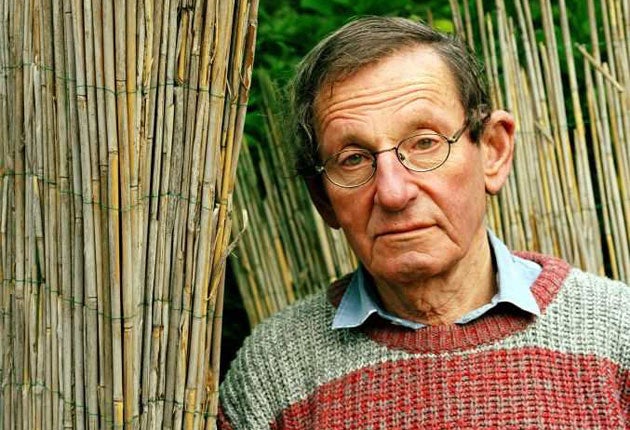
Amos Elon, a leading Israeli writer and historian who became increasingly disenchanted with the course taken by his country after the 1967 Six Day War, has died in Italy, his home since 2004, at the age of 82. He had leukaemia. Elon built up an unrivalled reputation in a 30-year career as a journalist on the liberal daily Haaretz, a public intellectual, and an early critic of the occupation and advocate of Palestinian self-determination. But he will probably best be remembered most for his books; an author who wrote with equal insight and scholarship about Zionism and its impact, and the assimilated pre-holocaust European jewry into which he himself had been born.
Elon was born in Vienna on 4 July 1926. His father, a businessman with a taste for adventure, left Austria for British-run Palestine two years later, bringing the rest of his family, including his young son, to join him in 1933, against the darkening background of Nazism. Elon grew up in Tel Aviv and was for three years a member of Haganah, the pre-state military which fought for Israel's independence, and after the 1948 war studied law and history at Hebrew University in Jerusalem, and at Cambridge. He joined Haaretz in 1951, and as a protégé of Gershom Shocken, the paper's publisher and editor-in-chief, was sent to Europe as a foreign correspondent and later for six years to Washington.
He was in his forties when he wrote the book which first made him famous. The Israelis: Founders and Sons was an early example of "revisionist" history, in which he examined critically, from an essentially left-wing Zionist perspective, the development of the Zionist project and its failure to take into account the plight of Arabs displaced by the founding of the Israeli state. "The Arabs bore no responsibility for the centuries-long suffering of Jews in Europe," he wrote. "Whatever their subsequent follies and outrages might be, the punishment of the Arabs for the sins of Europe must burden the conscience of Israelis for a long time to come."
Not long after the Yom Kippur war between Egypt and Israel, a chance meeting Elon had at Harvard with Sana Hassan, the daughter of the then Egyptian ambassador to Egypt, led to a correspondence between them which was published as Between Enemies: A Compassionate Dialogue Between an Israeli and an Arab. The book reportedly infuriated Egypt's President Anwar Sadat, whose chief of staff was married to Elon's co-author, and was obliged to divorce her as a result. But the taboo-breaking status of the book was reinforced when Sadat made the historic visit to Jerusalem three years later which led to the 1979 Israel-Egypt Treaty. Elon travelled frequently to Egypt in the years after that. In each of several subsequent years Elon made lengthy trips to Egypt to interview Egyptians, saying in a 1987 interview: "In all my writing I have felt that my most important task was to work for that emotional detente and ideological disarmament which is so necessary for any Arab-Israeli settlement in the future."
Tom Segev, like Elon a left-of-centre Haaretz commentator-turned-historian, wrote in his paper this week that after the Six Day War "Elon increasingly believed that Israel's occupation of the West Bank and Gaza would disastrous to its society."
He finally left Haaretz in 1986 and from the 1990s began to spend more of his time in the Tuscan holiday home he had bought with his wife, the former Beth Drexler, an American whom he had met during his spell in Washington. The author of a highly praised biography of Theodor Herzl, a founding father of Zionism, he came to the conclusion, as he put it, when pressed by Ari Shavit in a Haaretz interview in 2004 to say whether he was a now a "post-Zionist": "I think that Zionism has exhausted itself. Precisely because it accomplished its aims." In the same interview he was withering about the post-1967 occupation, describing it as "perhaps the least successful attempt at colonialism that I can think of. This is the crappiest colonial regime that I can think of in the modern age."
Explaining his gradual withdrawal from Israel and perhaps his return – especially in his major book of his later years, The Pity of It All – to the history of German Jewry, he added: "Nothing has changed here [in Israel] in the last 40 years. The problems are exactly the same as they always were. The solutions were already known back then. But no one paid attention to them. And I found myself repeating them ... And I started to bore myself. The dialogue wasn't fruitful... I was a lone voice in the wilderness."
The Pity of it All: A Portrait of the German Jewish Epoch 1743-1933 is an elegiac account of the dazzling intellectual, political and cultural contribution made by Jews to German life before the rise of Hitler. Its pen portraits, running in time from the 18th-century scholar Moses Mendelssohn, the composer's grandfather, to the political theorist Hannah Arendt, and including figures as diverse as Henrich Heine and Karl Marx, leave the reader hungry for more, as if several of the chapters could each have made a book in themselves.
But Elon continued to write about the worsening problems of his own country, for example in a 2002 essay for the New York Review of Books which seems especially apposite now that President Barack Obama has once again been seeking to push the Jewish West Bank settlements to the forefront of the international Middle East agenda. Remarking that the total settler population had risen to 400,000, he wrote: "Imagine the effect on the peace process in Northern Ireland if the British government continued moving thousands of Protestants from Scotland into Ulster and settling them, at government expense, on land confiscated from Irish Catholics... With few exceptions, the settlements have not made Israel more 'secure', as was sometimes claimed; they have made Israel less secure."
Elon, who wrote at different times for publications in Hebrew, English and German, said that he had never considered himself "an ideological Israeli". But he confessed that even in Tuscany he rose every morning to listen to Israel Radio and then read Haaretz. "I did not grow up here out of choice," he told Shavit in 2004 as he was finally packing up his home in Jerusalem. "But I did grow up here. Here is where I kissed a girl for the first time. And what is a homeland if not the place where you kiss a girl for the first time?"
Donald Macintyre
Amos Elon, journalist, author and historian: born Vienna 4 July 1926; married 1961 Beth Drexler (one daughter); died Tuscany 25 May 2009.
Join our commenting forum
Join thought-provoking conversations, follow other Independent readers and see their replies
Comments