Art Clokey: Animator whose work captivated generations of American children
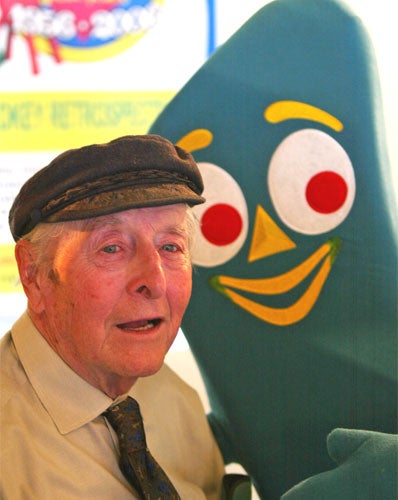
Art Clokey's most famous animated creations, Gumby, Pokey and their friends, entranced generations of American children.
Following his parents' divorce and his father's death in a car accident, Arthur C. Farrington moved to California to live with his mother. Rejected by his new family, Arthur was put into a home before being adopted at 12 by the composer Joseph W. Clokey, who gave him his new surname.
As a child, Clokey had had a toy fort and reinforced his troops with ones that he had modelled from clay, and his new father encouraged this artistic streak, introducing him to photography and film.
After a wartime spent in photo reconnaissance, Clokey studied film at the University of Southern California. His professor was Slavko Vorkapich, a Yugoslavian avant-gardist who was a Hollywood special effects legend in the 1930s and '40s. Vorkapich, Clokey said, "turned my head around as far as motion pictures were concerned."
But rather than enter the film industry after graduating, Clokey went to a Connecticut seminary to become an Episcopal minister. However, he left after a year: "confronted with everybody's problems, I didn't want to deal with that." He also met and married the daughter of a minister, Ruth Parkander, who became the co-creator of many of his films.
Returning to Hollywood, the Clokeys made live-action advertising films and when Budweiser wanted to show a sandwich disappearing a bite at a time, they achieved it with a clay model.
Clokey began to experiment further with the technique and in Gumbasia (1953) intensely coloured simple shapes grow, shrink, metamorphose and move to a jazz score. It fulfilled Vorkapich's idea that film could be like poetry or music.
A couple of years later Clokey was tutoring the son of movie producer Sam Engel, who thought Gumbasia the most exciting film he had ever seen. Hoping to improve the quality of children's television, Engel suggested that the Clokeys use the same technique to create a character and tell a story. Shaped like a gingerbread man and with an asymmetrical head based on his dead father's cowlick, the flat, green, goggle-eyed Gumby was born.
Engel funded a pilot episode and introduced Clokey to Tom Sarnoff at NBC. Sarnoff tested the character with segments in The Howdy Doody Show. Gumby was a hit and NBC gave Clokey Productions a seven-year contract to make a show with the clay star. It eventually ran until 1967, notching up over 200 episodes. Despite his crucial role, Engel generously passed on any rights. But despite its success, the idealistic Clokey initially didn't allow merchandising, fearing that parents would see it as exploitative.
Other NBC work done by Clokey included elaborating the network logo to create the claymation peacock that opened The Dinah Shore Show and, in an Easter special, animating a giant rabbit with which the star appeared to dance.
Despite leaving the seminary, Clokey had retained his religious feelings and in 1958 accepted a commission from the Lutheran Church. In Davey and Goliath a boy and his talking dog face moral questions from a Christian perspective. Though its wholesomeness has occasionally been parodied, the 15-minute episodes ran from 1956 to 1973 along with half-hour Christmas and Easter specials. In 2004 Clokey's son Joe made a post-911 ecumenical special.
With two ongoing series as well as occasional other jobs, Clokey's spiritual side came to the fore again in 1964 when, with help from his entire family, he made Mandala. His idea was to communicate "the idea of evolving our consciousness from primordial forms to human form, and then beyond the human to the spiritual and eternal." Wanting to show that we all live behind masks, he filled the film with tribal art. The following year saw a very different project as he created the title sequence for the bizarre comedy Dr Goldfoot and the Bikini Machine.
In the 1970s Clokey studied Zen Buddhism, travelled to India and briefly experimented with LSD, though his films were surreal enough even without the drug's help.
In the 1980s Eddy Murphy on Saturday Night Live parodied Gumby as a profanity-spouting cigar-smoking prima donna. Clokey enjoyed it immensely and it led to another surge in Gumby's popularity. In 1988 Clokey made a new series with his second wife, and the old series were repeated. Meanwhile, merchandising and DVD finally brought Clokey serious returns.
In 1995 Clokey made Gumby: the Movie with all the show's favourite characters. These included Pokey, the red horse and the eccentric Professor Cap, a wispy-haired brown blob who wore nothing but a Phi Beta Kappa key to protect his modesty. Cap was based on one of his adoptive father's friends.
Having grown up with silent comedians like Buster Keaton, Clokey hoped to do something similar in animated form and created The Plucky Plumber, but it never got beyond a self-funded pilot.
As is clear from his work, Clokey hoped to be remembered as "a lover of children and a servant of society."
John Riley
Arthur C Farrrington (Art Clokey), animator: born Detroit 21 October 1921; married firstly Ruth Parkander (marriage dissolved 1966, died 2009; one daughter deceased, one son), 1977 Gloria (died 1998); died Los Olos, California 8 January 2010.
Join our commenting forum
Join thought-provoking conversations, follow other Independent readers and see their replies
Comments
Bookmark popover
Removed from bookmarks