Bert Schneider: Film producer at the epicentre of the 'New Hollywood'
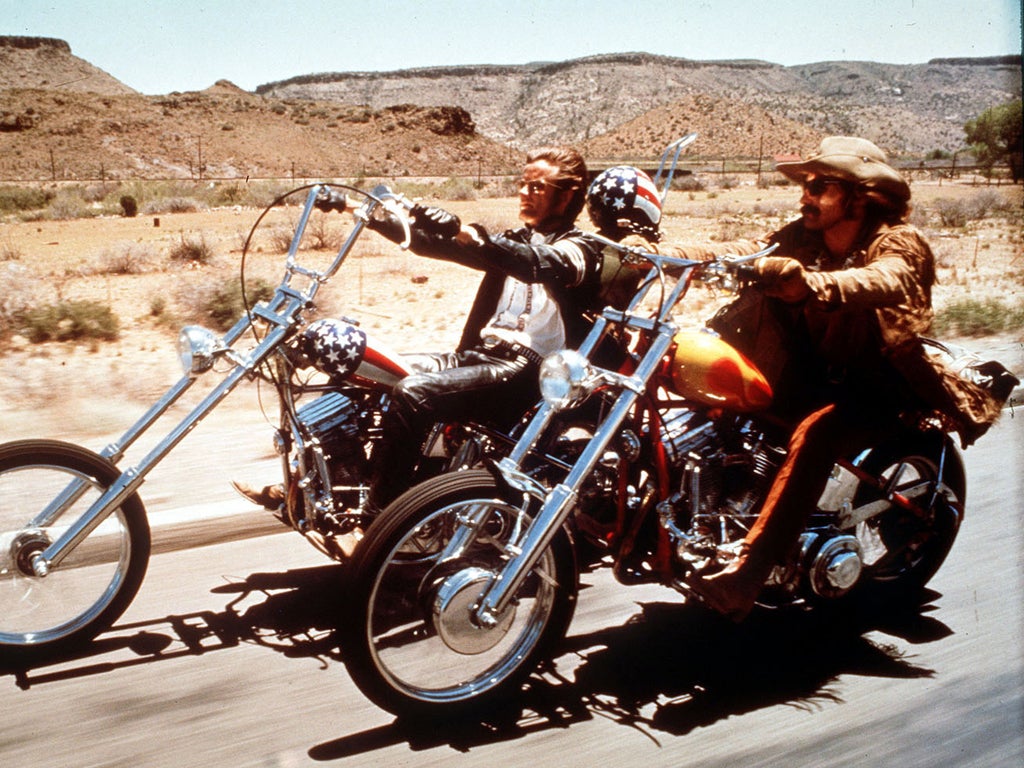
In the 1970s a new generation arrived in Hollywood, making a series of films that questioned the status quo.
But some of the most prominent – and most rebellious – members of "New Hollywood" were far from being outsiders: Bert Schneider, who produced some of the most important films including Easy Rider and Five Easy Pieces was the second of three sons of Columbia Pictures' President.
Tall, strikingly good-looking and charismatic, Schneider was expelled from Cornell for gambling and girls, not to mention his terrible grades. Unsurprisingly he was also unwanted by the army. Unperturbed, he joined Screen Gems, Columbia's television wing, married the first of his four wives and had two children. He seemed set for corporate life: "I was into the American Dream. I pushed my political instincts into the background. I wanted a family, career, money, the whole bit."
But he soon reverted to rebellion and Buck Henry recalled him as an expert on exotic drugs. He also became avociferous champion of left-wing causes including the Black Panthers and the Yippies (though his funding was sometimes "channelled" through their female members). Unsurprisingly, many of the films he produced would centre on Vietnam.
But first he formed Raybert Productions with Bob Rafelson and sold a TV series inspired by A Hard Day's Night. They advertised for "four insane boys" and the Monkees made everyone rich. But the spin-off film Head (1968) repelled everyone: rock fans rejected it as a "pop" movie while any Monkees fans who managed to escape the age restriction were appalled at the drug-fuelled, plotless surrealism. It was an infamous bomb.
But they were still rich and funded a film about two hippies on motorcycle trip across America. Easy Rider (1969) was as huge a success as Head had been a flop, quickly returning a hundred times its budget and becoming one of the key counterculture films. It made the big studios look up, but Raybert resisted the temptation to invest in just anything.
Over the next few years they dominated New Hollywood, with friends and associates permutating through half a dozen key films of the period, later adding the agent Stephen Blauner and Schneider's younger brother Harold, a ferociously cost-aware co-producer, to form BBS Productions.
But it had a viciously frat-house atmosphere, soaked in drugs, arrogance, casual cruelty and cuckoldry: no detail of a woman's anatomy or performance was beyond public discussion. While dating Candice Bergen Schneider said that she just had to deal with the fact that he was "a love object for every woman who walks into my office". Nevertheless, for all its louche liberality and radical chic, it was furiously efficient and maintained artistic control by underwriting cost overruns and ensuring that there were none.
The years 1970 and '71 marked BSS's highpoint. In 1970 Rafelson directed Nicholson in Five Easy Pieces, about a classical pianist who drops out to become an itinerant oil worker. The following year brought Nicholson's directorial debut, Drive, He Said, another story of a young man at a loss and at a crossroads, hoping to avoid the draft to Vietnam. The same year's A Safe Place, directed by Schneider's old friend Henry Jaglom, has a strange flotsam cast including Nicholson, Tuesday Weld, and Orson Welles and its fractured editing reflects the heroine's attempts to get a grip on life.
Slightly more mainstream was Peter Bogdanovich's breakthrough The Last Picture Show (1971), though it was yet another story of fag-end America. But their loyalty had its bounds and they passed on The Last Movie (1971) feeling that Dennis Hopper was the wrong star: it needed a broken Joel McCrea type.
The documentary Heart and Minds (1974) was Schneider's most explosive film, making no attempt to conceal its partisanship and portraying the Vietnam War as essentially racist. There was a storm when it won an Oscar and Schneider read out a congratulatory telegram from the Vietcong delegation at the Paris peace talks. Host Bob Hope insisted the Academy immediately issue a disclaimer, which was duly read out by Frank Sinatra before he and Rafelson, allegedly, had a backstage fight.
In a surprising change of direction, The Gentleman Tramp (1976) is a documentary about Chaplin. But there was one more flaring-up with Tracks (1977), Jaglom's over-directed story of a Vietnam vet (Hopper) suffering terrible flashbacks and unable to maintain a relationship.
Terrence Malick's langourous Days of Heaven (1978) tested Schneider's patience (and bank balance) to the limit before his last film, the mixed marriage drama Broken English (1981), featuring the only performance by Chaplin's widow, Oona O'Neill. Its director Mitchie Gleason was shocked to learn that Schneider had signed to make an explicit film for European arthouse cinemas and hoped to bounce her into making it. The end result satisfied nobody and was not released.
After that, Schneider retired from films to struggle with his various addictions.
Berton Schneider, film producer: born New York 5 May 1933; married four times (one son, one daughter); died Los Angeles 12 December 2011.
Join our commenting forum
Join thought-provoking conversations, follow other Independent readers and see their replies
Comments