Bheki Mseleku: South African jazz pianist
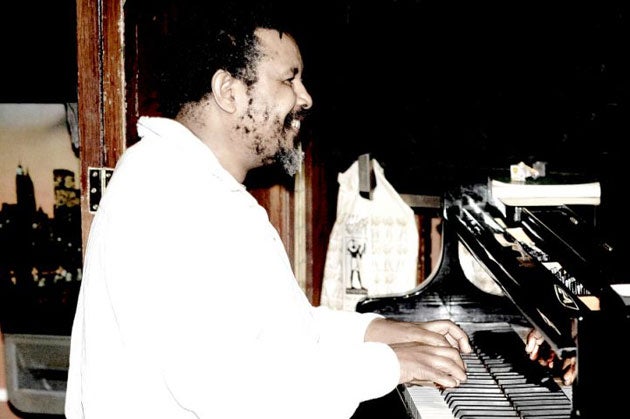
Broadly but inadequately defined as a "jazz musician", Bheki Mseleku had a brilliant but chequered career that bridged his native South Africa and the UK, where he made his international debut with the stunning album Celebration in 1992. A self-taught multi-instrumentalist, Mseleku sometimes played saxophone and guitar, but his undoubted forte was the piano, on which he displayed an advanced grasp of harmony and unique chordal voicings, sometimes scat-singing as he played.
His compositions reflected strong spiritual leanings and drew on the local marabi jazz tradition and classical technique, as well as having an ancient African melodicism and rhythmic sophistication. As his compatriot and colleague, the percussionist/composer Eugene Skeef (with whom he was recording two albums at the time of his death) put it, the man had "elephant ears".
Mseleku's musical quest for inner peace was thwarted by problems with physical and mental health – he suffered from diabetes and was dubiously diagnosed as bipolar – as well as financial difficulties, politics and insufficient recognition of his prodigious gift. Although these meant that he did not realise his full potential, he leaves a fine if relatively modest recorded legacy that marks him out as a major figure in contemporary South African music.
The sixth of seven children, Mseleku grew up in Lamontville, a suburb of Durban. Although his social-activist father had a Bachelor of Music from Cambridge and was a music teacher, he was also deeply religious and fearful that any of his children should choose such a "devilish" and low-status profession as music. Thus, the family's upright piano – eventually cut up for firewood one winter – was kept locked for much of Mseleku's childhood. His mother would give him the keys while his father was away, and his older brother Langa also encouraged him. He was largely self-taught, overcoming the loss of the top joints of two fingers on his right hand in a go-karting accident by developing a very rapid technique to compensate for his reduced hand span. It was also during this time that he met his future partner, Nomvula Ndlazilwane, who would eventually bear four of his eight children.
By his early teens, Mseleku was playing electric organ semi-professionally with a local group, Expressions. In 1975, he moved to Johannesburg and honed his skills with the soulful hard-bop group The Drive, later forming the progressive jazz outfit Spirits Rejoice with the bassist Sipho Gumede. Mseleku's first overseas trip was in 1977, when he was enthusiastically received at the Newport Jazz Festival, playing with Philip Tabane's group Malombo. While there, he met his idol McCoy Tyner and Alice Coltrane, who gave him the mouthpiece of the saxophone that her late husband, John, had used to play "A Love Supreme".
On returning home, he found the oppressive climate of apartheid increasingly unbearable. After a period in Botswana, where he worked briefly with the horn player and trumpeter Hugh Masekela, he left South Africa in 1980 along with Eugene Skeef. Mseleku eventually found refuge in Stockholm, where he spent a number of unhappy years on the breadline and in poor health, despite becoming accepted and even revered by the local jazz fraternity and visiting musicians.
By the mid-1980s he had rejoined Skeef in London, where his early promise finally flowered. Haunting Ronnie Scott's Jazz Club in Soho, he got himself noticed after the pianist Horace Silver helped him land a two-week residency in 1987. There, he attracted emerging talents such as the saxophonists Courtney Pine and Steve Williamson, who both went on to contribute to his album Celebration. The low-key follow-up Meditations (1992) was a live solo recording which demonstrated his unusual ability to play sax and keyboards simultaneously, and in the same year he was featured on Melvyn Bragg's The South Bank Show.
Mseleku's international career took off, and over the next few years he toured Europe, the US, the Far East and India. He also made guest appearances on albums by Courtney Pine and the South African singer Sibongile Khumalo, among others. In 1994, his Timelessness featured his newly acquired rhythm section and US jazz heavyweights including the saxophonists Pharoah Sanders and Joe Henderson, drummer Elvin Jones and singer Abbey Lincoln, but took Mseleku somewhat away from his original vision.
The same year he returned to live in Johannesburg, soon squandering his major-label earnings in acts of spontaneous philanthropy – and losing the cherished Coltrane mouthpiece in a burglary, which seriously destabilised him. In 1995, he recorded Star Seeding in LA. Despite two fine subsequent albums – Beauty of Sunrise (1997) and Home At Last (2003) – he struggled to make a living from music in South Africa, having to teach to make ends meet. By early 2006 he had given up trying, and returned to London.
Jon Lusk
Bhekumuzi Hyacinth Mseleku, musician and composer: born Durban, South Africa 1955; died London 9 September 2008.
Join our commenting forum
Join thought-provoking conversations, follow other Independent readers and see their replies
Comments
Bookmark popover
Removed from bookmarks