Bill Shorthouse: Stalwart of the finest Wolves side
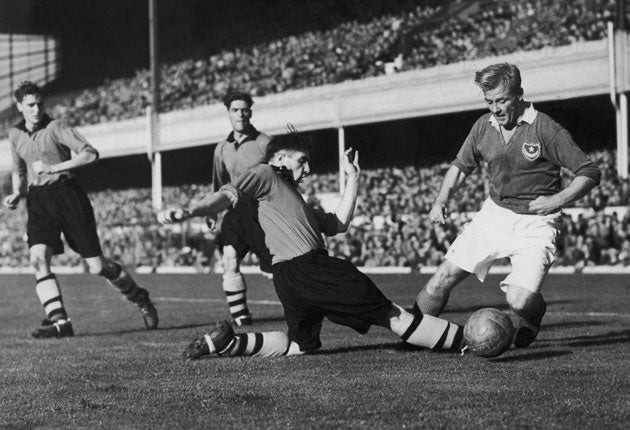
Ask most modern football fans to name the defender unluckiest never to win an England cap and the chances are that they will speak of Steve Bruce, the courageous stopper at the heart of Alex Ferguson's first successful Manchester United team. But pose the same question to those who followed the game during the middle years of the last century and, likely as not, they will mention Bill Shorthouse.
The stalwart Black Countryman played at centre-half and in both full-back positions for what was, by common consent, the finest side in Wolverhampton Wanderers' 129-year history.
Shorthouse was vastly influential as Wolves, under the iron guidance of Stan Cullis, won the FA Cup in 1949, followed by the League Championship five years later. However, veteran denizens of Molineux maintain that those twin peaks only begin to reflect the full glory of an exceptional team. They would maintain that an even more memorable achievement was Wolves' blazing of a trail for British clubs in Europe, when they embarked on a series of floodlit matches against many of the continent's top performers.
In the mid-1950s, before Manchester United became the first English entrants in the European Champions' Cup, Wolves took on and beat Spartak Moscow, Honved of Budapest and Moscow Dynamo in games which were billed as friendlies but played with a keen competitive edge.
The 3-2 home win over Honved in December 1954 was particularly significant. Included in the visitors' line-up was Ferenc Puskas, then vying with Stanley Matthews for the title of the world's best-known footballer, and five other members of the "Magnificent Magyars" who had recently humbled England 6-3 at Wembley and 7-1 at the Nep Stadium.
On that misty Molineux evening, in a match which Wolves won after falling two goals behind, Shorthouse, at left-back, was pitted directly against the pacy winger Laszlo Budai. After being stretched in several early attacks, he subjugated his illustrious opponent, employing the full array of redoubtable qualities which had earned him renown in the domestic game.
There were no frills about Shorthouse. Rather, he stood out as a hard man in a hard side, tackling like a runaway steamroller, positioning himself shrewdly, and passing simply and sensibly to team-mates blessed with skills more creative than his own. He was not particularly big, but he was remarkably strong and his fellow Wolves were invariably desperate to be on his side in the often volcanically-contested training matches in the old car park behind Molineux.
Above all, he was phenomenally dependable, which was reflected by his extraordinary record of never being dropped (his only absences came through injury or illness) from the moment he earned a regular place, during the 1947-48 season, until he bowed out, in his mid-thirties, in 1956-57.
The Staffordshire-born Shorthouse joined Wolves as an amateur in 1941, then served in the Army, suffering a serious wound during the D-Day landings in Normandy. He returned to Molineux and flourished under the rigorous training regime which the manager, Cullis, reckoned made his Wolves the fittest side in the land.
After an initial outing at left-back, Shorthouse settled at centre-half in the autumn of 1947. He played in every tie as the men in the famous gold and black strip lifted the 1949 FA Cup, beating Leicester City 3-1 at Wembley.
Shorthouse was outstanding in the following season as Wolves were pipped to the League title on goal average – the absurdly confusing precursor to goal difference as the means of separating teams on equal points – by Portsmouth. Thereafter, he maintained his lofty standards during periodic shifts to either defensive flank.
Shorthouse missed only two games as Wolves were finally crowned champions, for the first time, in 1953-54. He had made his mark as a centre-half, but he switched to left-back to accommodate the captain Billy Wright's switch from wing-half to centre-half for the subsequent campaign. He was part of a granite rearguard which comprised the goalkeeper Bert Williams, the full-back Eddie Stuart, the wing-halves Bill Slater and Ron Flowers and Wright as the classy pivot. It was a formidable unit which formed a solid base for a dashing forward line featuring the likes of the wingers Johnny Hancocks, Jimmy Mullen and Les Smith, the inside-forwards Peter Broadbent and Dennis Wilshaw, and the spearhead Roy Swinbourne.
Nicknamed "The Baron" for the imperious manner in which he presided over his area of the pitch, Shorthouse was appealingly unassuming away from the action and a dedicated professional who neither smoked nor drank.
When he gave way to youth, in the form of Gerry Harris, in the autumn of 1956, he began coaching young players for Wolves, later working with the youth teams of England, Birmingham City (under Cullis, who had been sacked, controversially, by Wolves), and Aston Villa, whom he guided to the FA Youth Cup in 1980. In 1988 he helped to form the Wolverhampton Wanderers Former Players Association, of which he remained an active member until shortly before his final illness.
Bill Shorthouse never played for his country, but many a footballing friend and foe will maintain stoutly that he was the equal of plenty who did.
Ivan Ponting
William Henry Shorthouse, footballer and football coach; born Bradley, Staffordshire 27 May 1922; played for Wolverhampton Wanderers 1946-57; married, two sons; died Wolverhampton, Staffordshire 6 September 2008.
Join our commenting forum
Join thought-provoking conversations, follow other Independent readers and see their replies
Comments