Commander Dan Duff: Naval officer who played a decisive role in the Battle of Normandy
He received the rare honour of being made an honorary corporal by the Foreign Legion
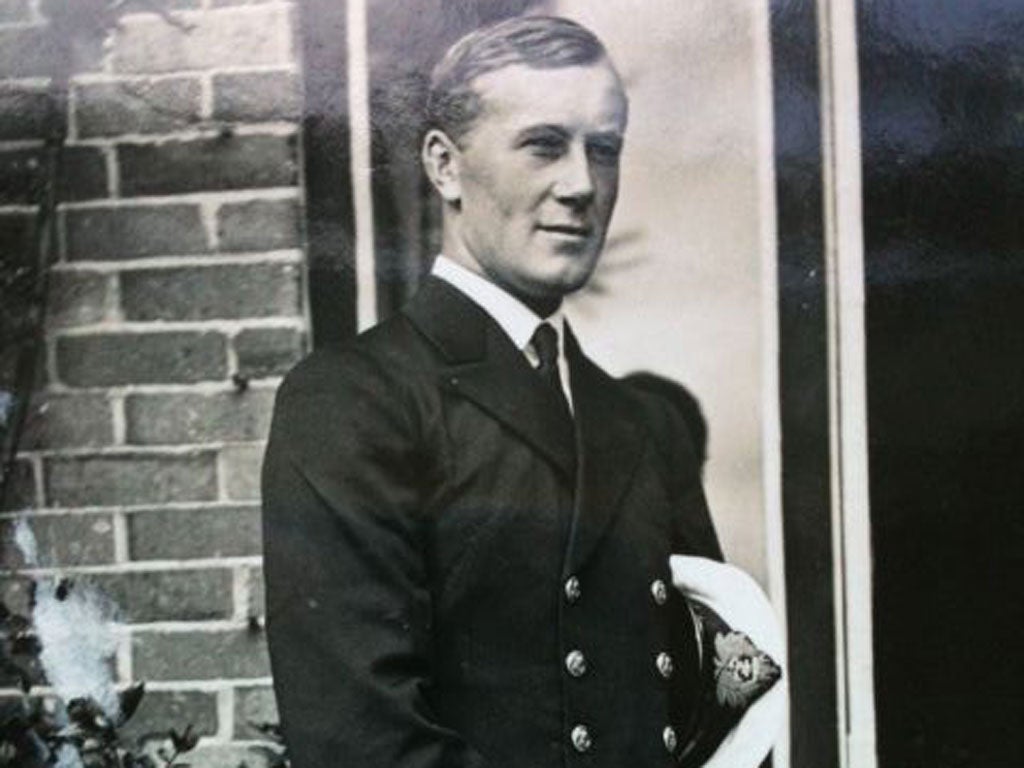
Commander Dan Duff, RN, played one of the most decisive roles in the Battle of Normandy in 1944 when he directed naval gunfire as part of Operation Neptune, the D-Day landings. With more than 100 ships assembled off the Normandy coast, Duff had what he recorded in his memoir as "an interesting bombardment task", using the 16in guns of the "Nelson" class battleship HMS Rodney. She was to try to deter one of the German Panzer divisions hurrying to the scene, and under Duff's direction achieved this by firing a single round every three minutes for 36 hours. The huge shells, each as heavy as a small car, landed as far as 22 miles inland, causing havoc among the German tank formations.
As staff officer in charge of bombardment for Naval Command Assault Force "S", supporting troops landing on Sword Beach, west of Caen, the then Lieutenant-Commander Duff worked from the Combined Operations Headquarters ship HMS Largs. He liaised with a fellow officer accompanying the troops, and derived intelligence from the "ringside commentary" of Canadian pilots flying Mustangs. Once the Allies had advanced beyond the range of naval guns, the forward observers on shore switched to directing Royal Artillery batteries, and communications staff, including Duff, returned to England.
The DSC that his part in the invasion of Europe won him was far from being his only wartime prize. Already, in June 1940, the brilliant young naval officer had been decorated by both the British and the French for his services in Norway, honours won less than a month before he carried off as his bride the daughter of the First Sea Lord, Sir Dudley Pound.
Duff stepped up the aisle at St Michael's, Chester Square, on a windy 29 June 1940, the recipient of the DSC and the Croix de Guerre avec Palme de Vermeil; his new wife Barbara's full-length veil briefly caught on the swords of the guard of honour. Dan Duff had got to know Pound well as the Admiral's Flag Lieutenant when Pound was C-in-C in the Mediterranean between 1936 and 1939, in HMS Queen Elizabeth and HMS Warspite.
Between 28 May and 10 June 1940 Duff had been attached to the 13th Demi-Brigade Legion Etrangère under Colonel Raoul Magrin-Verneret, when it liberated 60 allied captives and took 400 German prisoners, briefly recapturing the northerly iron-ore port of Narvik before France fell and the victory had to be abandoned. Duff established air defence batteries for the port of Andalsnes before being seconded to the Legion and setting his men to ferrying supplies across the fjords in requisitioned fishing-boats.
A legionnaire's tribute to Duff's bravery is recorded in a newspaper cutting, undated: "A small Norwegian boat had been hit by a bomb. Some of us had friends on that boat. Well, that man dived into the sea to help the ship alongside the quay... On the first day of the battle of Narvik the same officer again jumped into the sea... to help some wounded soldiers who were in difficulties on a small boat which had been bombed."
The legionnaire, identified only as "now serving in the army of all free Frenchmen under General de Gaulle", described Duff as "un officier au poil" – "every inch an officer" – and added: "He is remembered by all the French troops who were there, and has been made an honorary corporal in the Foreign Legion. That is an honour very seldom given."
Duff finished the Royal Navy's Long Gunnery Course at Whale Island, Portsmouth in 1941 before being appointed in 1942 gunnery officer in the cruiser HMS Manchester. She was torpedoed twice in the Mediterranean, and on her sinking, Duff was taken prisoner and held in North Africa by the forces of Vichy France, the faction that collaborated with the Germans after France's defeat.
Operation Torch, the Allied landings in Morocco of November 1942, brought his release, and he arrived home to become course officer in gunnery at Whale Island. After D-Day he was appointed gunnery officer on the aircraft carrier Formidable, which on 4 April 1945 arrived at the recently-recaptured island of Leyte in the Philippines to join the British Pacific Fleet as Admiral Philip Vian's flagship, seeing action in the Ryuku archipelago.
On 4 May she received what Duff termed "her kamikaze wound", when a Japanese suicide pilot defied Duff's anti-aircraft guns to crash a Zero into her armoured deck, killing eight men and wounding about 50. The aircraft's bomb holed the deck and one of three fragments that penetrated the hangar deck went through a boiler and into the double bottom. Nevertheless the carrier was out of action for only five hours.
After VJ Day, 15 August 1945, Formidable carried Indian soldiers held prisoner since the fall of Singapore in February 1942 to Madras and Bombay. Duff was promoted Commander in December 1946 at the early age of 34.
Daniel Alexander Wyatt Rawson Duff was educated at The Old Malthouse preparatory school at Langton Matravers, Dorset, then Britannia Royal Naval College, Dartmouth, one of four children of Admiral Sir Arthur Duff, the man believed to have been the first to sink a German submarine in the First World War. After passing out in 1929 Dan Duff served in the battlecruiser HMS Renown and the Royal Yacht Victoria and Albert, and began his war as First Lieutenant in the destroyer HMS Venomous, escorting ships ferrying the British Expeditionary Force to France, then east-coast convoys from Harwich.
After the war he held staff positions at the Admiralty, and between 1948 and 1950 was back at HMS Excellent as Commander (XP). But the price he paid for his wartime prowess with mighty guns was deafness. He retired from the Navy on medical grounds in 1950, and made a career with the British defence electronics company Ferranti, becoming works manager at Wythenshawe, and general manager at Bracknell, until his retirement in 1975. He enjoyed fishing, and he and his wife had a house in Portugal. Duff died 16 days after his 100th birthday.
Daniel Alexander Wyatt Rawson Duff, naval officer: born Westbourne, Hampshire 3 August 1912; married 1940 Barbara Pound (died 1999; two sons, two daughters); died Winterbourne Steepleton, Dorset 19 August 2012.
Join our commenting forum
Join thought-provoking conversations, follow other Independent readers and see their replies
Comments