Daniel Schorr: Unflinching broadcast journalist who became a thorn in the side for both the Soviet and US authorities
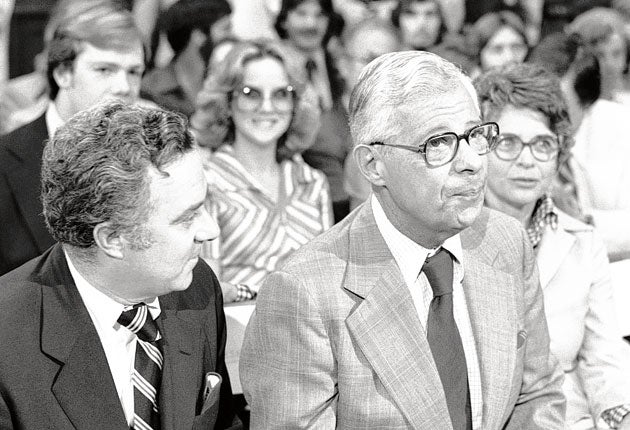
Among Daniel Schorr's many awards, distinctions and achievements as a journalist, one was surely unique. He was the only US reporter both to be expelled from Moscow for crossing a Soviet leader – and to feature as an officially designated "enemy" of an American President.
The first incident occurred at the end of 1957, not long after Schorr, then the Moscow correspondent of CBS News with a long record of clashes with the Soviet censors, secured a formal interview with Nikita Khrushchev, who the previous year had ordered the crushing of the anti-Communist uprising in Budapest.
"We are not here, Mr. Khrushchev, to argue with you, but to get your opinions," Schorr noted. "But since you have raised America's troubles in Formosa [now Taiwan], and this is a frank discussion, I only wanted to ask you, how long do you think the [Janos] Kadar regime would last without Soviet troops and tanks in Hungary?" Not long afterwards he returned to New York for a holiday break. By then the Russians had had enough, and didn't allow him back.
But even this scrape paled beside what Schorr would later describe as "the most electrifying moment of my career." It came in 1974, when Schorr, by then covering the Watergate scandal for CBS, managed to get hold of the celebrated "Enemies List" drawn up by the Nixon White House, just before he was due to go on air.
Without having had time to look it over, Schorr read out the list live – only to find that enemy No. 17 on the 20-person list was one "Daniel Schorr, Columbia Broadcasting System, Washington", described as "a real media enemy". Somehow Schorr continued as if nothing had happened. "I think I did pretty well," he reflected, decades later.
The two episodes not only tell much about Schorr's professionalism – his nose for a story combined with a reluctance, virtually unthinkable today, to make himself the centre of that story. They also underline his toughness, his stubbornness, and his readiness to speak truth to power, irrespective of whether that power resided in the Oval Office, the Kremlin, or in the boardroom of his own employers.
Schorr started out young in the news business. The son of emigrants from what is now Belarus, he had his first scoop in 1929, when he was 12, and a body fell from the roof of the block of flats in the Bronx where he lived. The boy knew exactly what to do. First he called the police, and then the local paper, the Bronx Home News, earning $5 for the tip-off.
By the early 1940s, Schorr was working for Jewish Daily Bulletin and as a stringer for a Dutch news agency in New York. After the war he went to the Netherlands for the agency, and worked as a freelance for a variety of US and British newspapers. Then, in 1953, his reporting on the terrible Dutch floods that year caught the eye of Ed Murrow, the titan of CBS News, who offered him a job.
Thus began a career in broadcast news that would take Schorr to Moscow, Berlin, and back to Washington to cover the Johnson and Nixon presidencies for CBS. In 1980 he was one of the very first hires for Ted Turner's brand new cable news network, CNN. His last home was National Public Radio, where he worked for a quarter century as an analyst and commentator, filing his last report a fortnight before his death.
By the end, Schorr was one of the grand old men of American journalism, the last active practitioner among what became known as the "Murrow Boys", the group of reporters hired for CBS by Murrow, and who collectively set the standard for US broadcast journalism for decades. But he could also be as cantankerous as they come.
On several occasions he fell foul of CBS management, the last of them in 1976 when he obtained a copy of a secret Congressional report on disreputable doings by the CIA that CBS refused to publish. Schorr then leaked the document to The Village Voice, and came within an ace of being cited for contempt of Congress for refusing to divulge his source. Amid the uproar he was suspended by CBS, and then resigned.
Much the same happened at CNN, where Schorr clashed with Turner, the network's founder, over its coverage of the 1984 Republican convention. Once again he was suspended, and once again he resigned. Public radio, by contrast, was a perfect haven, with its thoughtful, liberal-leaning style, and the lack of editorial interference.
With the passing of the years, Schorr became a monument to an earlier, heroic age of journalism; within the NPR office, he was treated as a walking historical encyclopedia. But even Schorr was not Methuselah. "You covered the Spanish-American war, didn't you?" a producer asked one day. Schorr's reply was as matter-of-fact as when he read out his own name on Nixon's enemies' list. "That was in 1898."
Rupert Cornwell
Daniel Louis Schorr, journalist: born New York City 31 August 1916; married 1967 Lisbeth Bamberger (one son, one daughter); died Washington DC 23 July 2010.
Join our commenting forum
Join thought-provoking conversations, follow other Independent readers and see their replies
Comments