Dede Allen: Pioneering film editor who worked with Sidney Lumet and Arthur Penn
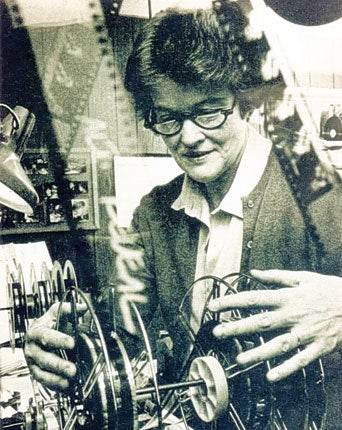
Dede Allen, who has died aged 86, was the most important film editor in the most explosive era of American film. Between Bonnie and Clyde (1967) and 1978's The Wiz, Allen edited or co-edited 11 films, all but one for Arthur Penn, George Roy Hill or Sidney Lumet, that helped redefine the way that Hollywood cut – using jump cuts, overlapping sound, and abrupt changes of pace to capture the inner qualities of characters and highlight narrative tension.
She elevated the position of editors themselves; Allen's pre-credit in Bonnie and Clyde is thought to be a first for an editor, and on Warren Beatty's Reds (1981) she was also executive producer, with a percentage of the film's revenue. Actor-directors prized her ability to choose moments from different takes and seamlessly improve their performances. Known for rapid cutting, she was equally adept at capturing gentler moods; in Paul Newman's Rachel, Rachel (1968) her cutting reflects the hesitations and confusions of Joanne Woodward's spinster schoolteacher, while for Robert Redford's slow-paced The Milagro Beanfield War (1988), she wove in elements of magical realism.
But her work blossomed with Penn, who called her "an extraordinary collaborator". Ironically, her slow progress toward feature films left her perfectly placed for that creative explosion in New York in the Sixties.
Allen was born in Cleveland on 3 December 1923. Her father was an executive with Union Carbide but her mother had been an actress. She abandoned architectural study at California's Scripps College to work as a messenger at Columbia Pictures, where she wound up in the sound effects department, which proved crucial. As Walter Murch, who rated Allen among the ten greatest editors ever, explained to Michael Ondaatje in his book The Conversations, in silent film, editing was often perceived as "a woman's craft... knitting pieces of film together." But sound engineering was a male domain.
Allen moved to editing trailers, where quick cutting was a necessity, and cut her first feature, Because of Eve, in 1948. She would not edit another until the B-thriller Terror from the Year 5000 ten years later, working instead on commercials and industrial films. In 1959 she cut Odds Against Tomorrow, a literal film noir with a racial theme, for director Robert Wise. Wise, having edited Citizen Kane for Orson Welles, understood the importance of Allen's background in sound, and her success with Wise landed her The Hustler (1961) for Robert Rossen. Although the showy moments with pool balls catch the eye, the real brilliance of her cutting lies in the different rhythms established for Jackie Gleason's Minnesota Fats and Paul Newman's Fast Eddie.
Even so, it would be another five years before she was hired for Bonnie and Clyde. Penn and Warren Beatty had previously made Mickey One (1965), heavily influenced by French New Wave, and in Allen they found the perfect cutter to transform the gangster film. It's not just the famed mixing of slow and fast motion in the ultimate death scene, but the jagged story telling itself. Allen recalled Penn going through the edits saying "take out more", leaving shots mismatched, until she told him, "I'm going to be known as the mismatch person of the universe."
Penn's trademark is ambiguity, and Allen helped create it in the stoned feeling of Alice's Restaurant (1969), the multiple flashbacks of Little Big Man (1970), the onion-layered uncertainties of Night Moves (1975) and the multiple anachronisms of The Missouri Breaks (1976). Her editing showed how Billy Pilgrim came "unstuck in time" in Hill's Slaughterhouse-Five (1972), and was perfect for capturing the confused sex roles at the heart of Slap Shot (1977). She built Al Pacino's growing paranoia in Serpico (1973) for Lumet, working with Richard Marks; Allen would help develop a number of New York's best editors. For Lumet's Dog Day Afternoon (1975), like Slap Shot a film about sexuality hidden under an action format, she received her first Academy Award nomination. She didn't win an Oscar, though BAFTA honoured her for the film.
Reds brought her second Oscar nomination (along with Craig McKay), but for the next decade she worked on smaller films, some of which, like The Breakfast Club (1985) and The Addams Family (1991), are well-known, while others, like Newman's Harry & Son (1984) and Jim Bridges' Henry and June (1990), deserve to be. She spent eight years as an executive at Warner Bros., basically in charge of post-production, before receiving her third Oscar nomination for Curtis Hanson's Wonder Boys (2000). Allen learned digital editing in her eighties. She would do three more features, the last of which was the Julia Roberts vehicle Fireflies in the Garden (2008), based on a Robert Frost poem.
Although she never won an Oscar, Allen received the American Cinema Editors' Lifetime Achievement award in 1994. She died in Los Angeles on 17 April, shortly after suffering a stroke, and is survived by her husband of 63 years, the documentary maker Stephen Fleischman, her son Tom, a sound-mixer, and her daughter Ramey Ward.
Michael Carlson
Dorothea Corothers (Dede) Allen, film editor: born Cleveland 3 December 1923; married Stephen Fleischman (one son, one daughter); died Los Angeles 17 April 2010.
Join our commenting forum
Join thought-provoking conversations, follow other Independent readers and see their replies
Comments