Eddy Arnold: Country music superstar
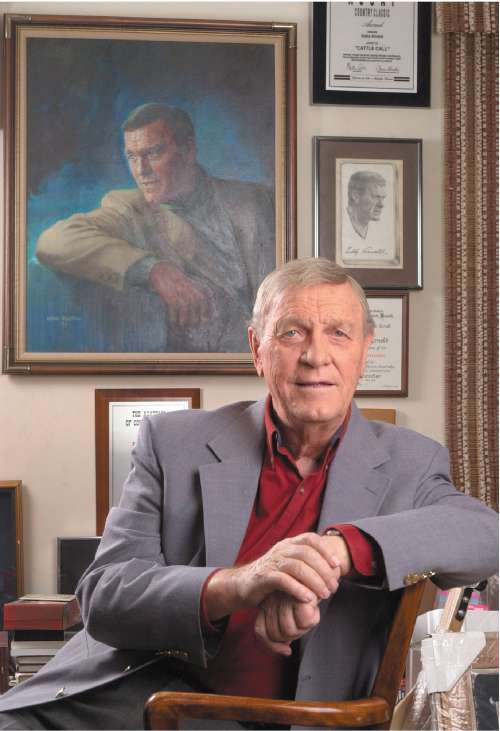
Eddy Arnold was arguably the most successful country singer of the 20th century. He sold an estimated 85 million records and enjoyed more than 140 US hits, 28 of them chart-toppers. He cut his first single for RCA Victor in 1944 and was still very much a presence on the country scene in the 1990s, having made a guest appearance on the teen sensation LeAnn Rimes' award-winning album Blue in 1996.
The possessor of a smooth and supple baritone which gained warmth over the years, he was one of the genre's great vocalists. Building on the pioneering work of musicians like Gene Autry and Elton Britt, with his effortless and intimate country croon he appealed beyond the music's core audience and won fans across the United States.
When Arnold was elected to the Country Music Hall of Fame in 1966, his plaque noted his "powerful influence in setting musical tastes"; something he achieved not only by assuming a leadership role, but also by virtue of a series of television appearances in which his Southern charm reassured suburban America that not all country singers were backward hillbillies.
Eddy Arnold was born on a west Tennessee cotton farm in 1918. His mother taught him the guitar at an early age, and he accompanied his fiddle-playing father at local dances until the latter's death. At the age of 11 he quit the local school and literally took over the reins of the family mule. He later remembered: "I lost my father in 1929 – I was a little boy and it was tough then. Then it got tougher." Music, however, remained important, and in 1936 he made his radio début in nearby Jackson.
After six years at WMPS Memphis, he was a popular local star and during the Second World War, he toured military bases with Pee Wee King's Golden West Cowboys and the comedienne Minnie Pearl. By now billed as "The Tennessee Plowboy", he gravitated to King's band, becoming both its featured vocalist and, in 1942, a member of the Grand Ole Opry.
Signed to RCA in 1944, his first release, "Mommy Please Stay Home With Me", made little impact, but the follow-up "Each Minute Seems a Million Years" (1945) went Top Five, kick-starting an incredible, hit-making career.
His chart entries from this period include a number of outright classics, such as "Chained to a Memory" (1946), "It's a Sin" and "I'll Hold You In My Heart (Till I Can Hold You In My Arms)" (both 1947), Will S. Hays' folk standard "Molly Darling", Happy Lawson's "Anytime", "Bouquet of Roses", which spent 19 weeks at the top, and "Just a Little Lovin' (Will Go a Long, Long Way)" (all 1948). Arnold was joined on these recordings by the distinctive "crying" steel guitar of Little Roy Wiggins, who remained with him from the early 1940s until 1968; his manager at this time was a pre-Elvis "Colonel" Tom Parker.
In 1951 he enjoyed three number ones: "There's Been a Change In Me", Bill Monroe's "Kentucky Waltz" and "I Wanna Play House With You". Other major successes in the first half of the 1950s included the witty "Eddy's Song" (1953), "I Really Don't Want to Know" (1954) and "I've Been Thinking" (1955).
That year he revived, for the second time, Tex Owens' "Cattle Call". With its prominent use of a chorus conducted by Hugo Winterhalter, it anticipated, by a couple of years, the famed Nashville Sound, Music City's slick response to the onslaught of rock'n'roll. He later recalled:
I had recorded with a little group for so long that there wasn't anything else for me to do from an instrumental standpoint. . . So I just got to thinking that the songs I sang were pretty good – lyrically and melodically – and that all I needed to do was change the background a little. And that's what I did. I went in and did some things with violins and – boom! – I had a hit.
If Arnold was not, perhaps, a major force in the Sound's success, the hits nevertheless continued. Ironically, one of his biggest during the period was a spartan version of Jimmy Driftwood's folk song "Tennessee Stud" (1959).
In the mid-1960s, his approach to music-making changed. Realising that the gap between country and other adult forms of popular music was narrower than it had ever been, his songs now featured full symphonic backing and he found himself in the upper reaches of both the country and pop charts. His successes from this period included "What's He Doing In My World" and "Make The World Go Away" (both 1965); the latter was a hit in the UK, too, in 1966. "I Want to Go With You" (1966) followed, and John D. Loudermilk's "Then You Can Tell Me Goodbye" (1968). In 1967, as a popular host on American television and having headlined at Carnegie Hall in New York, he fittingly became the Country Music Association's first Entertainer of the Year.
In 1972, after nearly 30 years, he parted company with RCA, signing to MGM. When he returned to his old label just four years later he celebrated with his 100th hit, "Cowboy".
Although he continued to chart into the 1980s, even scoring a Top Ten hit some 35 years after his first with "That's What I Get For Loving You" (1980), he cut back on live performances and increasingly spent time on his business and property interests. A mainstay of award shows, he also found himself in demand for cameo appearances in the music videos of other acts.
In 1993 RCA offered a fine overview of his career, Last of the Love Song Singers: then and now. In 2005, he released his 100th album: After All These Years.
Paul Wadey
Richard Edward Arnold, singer: born Henderson, Tennessee 15 May 1918; married 1941 Sally Gayhart (died 2008; one son, one daughter); died Nashville, Tennessee 8 May 2008.
Join our commenting forum
Join thought-provoking conversations, follow other Independent readers and see their replies
Comments
Bookmark popover
Removed from bookmarks