Elaine Dundy: Author of 'The Dud Avocado' who first took up writing as a response to life as 'poor little Mrs Tynan'
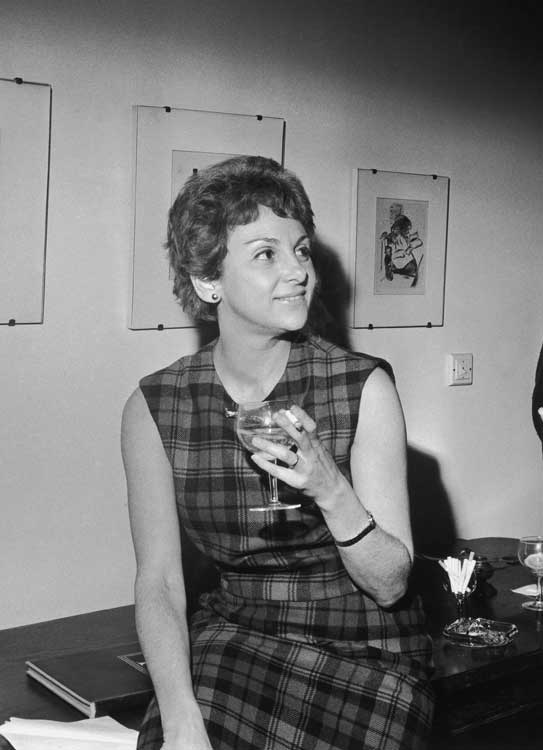
Elaine Dundy, the author of The Dud Avocado (1958) and biographies of Peter Finch and Elvis Presley, was a remarkable writer, playwright and glamorous actress whose marriage to Kenneth Tynan was, perhaps, the greatest drama of her life.
Hers was a privileged, Park Avenue, governess-educated upbringing. Born Elaine Brimberg in 1921, she attended Mills College, Oakland, California, studied art history at Sweet Briar College in Lynchburg, Virginia, and with the outbreak of the Second World War she joined the Army Signals Corps at Arlington, Virginia.
After the war, she decided to become an actress, studying at the Jarvis Theatre School in Washington under the stage name Elaine Dundy, along with fellow pupils Rod Steiger and Tony Curtis. She left Washington for Paris in 1950, and then moved to London where, fatefully, she met the up-and-coming drama critic Kenneth Tynan.
Tynan took her to the movies, then to the largely gay nightclub the Rockingham, where, in one of the more extraordinary propositions to which its flock-papered walls had been witness, he declared, "I am the illegitimate son of the late Sir Peter Peacock. I have an annual income. I'm 23 and I will either die or kill myself when I reach 30, because by then I will have said everything I have to say. Will you marry me?"
Dundy declined, on account of having just fallen in love with Peter Ustinov. Two weeks later, she moved into Tynan's flat. "We lived a life of undomesticated bliss," she wrote. "The only home virtue I practised . . . was making English tea and fried bread and bacon and eggs. . . The only ones he practised were setting traps for mice and throwing them out the window the next day." They were married the following January at Marylebone Town Hall. "Have married Englishman," Dundy telegraphed her parents. "Letter follows."
Their honeymoon lasted three weeks – Tynan returning to direct Fay Compton in Cocteau's Intimate Relations, Dundy to rehearse for a BBC TV production of Kaufman and Ferber's Dinner at Eight, in which she played the maid: "One of those small parts an actress can do absolutely nothing with except look as pretty as possible, act as naive as possible and stay out of the way of the knives."
Subsequently, Dundy played a series of parts on Radio Luxembourg's Harry Lime dramas, directed by Orson Welles, whom she had met through Tynan. (The couple would appear as hosts of a bullfighting episode for Welles's Around the World TV series in 1955). Halfway through one rehearsal, Dundy had to point out to her director, "Orson, I'm following myself on." Welles roared, "What happened to the other actors?" Dundy gently reminded him that he had fired them that lunchtime. Later, when Tynan issued a characteristically acerbic review of Welles's Othello (with the memorably offensive line, "Citizen Kane had become Citizen Coon"), he and Dundy were ordered out of the actor's dressing room.
Three years into their marriage, Tynan admitted his desire to return to his "Oxford practices". He gave his wife two books on sado-masochism, and produced a schoolmaster's cane. Dundy submitted to his "flagellomania".
"The fact was, however, that before Ken's idea of beating as foreplay I had never had a bad lay in my life," wrote Dundy. "In short, I felt cheated." She fought back, afterwards, with vituperative words – and realised that her response to her husband's abuse was in fact rooted in the abuse she had received from her own father.
In 1954, Marlene Dietrich appeared in her cabaret act of reinvention at the Café de Paris, lionised by Tynan. Noël Coward – who introduced Dietrich on stage – brought the two together, and on leaving Dietrich and Tynan alone at the Dorchester, promptly floated the rumour that they were having an affair. "Poor little Mrs Tynan," the Master remarked of Dundy, "she must be putting her head in the oven by now."
"Poor little Mrs Tynan was – at that very moment – on the town with Henry Green. The great English novelist," insisted Dundy. But Coward's quip was ironic. Tynan was now regularly threatening to throw himself out of the window if Dundy didn't do as he wanted. How could any marriage survive such impossible strains?
Still, Dundy persevered. Indeed, her foray into writing – which would be the saving of her – came as a response to these pressures. "I decided I would write a wonderful novel and that he would be proud of me." The book was about an American woman in Paris, its title supplied by Tynan when he heard Sandy Wilson tell Dundy she was attempting to grow "a dud avocado" from a pit.
To Dundy it summed up her sense of herself as an exotic import. Later, asked about how autobiographical the book was, she responded: "All the outrageous things my heroine does like wearing an evening dress in the middle of the day are autobiographical. All the sensible things she does are not."
On reading her manuscript, Tynan pronounced, "This is going to be a colossal bestseller." "Now I could love him again," she wrote. Shortly after, Tynan returned from Los Angeles with a chic black dress for his wife, and the news that he was going to Spain with Carol Grace, another actress, with whom he was "sexually compatible".
Dundy's book was published in January 1958 to brilliant notices from The Sunday Times – "as delightful and delicate an examination of how it is to be 20 and in love in Paris as I've read" – and The Observer – "One falls for Sally Jay from a great height from the first sentence"; although Cyril Connolly (not for nothing the coiner of the term "the pram in the hall") dismissed it as "just another wife trying to justify her existence".
The relationship gradually disintegrated over the next few years, as Tynan descended into a spiral of alcoholism and drug addiction; vices which his wife, unhappily, began to share. Despite Tynan's approaches to Gore Vidal, their mutual friend, for help (Vidal replied, "Elaine wants something that neither you nor anybody can give her. She wants herself"), the marriage was dissolved in 1964, the same year in which Dundy published her second novel, The Old Man and Me.
Dundy overcame her addictions, and reinvented herself as a writer and playwright, as well as exercising her highly individual and witty voice as a script-writer for Ned Sherrin's Sixties satire show, That Was The Week That Was. She wrote biographies of Peter Finch and, perhaps surprisingly, Elvis Presley – not least because she admitted, "Prior to 1977, I didn't know that Elvis was alive until he died."
To write the book, Dundy moved to Tupelo, Mississippi, in order to better acquaint herself with her subject. The result, Elvis and Gladys: the genesis of the king, published in 1985, was acclaimed by the Boston Globe as "the best Elvis book yet". In it, Dundy brought a classical education to bear, reading a Mephistophelean compact into Presley's contract with "Colonel" Tom Parker, and seeing a metaphysical sense of double identity in her subject's life.
Her own life story was itself examined in 2001, when Dundy published Life Itself!, a racy and often highly amusing autobiography detailing, inter alia, her extraordinary years with Tynan. In 2006, Dundy wrote a heart-rending account of the loss of her eyesight, due to macular degeneration, in The Guardian. Yet ever optimistic, she even saw the positive aspects to her late loss. "Those of us who become low visioned late in life are lucky. Our mind's eye is filled with remembrance."
Philip Hoare
Elaine Rita Brimberg (Elaine Dundy), actress and writer: born New York 2 August 1921; married 1951 Kenneth Tynan (one daughter; marriage dissolved 1964); died Los Angeles 1 May 2008.
Join our commenting forum
Join thought-provoking conversations, follow other Independent readers and see their replies
Comments
Bookmark popover
Removed from bookmarks