Elfriede Gerstl: Viennese writer who survived the Holocaust
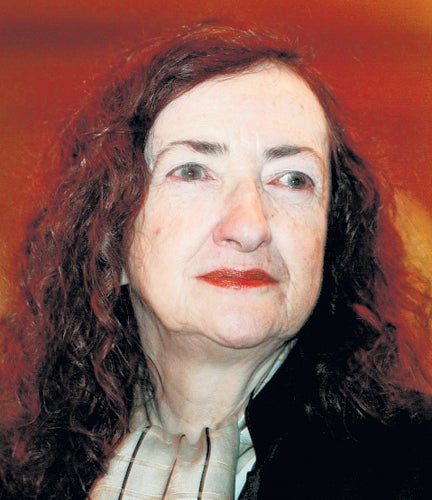
Elfriede Gerstl was an award-winning Viennese writer and feminist campaigner who, as a Jewish child with her mother, remarkably survived Austria's Nazi years. Sadly, her work had only limited exposure beyond the German-language area, but the Nobel Prize winner Elfriede Jelinek has described her as one of the most important post-war writers.
Gerstl was born in 1932 in Vienna, the daughter of a Jewish dentist. She survived the war years by moving, with her mother, from one empty apartment to another, on occasion even finding sanctuary in a wardrobe. She was one of only a few hundred "U-Boote" (as those who evaded the Nazis in this manner were known) in Vienna to avoid being caught and shipped off to the concentration camps.
In the early 1950s, Gerstl went to Vienna University to study medicine and psychology, but she was drawn increasingly to writing and published her first pieces in 1955, in the journal Neue Wege (New Ways). In 1960, she abandoned her medical studies and married Gerald Bisinger, an author and radio editor. They had a daughter, Judith Bellina, and lived with Gerstl's mother in a tiny flat.
In 1963, Gerstl and Bisinger moved to West Berlin when she was awarded a scholarship by Walter Höllerer's newly founded Literarisches Colloquium Berlin. The Colloquium was attempting to revive the literary brilliance of 1920s Berlin by encouraging German authors and foreign writers to the Cold-War-divided city; it provided space for new and established writers to stay, discuss and gain an audience. Gerstl lived there for much of the 1960s, in an atmosphere of constant intellectual debate and growing student activism. As an Austrian, she could also cross the Wall and imbibe both the official and the unofficial intellectual life of East Berlin. In 1972 she took up permanent residence again in Vienna.
Gerstl was a staunch feminist and much of her work examined gender roles, including the 1977 novel Spielräume (Room to Manoeuvre), and Kleiderflug (1995, Clothing Flight). Perhaps understandably, Gerstl was interested in antique clothes, including hats, from the 1920s onwards. She would buy items from second-hand shops and house clearances, which she later wore visiting the cafes of Vienna.
Professor Konstanze Fliedl of Vienna University has noted that, for all her passion and moral purpose, Gerstl's writing was "quieter, more subtle and more precise than an indignant lashing-out in all directions. That is why Elfriede Gerstl's voice has often gone unheard".
Spielräume, written in 1968-69, was not published until 1977. But she had latterly received more recognition. Among her awards were the Literature Prize of the City of Vienna (1990) and the Honorary Medal in Gold of the Federal Capital, Vienna (2003). In 1999, she received two major German-language literature awards: the Erich Fried prize and the Austrian Georg Trakl prize for poetry. Her last work, Lebenszeichen (Sign of Life), a collection of poems, postcards and notes, was published in April 2009.
David Childs
Elfriede Gerstl, writer and feminist: born Vienna 16 June 1932; married Gerald Bisinger (died 1999, one daughter); died Vienna 9 April 2009.
Join our commenting forum
Join thought-provoking conversations, follow other Independent readers and see their replies
Comments
Bookmark popover
Removed from bookmarks