Elisabeth Noelle Neumann: Pioneer of public-opinion polling and market research
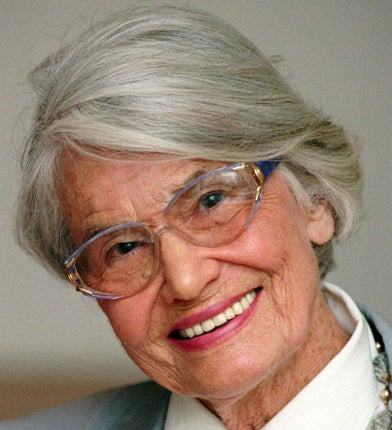
Elisabeth Noelle Neumann was an internationally recognised pioneer of public opinion research who enjoyed the confidence of successive German leaders.
Born in 1916 in the prosperous Berlin suburb of Dahlem, Elisabeth Noelle was proud of her family. Her father was a lawyer who founded the film company, Tobis-Filmgesellschaft. On her mother's side, her grandfather, Fritz Schaper, was a sculptor known for his statues of Goethe, Lessing, Luther and Krupp. After early schooling in Berlin, Elisabeth attended the famous Schloss Salem School, completing her matriculation in Göttingen, in 1935. She went on to study philosophy, history, journalism and American studies at the universities of Berlin, Königsberg and Munich. An exchange student award took her to the University of Missouri, from 1937 to 1938, where she worked hard to learn the methods of George Gallup. She returned to Germany via Japan and China. In 1940 she was awarded a doctorate for a dissertation on public opinion research in the US.
Although she was later to claim she was never a Nazi, in 1940, she worked briefly for the notorious Nazi weekly, Das Reich, which on 8 June 1941, published her article "Who informs America?" She insisted it was the Jews. Whether she was advised to write something of the sort to get into the media controlled by the Minister of Propaganda, Dr Joseph Goebbels, was never explained. She was, in any case, unable to take up an offer of work from Goebbels due to illness.
Noelle then found employment with the Frankfurter Zeitung, until it was banned in 1943. Just before the Soviet Army occupied Berlin in May 1945 she joined the flood of refugees to the west, finding sanctuary in the small town of Allensbach on Lake Constance.
The war over, she had to decide what to do. Luckily a French colonel assigned to the occupation came to her aid. He had stumbled on her dissertation and thought she could be useful in measuring German public opinion, of which all three western powers were anxious to keep abreast. With her new husband, Erich Peter Neumann – who, after working for the pacifist Die Weltbühne before the Nazi takeover in 1933, joined the Nazi party and held a leading position on Das Reich – she established the first opinion-polling body in Germany.
She was now Noelle-Neumann and Erich worked hard to bring success to both of them. He joined the Christian Democratic Union (CDU), the party backed by the Americans, the Catholic Church and much of business. Later he served as a CDU member of the federal parliament, from 1961 to 1965. Elisabeth, who had taken tea with Hitler, was soon having tea with Konrad Adenauer, West Germany's leader. She probably took tea and more with all West German Chancellors and had a particularly close relationship with Helmut Kohl, the Chancellor from 1982 to 1998.
Her detractors regarded her as a tame CDU researcher. However, by the time Kohl hit the headlines her Institut für Demoskopie Allensbach played a leading role not only in political research but also in commercial market research. Noelle-Neumann also branched out in other directions: she held a chair at the University of Mainz from 1964 to 1983, while from 1978 to 1980 she was President of the World Association for Public Opinion Research, which she helped to found.
Noelle-Neumann published a number of works but was best known for Die Schweigespirale: Öffentliche Meinung – unsere soziale Haut (The Spiral of Silence: Public Opinion - Our Social Skin), which described why individuals in the minority on a particular issue might be unwilling to speak out, and as fewer in the minority speak out, a spiral occurs, and minority viewpoints disappear. Fear of isolation is a key motivation for some not to speak out, she believed, and she also posited a "quasi-statistical organ" that suggested people are constantly monitoring the climate of opinion.
Noelle-Neumann received a number of awards including the Order of Merit of the Federal Republic of Germany in 1976.
Asked in 2006 whether she was afraid of death, she replied, "Truthfully, no. I sometimes think with a certain joy about my next life."
Elisabeth Noelle, political scientist: born Berlin 19 December 1916; married 1946 Erich Peter Neumann (died 1973), 1979 Heinz Maier-Leibnitz (died 2000); died Allensbach, Germany 25 March 2010.
Join our commenting forum
Join thought-provoking conversations, follow other Independent readers and see their replies
Comments