Freya Gräfin von Moltke: Anti-Nazi activist
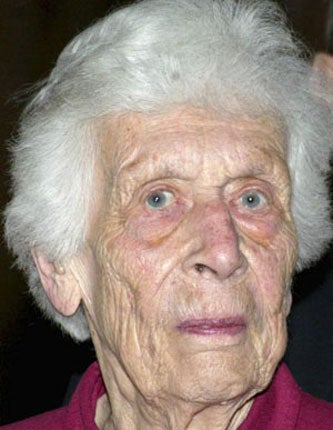
Freya Gräfin von Moltke was one of the last survivors of the Gestapo purge after the failed attempt to assassinate Hitler 20 July 1944. With her husband Helmuth she was involved in the anti-Nazi Kreisau Circle.
Freya von Moltke was born Freya Deichmann in Cologne, Germany, the daughter of Carl Theodor Deichmann, a banker, and his wife, Ada (née Ada von Schnitzler). In 1930 she began studying law at the University of Bonn and attended seminars at the University of Breslau, where she worked as a researcher for her future husband.
On 18 October 1931, Freya married Helmuth James Graf von Moltke in Cologne. From the famous military family, he was the eldest son of Graf Helmuth von Moltke and Dorothy, the only child of Sir James Rose-Innes, the Chief Justice of South Africa, both Christian Science followers. Helmuth and Freya lived, for financial reasons, in a modest cottage on the Kreisau estate in Silesia, but later moved to Berlin, where Helmuth completed his legal studies. Freya also studied law in Berlin and received a Doctor of Law degree from Humboldt University of Berlin in 1935.
Helmuth was greatly influenced by his parents' liberal values. In 1934, and again in 1936-37, Freya and Helmuth went to South Africa. The couple also visited England many times between 1935 and 1939 and, in 1938, Helmuth qualified for the English bar. They had seriously considered emigrating from Germany but were caught by the outbreak of war in September 1939.
In 1937 Freya gave birth to their first son, Helmuth Caspar. Thereafter, she lived at Kreisau all year round. Her husband inherited the Kreisau estate in 1939. In 1941 she gave birth to their second son, Konrad, at Kreisau.
Helmuth was called up and assigned as adviser on International Law to the foreign department of military intelligence (Abwehr). Without being fully aware of it, he had landed in one of the centres of the military conspiracy against Hitler. The Abwehr was headed by Admiral Wilhelm Canaris, who had organised German support for General Franco but later turned on Hitler. In his travels through German-occupied countries, Helmuth was confronted with many human rights abuses, which he sought to mitigate by arguing that German bodies observe the Geneva Convention.
Back in Kreisau in 1942 and 1943, Helmuth, supported by Freya, held three discussions about the situation in Germany and the country's future after Hitler. Smaller meetings were held in Berlin. They brought officers, trade unionists and churchmen together. Between the first and the third meetings the German Sixth Army looked like capturing Stalingrad. By the time of the third it had surrendered to the Soviets and the Germans had been thrown out of North Africa by the Western allies.
In January 1944 Helmuth was arrested by the Gestapo, accused of warning another of impending arrest. He was later tried for treason in the notorious People's Court, sentenced to death and hanged in Berlin 23 January 1945. Canaris was executed on 9 April 1945 for his connections with the 20 July 1944 plot. Her husband's fate put Freya in danger and she spent months in flight from the Gestapo and the advancing Russians. After the war, in 1945, she returned to Kreisau to salvage what she could, especially her husband's papers hidden in her beehives. But Stalin had decided Silesia was to be part of his Polish satellite and with the help of friends in the British Embassy in Warsaw, she left Kreisau for West Germany.
In 1947 she moved to South Africa, where she settled with her two young sons. She found employment as a social worker and a therapist for disabilities. In 1956, opposed to apartheid, she returned to Berlin, where she commenced her work in publicising the Kreisau Circle. She received support from Eugen Gerstenmeier, President of the Bundestag, and others. In 1960 she moved to Norwich, Vermont, to join the social philosopher, Eugen Rosenstock-Huessy, who died in 1973. At the age of 75, Freya von Moltke took up US citizenship to enable her pursue her interest in participating in the American political system.
In 2005, the Freya von Moltke Foundation for the New Kreisau was established and entrusted with the task of providing financial security for the projects that have taken root in Kreisau. The Foundation is a conference centre where youth and adults from eastern and western Europe meet to become better acquainted and to work on European integration. In the same year her Memories of Kreisau & the German Resistance was published by the University of Nebraska Press. On 11 March, 2007, the centenary of her husband's birth, Freya was received by the German Chancellor, Angela Merkel. She died of a viral infection surrounded by her family, in Norwich, Vermont on New Year's Day.
David Childs
Freya Deichmann, anti-Nazi activist: born Cologne 29 March 1911; married 1931 Helmuth James Graf von Moltke (died 1945; two sons); died Norwich, Vermont, US 1 January 2010.
Join our commenting forum
Join thought-provoking conversations, follow other Independent readers and see their replies
Comments