Geoffrey Woolley: 'Times' Letters Editor whose pages helped set Britain's public agenda
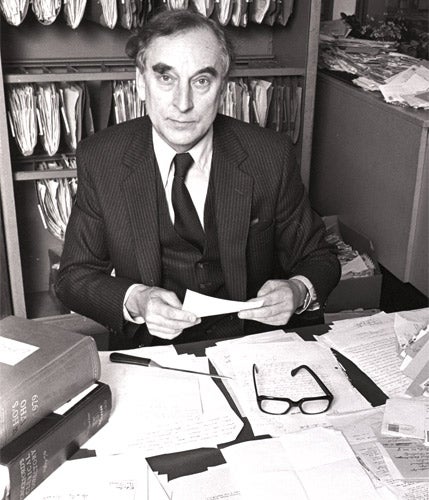
For three decades, from the year of the coronation, 1953, until the period of the Falklands conflict in 1982, Geoffrey Woolley was a potent, if unseen and largely unknown, influence on British public life. As Letters Editor of The Times he was the final arbiter of what and whose letters were published, which were afforded prominence as lead-letters, and at what point any long-running, controversial correspondence should be terminated. Fifty and more years ago – before the emergence of The Independent, The Guardian, and the Today programme – letters to The Times played an almost exclusive role in setting the public agenda, and Woolley's judgement was pivotal. Above all he was fair to those with minority or dissenting opinions. Woolley refused to be pressured by anybody – least of all by MPs.
Woolley's attitude is encapsulated in what was, from my point of view, a sad little tale. Three years old, as an MP, I expressed my extreme displeasure that a letter I submitted to The Times on the Borneo War, the confrontation against Indonesia in Sarawak and Sabah, had not been published. "Go and see Geoffrey Woolley," said Richard Crossman, whose PPS I was. It was singularly bad advice. Woolley did consent to see me in his office in Printing House Square. Quietly, with total courtesy, he said, "Mr Dalyell, I am not going to publish your letter." There followed a pause. I looked surprised. "For three reasons," he said. "It is too long," which it was. "It was sloppily expressed," which I had to concede. "And because you have tried to pressurise me into doing so." Woolley, then added that I could not expect any letter I submitted to The Times for the following six months to be considered. I departed with my tail between my legs!
Years later he told me that he deemed it would be a salutary lesson for a young MP. "Do you realise I get about 10 letters a day from the House of Commons, and have made it a rule not to publish any more than two letters from parliamentary sources on the same day?" Towards the end of his "reign" I got to know him well over letters on Scottish Devolution. He felt that the Labour Vote No Campaign (to an Assembly in Edinburgh) ought to be heard, and it greatly helped that Labour pro-devolution bigwigs from his native Wales tried to suggest that anti-Assembly letters should not be given such an airing. We never did know what his personal thoughts were on the creation of Assemblies in Cardiff and Edinburgh. In his personal beliefs, Woolley was impartial and inscrutable.
If he ever revealed bias, it was towards the caution of Pym and Whitelaw, and against the intransigent opposition to compromise of Mrs Thatcher. Certainly, those opposed her got a fair hearing on the Letters Page, if not in the editorial columns.
Born the son of William Woolley, who was manager of his own colliery in Tredegar – and a man who was held in respect by the local MP, Aneurin Bevan, for having won a George Cross for his courage during a mining accident in a local pit (not his own) – Woolley was sent to Clifton College. The school provided a house exclusively for boys from Jewish families, and Woolley had a lifelong interest in Israel-related issues. Going up to Caius College, Cambridge in 1933, he read English, influenced by "Dadie" Rylands, a Fellow of King's; he recollected the arrival in the Faculty of a young lecturer by the name of F.R. Leavis, whose presence was to become so divisive. Throughout Woolley's life he was interested in argument, and the interplay of conflicting opinions.
Memories of the Second World War, and the loss of contemporaries, never left him. From the D-Day landings, through Normandy to the Elbe, and being one of the first into the bombed ancient city of Lübeck, his service led to a Mention in Dispatches.
On demobilisation, following the advice of the then Deputy Editor of The Times, Robert Barrington-Ward, he gained experience on the Monmouthshire Beacon and the Western Mail. Robert's son, Mark Barrington-Ward, supervisory Editor of the Oxford Mail, the Northern Echo and the Westminster Gazette told me, "My father, as Deputy Editor to Geoffrey Dawson, had responsibility for choosing young talented men, and sending them for experience away from Printing House Square."
After a short period in the Obituaries Department of The Times, he was sent to Washington to help cover the 1948 election, at which Harry Truman triumphed over Governor Dewey. In 1952 Woolley returned to London, and a year later took over the Letters Department, over which he was to preside for more than 30 years.
According to Mark Barrington-Ward, and I am sure he is right, it is misleading to suggest that Woolley took over a single column on the Letters Page. What he did do was to sustain, with distinction, what was already a material institution.
Vividly, I recollect going late at night to see my old chum from his days as a reporter on the Scottish Daily Express, Charles Douglas-Home, Foreign Editor and then Editor of The Times, in his office under the portraits of his great predecessors. "Don't imagine for one moment," he said, "that I could presume to tell Geoffrey Woolley, or any other Letters Editor, what to put, and what not to put on their page." Woolley reigned supreme in his kingdom.
Tam Dalyell
Geoffrey Downing Woolley, soldier and journalist: born Tredegar, South Wales 29 June 1915; civil union with Ian Mylles 2007; died 17 February 2010.
Join our commenting forum
Join thought-provoking conversations, follow other Independent readers and see their replies
Comments
Bookmark popover
Removed from bookmarks