Gerry Anderson: Thunderbirds creator whose puppet adventures thrilled millions of children across the world
He was always thinking to himself, 'Why can't I work with actors and do the thing properly?'
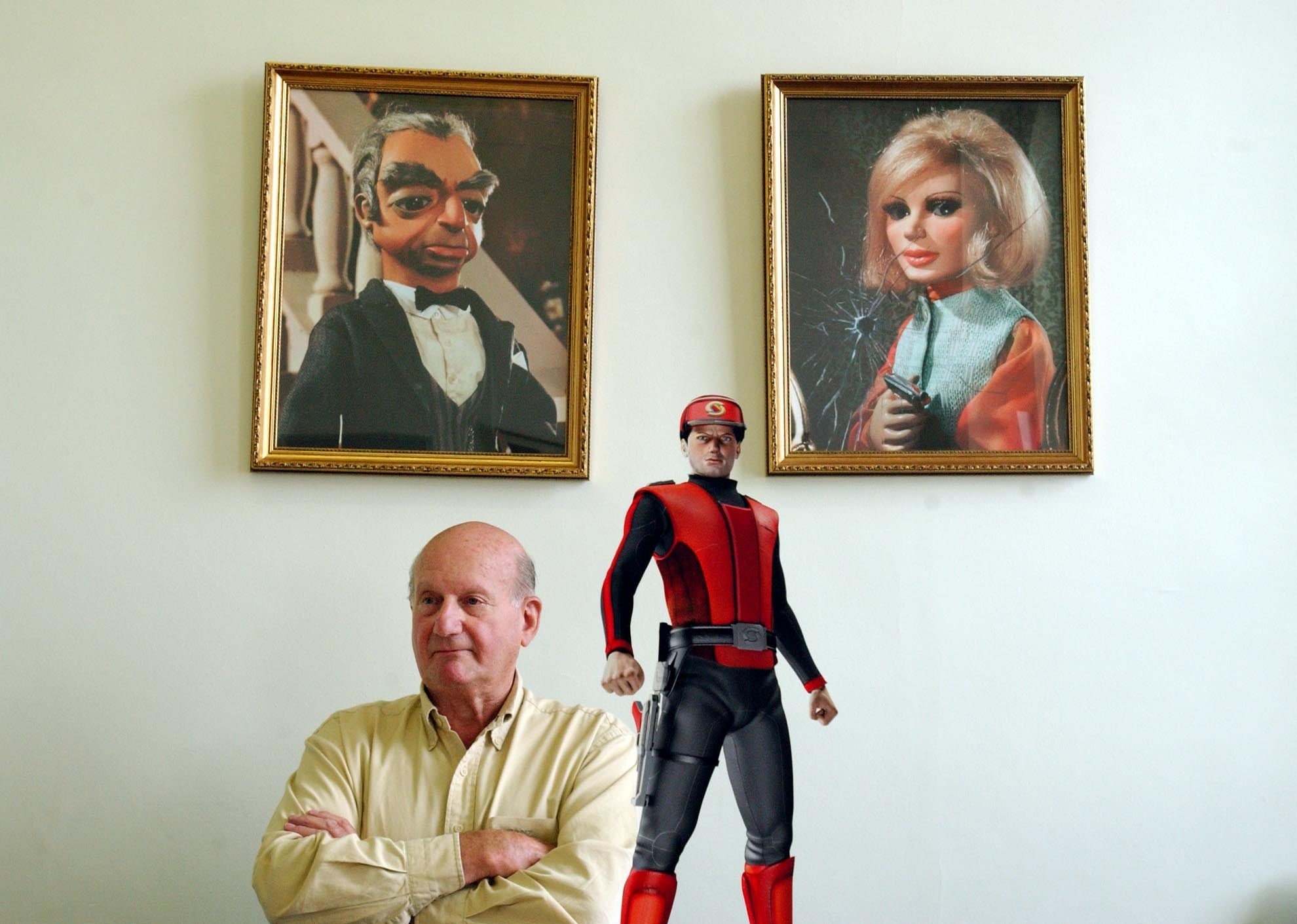
Gerry Anderson was responsible for some of the most instantly recognisable characters and series ever made for television. Never mind that most of his creations came with strings attached (quite literally), shows like Thunderbirds, Stingray and Captain Scarlet remain timeless, delighting and inspiring generation upon generation of children. Anderson once received a thank you letter from a scientist working for Nasa whose imagination was fired as a child watching one of his shows.
But how different it could have been. Anderson’s career in puppetry really began as a fluke. In the late 1950s he was running a fledgling production company hoping to land glamorous documentary work or even feature film assignments. The phone never rang. As he crawled ever closer towards bankruptcy a children’s writer offered him a batch of scripts for a puppet show called The Adventures of Twizzle. At the time Anderson knew nothing about children’s television and even less about puppetry. “We didn’t want to do it,” he recalled. “But we were broke. I was ashamed of it. It was not what I wanted to do. If they’d asked me to make a film about crocodiles, you might now be talking to a crocodile expert.” More than once Anderson was to claim that his life and career was ruled more by chance than design.
Gerry Anderson was born in 1929 in north London. His was a background of grinding poverty and zero education: home was a one-room flat he shared with his parents and elder brother that had no running water and neighbours which included one ex-con and a prostitute. Worse than being poor, the Anderson household was also a deeply unhappy one, his mother and father were temperamentally unsuited and bickered constantly. Anderson’s father, who barely scraped a living selling cigarettes, was a heavy gambler and usually in debt.
When he left the flat he was known to lock his two sons inside to stop his wife from leaving. When Anderson was 13 his mother finally walked out, taking the children with her. Always the dutiful son, Anderson later persuaded his parents to get back together, but the acrimony was still there and when his father died his mother refused to attend the funeral.
Entering technical college, Anderson set his heart on a career as a plasterer. Though he was extremely gifted, lime in the plaster caused dermatitis; he lost the skin on both hands and on doctor’s orders he was forced to abandon the profession. It was a crushing blow. So Anderson moved on to his second choice of career: the movies, which had always fascinated him as a child watching the adventures of Flash Gordon and Buck Rogers.
It was to be a long and tough apprenticeship, ideal grounding for his future role as producer and director of a unique brand of film-making. Working his way up from cutting room assistant, editor and then dubbing editor, he landed a job at the famous Gainsborough studios where one of his more interesting duties entailed recutting Margaret Lockwood’s heaving bosom for the American version of The Wicked Lady (1945).
By the mid-1950s Anderson was directing TV commercials and documentaries for an independent company, and it was here where he met and fell in love with Sylvia Thamm. The only problem was, he was already married, with two small daughters. A quick divorce enabled him to marry Sylvia but the decision to leave his wife and family was one he never truly forgave himself for. “When I look back I am ashamed,” he once said. “I don’t know how I could have done it.” Although Anderson kept in touch with both daughters, his relationship with them was never particularly close and over the years they drifted apart.
In 1956 Anderson took the biggest and bravest gamble of his life when he and Sylvia ploughed their last £500 into setting up their own film studio at Islet Park, an old mansion house near Maidenhead. Bedrooms and a ballroom were converted into workshops and offices and after a shaky start they were churning out highly popular puppet shows, beginning with The Adventures of Twizzle (1957), then Torchy the Battery Boy (1960) and Four Feather Falls (1960). Yet all the time Anderson strove to make each of his creations as much like a normal film as possible in the hope of landing live action assignments. “By making the puppets as lifelike as possible I thought people would see that I’d be good at making feature films.”
What people saw instead was his genius for the puppet genre, and more shows followed – Supercar (1961) and Fireball XL5 (1962), each one increasingly relying upon science fiction for their thrills. Then came Stingray, which made history in 1964 as the first colour television series produced in Britain.
Anderson was now head of a mini industry, employing a staff of 250 film-makers, designers and special effects men at new and more technically advanced studios in Slough. He was doing well financially, too, after the showbusiness tycoon Lew Grade bought out his company in 1962, though Anderson remained creatively in control and received 10 per cent of all profits.
Those profits skyrocketed with his next show, Thunderbirds (1965). Named after Thunderbird Field, the Arizona airfield where his elder brother, who was killed during the Second World War, had trained to be a Mosquito pilot, the adventures of millionaire Jeff Tracey’s sons – Scott, Virgil, Alan, Gordon and John (all named after American astronauts) and their daring rescues of people in peril was an instant phenomenon.
Sold to 66 countries the show earned Anderson the Royal Television Society silver medal for outstanding artistic achievement. As for its enduring cult appeal, winning over successive generations of fans, Anderson was clear: “Thunderbirds gives kids what they want – death and destruction – and yet the underlying story is about saving life, not destroying it.”
Although across the years Anderson had introduced numerous innovations in order to perfect his puppetry technique, coining the term Supermarianation to describe it, he remained professionally stifled and dissatisfied with his pioneering achievements, always thinking, “Why am I working with puppets, why can’t I work with actors and do the thing properly?”
After two more Supermarianation classics, Captain Scarlet (1967) and Joe 90 (1968), Anderson finally got his wish and moved into the live action arena with the blessing and financial backing of Lew Grade. Testament to Anderson’s genius, his first two live action shows for television, UFO (1970) – in which for the first time he broached adult themes like drug abuse – and Space 1999 (1975) were once again instant cult hits.
But at the time of Anderson’s greatest success his private life was in chaos. His volatile marriage to Sylvia (famously the voice behind Thunderbird’s Lady Penelope) was crumbling. In a last-ditch effort to save it he bought an expensive house without selling his first home first, and when the property market crashed he was left in financial crisis. The couple eventually divorced in 1975 and so acrimonious was it the pair were never to speak to one another again. “As far as I am concerned.” Anderson once said. “She no longer exists.”
Sylvia went on to carve out a successful solo career, working for the American cable TV company HBO. She also won custody of their only son, Gerry Jnr. A gruelling and costly three-year legal battle undertaken by Anderson to get access to the boy swallowed up most of his fortune but he did at least win some visiting rights with his child, but on the day of the first proposed visit he received a letter in Gerry’s handwriting stating his wish never to see his father again. Anderson was mortified, and was not to see him for another 20 years, until out of the blue his estranged son contacted him in 1998 for a long overdue reconciliation.
After more than a decade in the entertainment wilderness 1994 saw Anderson’s long-awaited return to big time television production with Space Precinct, a cop show set in outer space. It was his costliest series ever, with a $36 million budget, but the American backers went bust and the show folded. Anderson followed this up with a none-too-successful animated serial, Lavender Castle (1998), aimed squarely at the children’s market.
Genuinely modest about his achievements and slightly embarrassed by the fan adulation his shows engendered, Anderson received an MBE in 2001 for services to animation. Domestically, too, he found contentment in later life. His third marriage, to Mary Robins, produced his fourth child, Jamie. Anderson, who earlier this year was diagnosed with Alzheimer’s disease, claimed that not only did Mary save his life after the personal trauma following his divorce from Sylvia, but also taught him how to be a better parent.
Learning through the bitter experience of being so distant with his other children, Anderson forged a far deeper and stronger relationship with Jamie – although he liked to joke that the only fly in the ointment was that Jamie had grown up more a Dr Who fanatic than a Thunderbirds fan.
Gerry Anderson: television producer and director: born London 14 April 1929; married 1952 Betty Wrightman (marriage dissolved; two daughters), 1961 Sylvia Thamm (marriage dissolved; one son), 1981 Mary Robins (one son); died Oxfordshire 26 December 2012
Join our commenting forum
Join thought-provoking conversations, follow other Independent readers and see their replies
Comments