Hugh Lloyd: Popular comedy actor who found fame in 'Hancock's Half Hour'
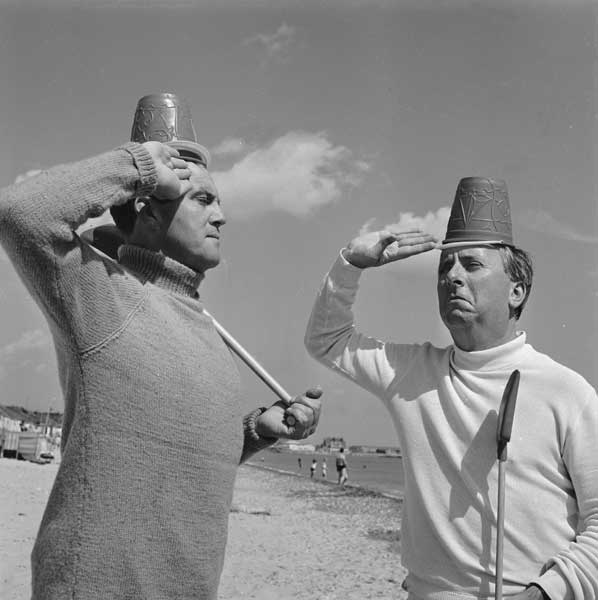
Hugh Lloyd found fame in Hancock's Half Hour and his was a perenially popular face in television sitcoms throughout the 1960s and 1970s. Meek, timid characters were his stock-in-trade; he saw himself as the man in the street and the underdog. His short, balding features and overweight frame, combined with sorrowful eyes and a deadpan expression of helplessness, gave him a wide appeal, especially to women. "I'm not so much an actor, but more of a performing dog with a wagging tail and anxious to please," he once said.
In the long-running Hugh and I (1962-67), written by John Chapman, Terry Scott starred as the undutiful, unemployed bachelor son living with his mother in suburbia while Lloyd was the fretting lodger who provided the rent through his job at an aircraft factory. Terry involved the unwitting Hugh (the characters had the actors' names) in his many money-making ruses but the schemer invariably lost out to his "simple" friend.
Then, in Lollipop Loves Mr Mole (1971, written by Jimmy Perry and retitled Lollipop in 1972), Peggy Mount and Lloyd played Maggie and Reg Robinson, whose pet names featured in the title. Seeing her role as protecting Reg from the outside world, as well as the threats presented by the arrival of his brother and sister-in-law to live with them on returning from Africa, Mount was the domineering wife to Lloyd's more vulnerable husband.
The actor's roles in both sitcoms typified the "little man" character he enjoyed playing. "I think the public like him because, in the end, he comes out on top and it only means something if he is faced by somebody who is dominant," he explained.
Born in Chester in 1923, Lloyd, the son of a travelling cigarette salesman who eventually managed a tobacco factory, had a Methodist upbringing in the city – and would later turn down acting roles if he considered them "blue" or offensive. He loved to watch summer shows during the family's annual holiday in Llanfairfechan, North Wales, and found a childhood hero in the mournful Stan Laurel. "My idols were always Laurel and Hardy, because they never needed to offend anybody," he said. "I saw them on stage in London and they were just as funny as they were in films."
On leaving King's School, Chester, at the outset of the Second World War, Lloyd was turned down by the RAF because he suffered from hay fever. Then, with ideas of joining MI5, he was given an interview in Whitehall, but rejected as being too young for espionage work. Instead, he became a journalist on the Chester Chronicle (1939-42), often reporting on Chester City football matches and local theatre. When he started acting in amateur dramatics himself, he became adept at writing good reviews of his own productions.
Lloyd left the paper to perform with Ensa, the troops entertainment organisation, during the last three years of the war and subsequently turned professional, appearing in variety shows and pantomimes, as well as doing a stand-up comedy routine between the strip acts at the Windmill Theatre in London.
Later, he entertained the troops again on a tour of Cyprus, Malta and Tripoli with the comedian Tony Hancock, after taking occasional, small roles in the radio series Hancock's Half Hour. In 1957, a year after the programme began its television run, Lloyd became a regular in the cast, playing a series of different characters, from a television engineer and council official to a librarian and camera shop assistant.
The legendary sitcom, written by Ray Galton and Alan Simpson, starred Hancock as the melancholy, sad and slightly seedy Anthony Aloysius Hancock, who shared a flat at 23 Railway Cuttings, East Cheam, with Sidney (Sid James). Lloyd stayed for the rest of the programme's run, with the final series (retitled Hancock, 1961) including the most famous episode of all, "The Blood Donor", in which Lloyd was the patient in the hospital bed next to Hancock, who had decided to donate blood and responded to the news that it must be a pint with the line: "I don't mind giving a reasonable amount, but a pint! That's very nearly an armful."
At the same time, Lloyd was playing foil to Eric Sykes in several episodes (1960-61) of Sykes, before he and Terry Scott – another comedy actor with a background in variety – were offered the starring roles in Hugh and I. The pair then took their popular characters to a sequel, Hugh and I Spy (1968), where Lloyd could finally indulge his craving for espionage. They continued the partnership as different characters in The Gnomes of Dulwich (1969), a slightly surreal and less successful sitcom from the pen of Jimmy Perry, about three life-sized gnomes in one garden – Big (Scott), Small (Lloyd) and Old (John Clive) – lined up against plastic impostors in the next.
After hitting his stride again with Lollipop Loves Mr Mole, the actor came up with his own idea for a sitcom, Lord Tramp (1977), scripted by Michael Pertwee and featuring Lloyd himself as the happy-go-lucky tramp Hughie Wagstaffe, who inherited a title, a country estate and a fortune but decided that he preferred his previous existence, unburdened by responsibilities and material wealth.
Lloyd subsequently made guest apearances in other sitcoms, such as Last of the Summer Wine (in 1983), In Sickness and in Health (1985 and 1990), You Rang, M'Lord (1993) and My Family (2002 and 2006), but he increasingly took dramatic roles, proving himself to be a valuable character actor.
He was in Alan Bennett's television plays A Visit from Miss Prothero and Me! I'm Afraid of Virginia Woolf (both 1978) and Say Something Happened (1982), and, among many other appearances, played Joseph Brown in Cider with Rosie (1998), the Aged P in Great Expectations (1999) and a vicar in Oliver Twist (1999). "I discovered that television was the right medium for me, because I like underplaying," he said. "I don't like being too obvious. I'm not an extrovert."
Although he preferred the small screen to the stage, Lloyd acted in the West End in When We Are Married (Strand Theatre, 1970), No Sex, Please – We're British (Strand Theatre) and Noël Coward's triple-bill Tonight at 8.30 (Lyric Theatre, 1981). He also performed with the National Theatre Company in 1985-86.
Lloyd's film appearances were few, but they included roles in the Tony Hancock comedies The Rebel (1961) and The Punch and Judy Man (1962), The Mouse on the Moon (1963), James and the Giant Peach (1976) and Quadrophenia (1979). When Anthony Hopkins directed August (1996), based on Chekhov's Uncle Vanya, he cast Lloyd as Porky.
In 1983, Lloyd married his fourth wife, the journalist Shan Davies, following three marriages that ended in divorce. His autobiography, Thank God for a Funny Face, was published in 2002 and he was appointed MBE in 2005.
Anthony Hayward
Hugh Lewis Lloyd, actor: born Chester 22 April 1923; MBE 2005; four times married; died Worthing, West Sussex 14 July 2008.
Join our commenting forum
Join thought-provoking conversations, follow other Independent readers and see their replies
Comments
Bookmark popover
Removed from bookmarks