Ian Carmichael: Actor who played likeable toffs in golden age of British comedy
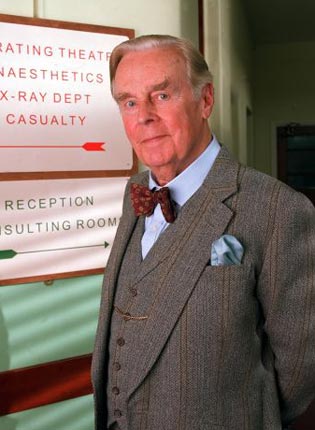
A career which began with a performance as a robot in the experimental RUR at the People's Palace, Mile End, followed by Julius Caesar on what was then the London "fringe" at the Embassy Theatre (both 1939) looked as if it was heading in distinctly unorthodox directions.
Yet after 1947, on returning to the stage after the war, Ian Carmichael never again appeared in London in a classic play (Shaw's Getting Married in a 1967 Strand all-star revival the sole exception). A career in light comedy, musicals and revue might be seen by some as a betrayal of his Rada training and talents, but Carmichael – Hull-born and from unlikely beginnings – in fact turned himself into the best player of light comedy of his generation, in the line of Hawtrey, du Maurier and Rex Harrison. His timing, rhythm and comedic energy all seemed effortless, with the relaxed ease within a formidably assimilated technique which stamps great acting of any kind.
He learnt all this the hard way, in the lost arts of intimate revue and light comedy. The sketch/song/sketch format of revue may look easy but it requires extraordinary discipline, versatility and technical virtuosity, not to mention the stamina for choreographic routines and multiple quick-changes. Most of Carmichael's revue scripts were topical and of necessity ephemeral, but occasionally more enduring material came his way. In The Globe Revue (Globe, 1952) – perhaps one of the best of those pre-Beyond the Fringe shows – he had some terrific chances, as part of a trio (made up by Dora Bryan and Graham Payn) performing Noël Coward's There are Bad Times Just Around the Corner with a defiantly gleeful refusal to cheer up against an Age of Austerity climate in which
"There are blackbirds over
The greyish cliffs of Dover,
And the rats are preparing to leave
The BBC"
Alan Melville's comedy Simon and Laura (Strand, 1954), set against the then novel background of the world of television, saw Carmichael perform miracles with relatively commonplace dialogue as a harassed producer dealing with a temperamental TV husband and wife team.
He often deftly drew continuous laughter from what on the page might inspire chuckles at best, in many now-forgotten light comedies such as comedy-thriller The Gazebo (Savoy, 1960) and the American import of Ira Levin's Critic's Choice (Vaudeville, 1961), a piece of Manhattan drollery in which he played a drama critic forced to review his wife's play.
Carmichael was by now an established star of the British cinema, the favourite of the Boulting Brothers team – Brothers in Law, Lucky Jim and I'm All Right, Jack remain some of his finest film appearances, all of them helped by his ability to play dramatists with telling economy. Unfortunately, very few after the 1950s were supplying his kind of vehicle and some plays by previous winners no longer found the right touch. Alan Melville's Devil May Care (Strand, 1963) put him in a witless farrago of Satanic reincarnation, while his Broadway excursion with Boeing-Boeing (Cort, NY, 1965) was a quick flop in a city where the old style of undemanding light comedy was likewise becoming redundant in an age of TV sitcom.
Carmichael was lucky with the inventive, accelerating farce of an adulterous quartet (with an onstage telephone box almost a fifth character) in Waterhouse and Hall's Say Who You Are (Her Majesty's, 1965) which seemed more in touch with contemporary mores and had some superbly-placed sight gags allowing Carmichael some of his classic double-takes.
Having toured in musicals in his early days, the demands of a two-hander show held no terrors for Carmichael. But I Do! I Do! (Lyric, 1968) a Broadway musical tracing the story of a marriage, although inventively directed by Gower Champion using many props (Carmichael played the trumpet at one point) was too sentimental to repeat its New York success.
Even more disappointing was Peter Ustinov's dismal effort to write a sophisticated light comedy in Overheard (Haymarket, 1981). This hapless piece was set in some Ustinovian state with Carmichael as the British ambassador opposite an uneasy Deborah Kerr as his wife, pursued by an impassioned dissident. Even Carmichael could do little to enliven this material.
Much of his finest television work coincided with a genuine Golden Age of British television comedy, not least in his unforgettable (and unsurpassed) portrayals of those great English archetypes, Lord Peter Wimsey and Bertie Wooster. The latter especially, in sublime partnership with the suavely unruffled Jeeves of Denis Price, saw Carmichael's ability to be simultaneously flabbergasted and in profound cogitation – monocle a-quiver, brow and gaze suggesting that Bertie's brain, like the dinosaur's, took a long time to assimilate information – most joyously used.
Awarded an OBE in the Queen's Birthday Honours List in 2003, Carmichael spent his later years living very happily with his second wife, the novelist Kate Fenton, back near his birthplace, in the idyllic North Yorkshire surroundings of Esk Valley.
Alan Strachan
Ian Carmichael, OBE, actor, born Hull 18 June 1920; married 1943 Jean Pyman (Pym) McLean (died 1983; two daughters); married 1992 Kate Fenton; died Esk Valley 5 February 2010
Join our commenting forum
Join thought-provoking conversations, follow other Independent readers and see their replies
Comments