Jacques Piccard: Oceanographer and pioneer of deep-sea exploration
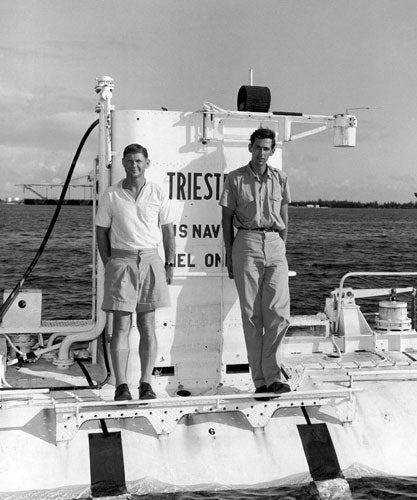
Jacques Piccard was a Swiss hydronaut and oceanographer and a pioneer of deep-sea exploration. In January 1960 he and Lieutenant Don Walsh of the US Navy plunged 10,900 metres into the Challenger Deep, part of the Mariana Trench, in the bathyscaph Trieste. No one has since endeavoured to repeat this undersea voyage nor exceeded the depth record set by the two-man team.
In his autobiographical account of the project, Seven Miles Down (1961), Piccard reported finding living flatfish and shrimps, even in such extreme conditions of depth and pressure. This discovery subsequently led to a ban on the dumping of nuclear waste at sea.
Jacques Piccard was born in 1922 in Brussels into a family of explorers of the world's most remote locations. His father, Auguste Piccard, and uncle Jean Felix Piccard, were both high-altitude balloonists. Jacques Piccard had initially trained in physics and economics, the subjects which he taught at the University of Geneva. During the late 1940s, and following military service in the French army during the Second World War, he became involved with his father's work on the development of bathyscaphs and decided to abandon his pedagogic career.
The father-and-son team worked together through the 1950s, supported from 1956 onwards by funding from the US Navy and other institutions. In August 1953 the pair tested the 15-metre-long bathyscaph Trieste to a depth of 3,100 metres in the Mediterranean, near Capri. Their research culminated in the 1960 record-setting dive into the Challenger Deep. Despite immense water pressure and ominous cracking noises on the way down, Trieste performed well and safely made the journey back to the surface. The same craft later went on to be used in locating and inspecting the wrecks of the nuclear submarines USS Thresher and USS Scorpion.
With their experience gained on bathyscaphs, Jacques and his father designed and built four mid-depth submarines, known as mesoscaphs, which were used in a variety of roles. One of these, the world's first passenger submarine, Auguste Piccard, transported around 33,000 tourists, 40 at a time, beneath the surface of Lake Geneva during the Swiss National Exhibition of 1964.
In 1969, Piccard and five other submariners, among them the British acoustician Ken Haigh, navigated the Gulf Stream from Florida to Nova Scotia in a mesoscaph named the Ben Franklin. They drifted for 1,500 miles intentionally without power, carried by the sea on a journey which lasted a month.
Hearing of the planned voyage, the Nasa rocket scientist Wernher von Braun foresaw similarities withon-board life during future spacetravel and commissioned research which was to provide valuable input into the Apollo and Skylab projects. Piccard documented this voyage in his book The Sun Beneath the Sea (1971), and the Ben Franklin is now on display at the Vancouver Maritime Museum. In 1979 Piccard launched the submersible Forel, which made some 2,000 dives in European seas and lakes on a variety of scientific, commercial and rescue missions.
Piccard's work gave him a profound insight into the effects of mankind's activities on life in the oceans. In a1996 interview he voiced his concern that the sea can only be saved fromits endangered state by dramatic changes in relation to fishingand marine pollution. In his later years Piccard established a "Foundation for the study and protection of seas and lakes", based in Cully, Switzerland and inspired by his belief that: "The more people discover the sea, the greater the chance of bringing marine issues into public view and the better off we will all be."
In 1999 Bertrand Piccard, Jacques' son, followed in the family's adventurer tradition by carrying out the first non-stop balloon circumnavigation of the globe, together with the British adventurer Brian Jones. The design of their balloon, which made use of the jet stream, benefited from work done by Jacques on the Gulf Stream in the Sixties.
Paying tribute to his father's inspirational qualities, Bertrand said: "He gave me a sense of curiosity, the wish to understand things beyond certainties and prejudices, freedom of action and trust in the unknown."
Marcus Williamson
Jacques Piccard, hydronaut and oceanographer: born Brussels 28 July 1922; married (three children); died La Tour-de-Peilz, Switzerland 1 November 2008.
Join our commenting forum
Join thought-provoking conversations, follow other Independent readers and see their replies
Comments