Jean Ferrat: Politically committed singer and songwriter who maintained the French 'chanson' tradition
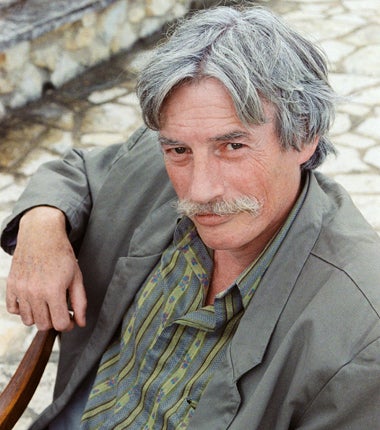
The French singer Jean Ferrat belonged to the great chanson tradition of Jacques Brel, Georges Brassens and Léo Ferré yet, while their work seeped into the Anglo-Saxon consciousness thanks to English-language adaptations by Scott Walker, David Bowie, Jake Thackray or Marc Almond, his popularity remained confined to French-speaking countries.
This might have been because he was a "chanteur engagé", a politically committed artist, a writer and interpreter of meaningful and beautiful lyrics that celebrated love as much as the workers' struggle. However, his deep, rich, warm baritone also touched people who didn't share his political views
His most popular song, "La Montagne" ["The Mountain"], a bittersweet chronicle of the "exode rural", the drift away from the land, chimed with France's preoccupation and complicated relationship with the countryside, and was maybe harder to enjoy without understanding these conflicting emotions. In fact, "La Montagne" contained a prescient reference to "hormone-fed chicken" and became a million-seller in 1964, at the height of the yé-yé era of Johnny Hallyday, Claude François and Sheila. Its success coincided with France's embracing of the consumer society, one of Ferrat's bugbears. "I wonder what will happen to a civilization that can put a man on the moon but has forgotten how to make soup," he said.
In the 1960s and '70s, France's state-controlled media banned Ferrat's songs on a regular basis. This happened most notably to "Nuit Et Brouillard" ["Night And Fog"], his 1963 composition about the shameful willingness of the Pétain régime to help round up and hand Jewish people over to the Nazis. His father was arrested in such a raid in 1942 and died in Auschwitz, while the teenage Ferrat was sheltered by communists. The singer alluded to this again in "A La Une" ["Headline News"], a not-so-veiled reference to the obscenity of TV news and "infotainment" on France's TF1, from his last album of original material, Dans La Jungle Ou Dans Le Zoo, issued in 1991 after the collapse of the Berlin Wall.
While he never joined the communist party, Ferrat was a "fellow traveller" of the left for many years. He particularly admired Fidel Castro. In 1967, he performed 10 concerts and spent two and a half months in Cuba, where he grew a luxurious moustache and composed "A Santiago", "Les Guérilleros" and "Cuba Si". However, he wasn't blind to the failings of Marxism, Leninism and Stalinism. Written in 1965 with Georges Coullonges, his "Potemkine" tackled the famous uprising on board the Russian battleship that started the Russian revolution 60 years before and also inspired the Sergei Eisenstein film The Battleship Potemkin in 1925. With "Camarade" [Comrade], Ferrat criticised the Soviet Union for sending troops and tanks into Czechoslovakia to quell the tide of liberalization during the Prague Spring of 1968. Twelve years later, he composed "Le Bilan" ["The Death Toll") in reply to the statement by the French Communist Party leader Georges Marchais that "all things considered, Eastern Bloc countries should get a positive assessment." It was therefore no surprise that Ferrat never appeared in the Soviet Union. Indeed, he retired from live performance in 1972 and spent most of the last four decades in his beloved Antraigues-sur-Volane in the Ardèche region of France.
He was born Jean Tenebaum in Vaucresson, five miles to the west of Paris, in 1930, the youngest of four children of a jewel-maker immigrant from Russia and a mother who worked in a factory making artificial flowers. The rest of his family survived the Second World War and he dropped out of school at 16 to bring in another income. He found a job in a chemical lab where his boss told him: "You're too much of a thinker and I don't like it."
Ferrat juggled this day job with evening classes and a growing interest in theatre and music-making. In the 1950s he began playing guitar in a jazz band and was billed as Jean Laroche when he first appeared in the cabarets of Paris, and used the pseudonym Frank Noël when briefly under contract to RCA. He took up the stage name Jean Ferrat after seeing the French Riviera town Saint-Jean-Cap-Ferrat on a map.
In 1956, the popular singer André Claveau recorded "Les Yeux D'Elsa", the first of many Louis Aragon poems Ferrat set to music. Two years later, Ferrat released Les Mercenaires, his first EP. He finally found success in 1960 with "Ma Môme" ["My Girl"], whose evocative lyrics by Pierre Frachet seemed tailor-made for him, and in 1963 won the prestigious Prix De L'Académie Du Disque Charles-Cros with his first album for Barclay, a 10in containing eight songs, among them "Nuit Et Brouillard".
With Zizi Jeanmaire and Isabelle Aubret recording his compositions "Eh! L'Amour", "Deux Enfants Au Soleil" and "C'est Beau La Vie", Ferrat should have been unstoppable. However, his beliefs, and especially his uncompromising lyrics, often attracted the attention of the authorities. In 1969, during a live television appearance alongside Brassens and Brel, a studio manager famously held a handwritten sign advising host Jean-Pierre Chabrol that his boss had phoned in with the following instruction: "Ferrat can sing but not take any further part in the conversation." He was persona non grata on TV for the next three years, denied the opportunity to perform "Ma France", another controversial song about the aftermath of May 1968.
In 1975, his feminist tract "La Femme Est L'Avenir De L'Homme" ["Woman Is The Future Of Man"] proved he still had his finger on the pulse of the left. He launched the Temey label and rerecorded much of his 200-plus song catalogue in an attempt to assert his independence from Polygram after it acquired Barclay. Following his move to the Ardèche, he was town councillor of Antraigues-sur-Volane between 1970 and 1983. In 2007, he supported the presidential campaign of the anti-globalisation activist José Bové.
"I don't sing to pass the time," he said and and sang in 1965. He later reflected: "I've never been a yes man for anybody. What really pleases me is that I reintroduced the great French poetry of writers like Aragon to the man in the street. I did that by going against the wishes of the music industry. They used to tell me that what I did was beautiful but of no interest to the general public. I proved them wrong but those idiots didn't learn their lesson. They are still flogging crap to young people."
Jean Tenenbaum (Jean Ferrat), singer and songwriter: born Vaucresson, Hauts-de-Seine, France 26 December 1930; married 1961 Jacqueline Christine Boissonnet (died 1981; one stepdaughter), 1990 Colette; died Aubenas, Ardèche 13 March 2010.
Join our commenting forum
Join thought-provoking conversations, follow other Independent readers and see their replies
Comments