Jeanne-Claude: Artist celebrated with her husband Christo for the pair's large-scale public artworks
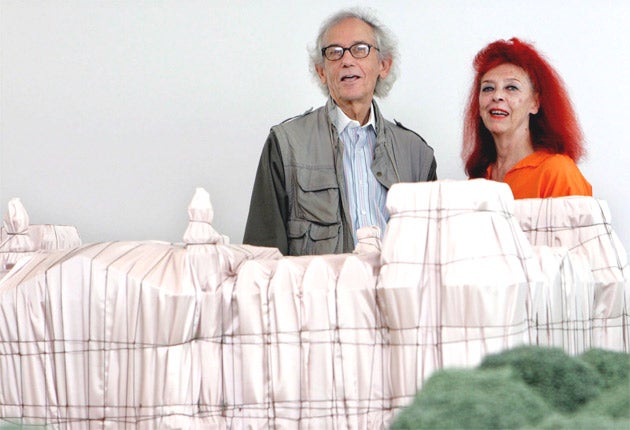
Jeanne-Claude was the flamboyant half of the symbiotic artistic partnership known as "Christo and Jeanne-Claude". The couple are widely recognised for their ephemeral projects together, over more than 50 years, involving the large-scale transformation of public places, by wrapping in fabric, surrounding in material or the planting of brightly-coloured objects.
The two artists were born on the same day, 13 June 1935: Jeanne-Claude in Casablanca, Morocco and Christo in Gabrovo, Bulgaria. Christo fled the repressive regime of his native country for Paris in 1956, and worked as a jobbing artist. It was there, two years later, that the couple met, while Christo was painting portraits of Précilda de Guillebon, Jeanne-Claude's mother. Although Jeanne-Claude married Philippe Planchon in 1959, she left him shortly afterwards, already pregnant at the time with Christo's son, Cyril.
The artists' first outdoor collaboration was in Cologne in 1961. Here, their Dockside Packages project made use of materials found at the port, including oil barrels and tarpaulin, to create substantial and impressive temporary sculptures. It was later the same year that they first proposed the "wrapping" of a public building, the Ecole Militaire in Paris, an idea which has so far not been realised. Other public installations, however, were later to materialise, based on the Christos' belief that "Traditional sculpture creates its own space. We take a space not belonging to a sculpture, and make sculpture out of it."
In 1962 the couple once again used oil barrels, this time to close off the Rue Visconti in Paris for a day. Although their request for permission to create the installation had been refused, they went ahead anyway, in a protest against the building of the Berlin Wall. This was one of the very few occasions when their art would make a political statement, instead of being simply for the pleasure of the spectacle, as Jeanne-Claude made clear, talking about their later work: "Our art has absolutely no purpose, except to be a work of art. We do not give messages."
The couple moved to New York in 1964, basing themselves first at the Chelsea Hotel and then in a Manhattan loft, which has been both home and studio space to them ever since. Little Bay, near Sydney, was the venue for the first "wrapping" which engaged with nature. Here, Wrapped Coast (1969), entailed covering a mile and a half of cliff and beach. Despite initial opposition, the work was hailed as a success and was to lead to many more works in urban and natural contexts.
The couple's best known piece, Wrapped Reichstag, which involved cloaking the German parliament building in cloth, had first been conceived in 1971. After years of deliberations and negotiations, undertaken for the most part by Jeanne-Claude as the couple's public face, it was voted on by representatives in 1994 and completed in 1995. Significantly, the then Chancellor Helmut Kohl, who had consistently opposed the idea, reportedly left Berlin for the two-week duration of the event. The finished artwork used over one million square feet of silvery material, to spectacular effect, and attracted hundreds of thousands of visitors to Germany's nascent capital city. Wrapped Pont Neuf (1985) again saw the couple up against the authorities. Fortunately, Jacques Chirac, the then mayor of Paris who had initially opposed the proposal, eventually warmed to the idea of shrouding the Paris bridge with golden fabric.
Christo and Jeanne-Claude's artworks have always been funded by themselves and have never received grants or sponsorships from governments, companies or other organisations, which assured the couple's artistic freedom. The labour and materials used to implement their projects are funded by the sale of preparatory drawings and photos of the finished works. Likewise, the many books published about their work are, with very few exceptions, funded by the couple themselves. Such was their determination to remain self-funded that in 1988 they refused a $1m fee for a proposed 60-second slot on Japanese television.
With their growing recognition, the ideas became ever more ambitious. In 1991 Umbrellas witnessed 3100 blue and yellow umbrellas spread over sites in Ibaraki, Japan and California over an 18-day period. The Gates was the first outdoor installation in their adopted city of New York. Completed in 2005, in Central Park, it involved the placing of bright orange drapes forming arches over the pathways, creating an event which brought some 5m visitors. Michael Bloomberg, the mayor of New York, described it as "one of the most exciting public art projects ever put on anywhere in the world" and emphasised that "it would never have happened without Jeanne-Claude".
At the time of Jeanne-Claude's death there are still two substantial works in progress: Over the River, which proposes a covering over nearly six miles of the Arkansas River in Colorado and The Mastaba, which envisages a pyramid formed of 410,000 oil barrels in the United Arab Emirates. Christo has undertaken to continue these works, as Jeanne-Claude would have wanted.
Marcus Williamson
Jeanne-Claude Christo-Javacheff (née Jeanne-Claude Denat de Guillebon), artist; born Casablanca, Morocco 13 June 1935; married 1959 Philippe Planchon (divorced), 1962 Christo Javacheff (one son); died New York 18 November 2009.
Join our commenting forum
Join thought-provoking conversations, follow other Independent readers and see their replies
Comments