John Chamberlain: Sculptor who gave new life to scrap-heap cars
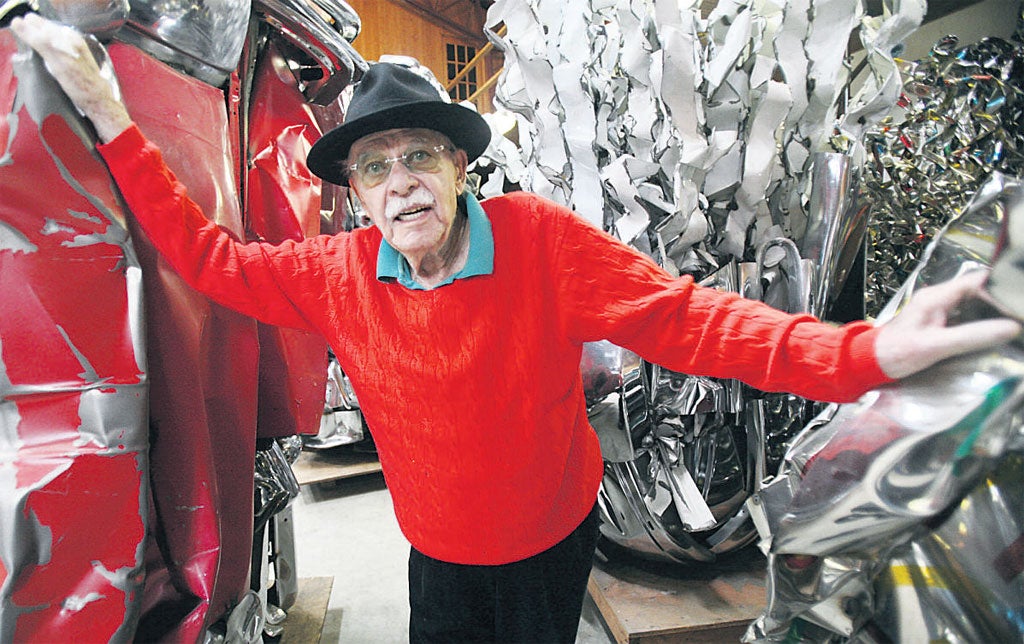
John Chamberlain was a sculptor who experimented with many techniques and materials over his half-century career as an artist. But his signature pieces remain the numerous sculptures made of metal from old cars. With titles such as Glove-Box Collision, Spark Plug Staccato and Fly Wheel Sonata, these colourful and imposing works give a new and enduring life to material from vehicles which have been consigned to the scrap-heap.
Chamberlain was born in Rochester, Indiana in 1927 and grew up in Chicago, Illinois. Following military service from 1943-46, he studied art at the Chicago Art Institute and also trained as a hairdresser, a move which he later explained as his way of meeting women. From 1955, he continued his art training for a further two years at the experimental Black Mountain College in North Carolina. Here he met artists and poets including Charles Olson and Robert Duncan, who became friends and influenced his work.
Chamberlain's first sculptures of the 1950s were monochromatic, flat pieces, made from welded iron rods and inspired by the work of David Smith and the paintings of his friend the abstract expressionist Franz Kline. It was in 1957 that he first took the initiative to re-use old automobile metal, following a find made in the backyard of the painter Larry Rivers. The result was the work Shortstop, created from the fused bumpers of a 1929 Ford car. Explaining his choice of this free and ubiquitous material in a recent interview, he said, "If you're roaming around and have just passed the back of a body shop, this stuff is all over the place; it's just marvellous..."
His first solo exhibition was at the Wells Street Gallery in Chicago, run by the abstract expressionist painter Robert Natkin (Obituary, 16 August 2010). Critical acclaim for his 1960 individual show at New York's Martha Jackson Gallery led to his inclusion in the 1961 group exhibition The Art of Assemblage, at the city's Museum of Modern Art. This collection of work by some 140 artists saw Chamberlain's sculpture featured alongside many established and well-known names such as Picasso, Braque and Rauschenberg.
During the late 1960s, Chamberlain experimented with sculptures based on urethane foam, tied with rope to create voluptuous and curved masses of material. These are as striking as they are simple in their method of manufacture. A critic observed of these pieces: "It seems that the gallery floor is inundated by a heaving sea of something very like flesh... or is it a mass of giant mushrooms or huge, sexy hamburger buns?"
In 1971 Chamberlain had his first retrospective at the Guggenheim Museum, an event which will be echoed in February 2012 with a tribute exhibition at the same venue. Chamberlain moved to Sarasota, Florida in 1980, finding new, large-scale studio space, which enabled him to create monumental works such as The Line Up (Dedicated to the Sarasota Police Department) (1982). Most recently, he had made his home and studio on Shelter Island, New York, where he had worked on Widelux panoramic photos, as well as continuing with his trademark automobile sculptures.
Chamberlain received numerous awards for his work, including a Lifetime Achievement Award in Contemporary Sculpture from the International Sculpture Center (1993), the National Arts Club Artists Award (1997) and a Distinction in Sculpture Honour from the New York Sculpture Center (1999). Chamberlain's sculpture Kora (1963) can currently be seen at Tate Liverpool as part of the exhibition This is Sculpture, which continues until April this year.
Two of Chamberlain's most recent shows were during 2011 at the Gagosian galleries, which represent his work in London and New York. Reviewing the London exhibition, the critic Anne Blood noted: "Made from the discarded fragments of metal gathered from automobile graveyards, Chamberlain's ready-made materials are the surplus remains of an American commodity fetish. However, far from a comment on consumerism or even the rise and fall of the American automobile industry, Chamberlain's new sculptures, made from 1950s automobiles, embrace the aesthetic potential provided by the fraktura of metal fragments, their material qualities and texture – qualities which, poignantly, would have been on the minds of the original designers of these automobiles."
The gallery's owner, Larry Gagosian, paid tribute to him, saying: "John Chamberlain made an indelible mark on the history of art in the 20th century. He was a spectacular, roaring figure who embodied the fierceness of mid-century American art and who was unparalleled in his adaptation of unlikely materials for his sculptures."
Marcus Williamson
John Chamberlain, sculptor: born Rochester, Indiana 16 April 1927; married four times (two sons, one son deceased, two daughters); died New York 21 December 2011.
Join our commenting forum
Join thought-provoking conversations, follow other Independent readers and see their replies
Comments
Bookmark popover
Removed from bookmarks