Louise Bourgeois: Inventive and influential sculptor whose difficult childhood informed her life's work
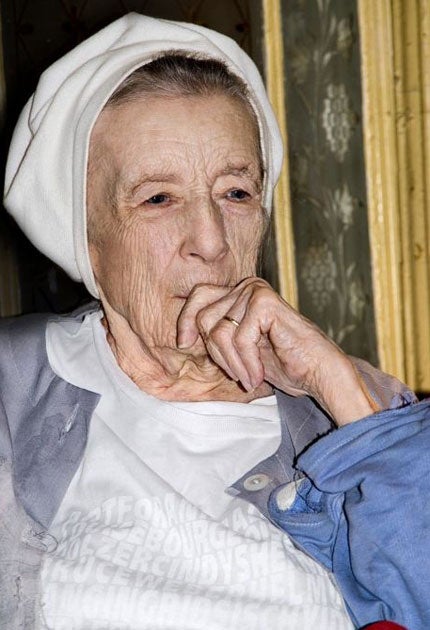
When Tate Modern opened its doors in May 2000, visitors were alarmed to find the gallery's Turbine Hall menaced by a 35-foot spider. It wasn't the creature's size that bothered the public so much as that it was called Maman ("Mummy") and had been made by a little old lady, herself the mother of three. The lady in question was Louise Bourgeois, who was 88 at the time and has died in New York at the age of 98.
Whatever else Maman may have been, it was not a hymn to parenthood. In this, it showed a remarkable consistency. Bourgeois' spider was the latest work in an oeuvre which had, for 70 years, been based almost entirely on her own abusive upbringing. Given to pithy sayings, the artist once remarked that her childhood "never lost its magic, never lost its mystery and never lost its drama." That drama was to be played out from her earliest career as a studio assistant to Fernand Léger in the mid-1930s until her death.
Certainly, life chez Bourgeois offered a rich fund of material for a Freudian-minded artist. Born in Paris on 25 December 1911, the baby Louise annoyed her parents by disrupting their Christmas festivities. It was to set the tone of their relationship: in old age, the artist recalled her parents "fighting like cat and dog, the country preparing for war, my father who wanted a son getting me and my older sister dying."
Affluent tapestry-dealers and restorers, the Bourgeois moved to the suburb of Choisy-le-Roi when Louise was eight years old. Her mother had nearly died of Spanish 'flu the year before, leaving her an invalid. Deprived of sex, her husband began a series of affairs with English governesses imported for the purpose. When, inevitably, these fell pregnant, they were swiftly shipped back to England. Seven decades later, Louise Bourgeois recalled this period of her childhood in a work called Red Room – Parents (1994), an installation piece that includes a pillow embroidered with the words "I love you".
If her upbringing provided the budding artist with psychological material, it also suggested the means for expressing it. Like a character from a Freudian casebook, Bourgeois' father would cut out his daughter's profile in tangerine peel and mock her in front of her younger brother, Pierre, by saying "Look! She has nothing! Nothing between her legs!" In retaliation, Bourgeois modelled her father in bread and spit and cut off the figure's limbs. "It was," she would grimly recall, "my first sculptural solution." As an art student in Paris in the 1930s, she had flirted with Surrealism. These twin experiences would merge in a series of fetish dolls Bourgeois made from the mid-1970s on – works like the aggressively phallic Fillette ("Young Girl"), stitched in black latex. Lest doubt lingered as to their meaning, one work, made in 1974, was called The Destruction of the Father.
Mothers, too, played their part. While the gregarious Monsieur Bourgeois bought and sold tapestries, his sickly wife restored them. This provided their daughter with one of the mainstays of her personal mythology, and of her art. Recruited to help her mother, the child Louise could only reach the knees of the woven figures she was set to repair. In her own telling, this led to a fascination with dismemberment – with seeing humanity as an assembly of body-parts – that would inform her work for the rest of her life. If her father was a destroyer, her mother was a mender. "When I was growing up," Bourgeois later said, "all the women in my house used needles. I have always had a fascination with the magic power of the needle. The needle is used to repair the damage. It's a claim to forgiveness." Thread and stitching were to be a dominant theme in her art from the 1960s onwards, culminating in the Tate's silk-spinning spider, Maman.
Given her childhood, Bourgeois' keenness to leave France is hardly surprising. In 1938, she married the young American art historian, Robert Goldwater, and moved with him to New York. Although the marriage endured, it was at some cost to Bourgeois' career. The newlywed couple lived in a tiny flat, initially limiting her output to works on paper. Only when they exchanged this for the so-called "Stuyvesant Folly" on 18th Street in 1941 could Bourgeois use the mansard loft-space of their new apartment to expand into painting and sculpture.
Even so, her time was divided between making art and raising three children, while her husband followed his academic career unhindered. This carried distant echoes of her parents' marriage, and of its sexual division of labour. Much of Bourgeois' work of this time is coloured by her frustration at marriage, notably her painting, Femme Maison (1946). A take on André Masson's Mannequin, its titular woman has a house for a head, a symbol of her domestic entrapment.
In 1951, Bourgeois took US citizenship; three years later, she joined the American Abstract Artists group. In truth, though, she was never either American or an abstractionist. Although she ridiculed Surrealism for making the tragic comic, her art remained grounded in pre-war Paris, in the work of Duchamp and Breton; while it abstracted psychological states into sculptural forms, those forms can hardly be called abstract. This refusal to sign up to local trends may explain her lack of early success. It was only with the rise of feminism in the late 1970s that Bourgeois began to enjoy the international stardom that marked her later career.
By now a widow and with her children away from home, she expanded her practice to include such contemporary trends as installation and performance. In 1978, Bourgeois wrapped a group of art historians and students in white cloth sewn with stuffed anatomical forms in a work called A Banquet/A Fashion Show of Body Parts. In 1981, at 70, she was given her first exhibition at the Museum of Modern Art in New York; this was followed, at 77, by her first European solo show at the Frankfurter Kunstverein. At 81, she represented the United States at the Venice Biennale, receiving the National Medal of Arts at 85. In 2007, Tate Modern staged a full-scale Bourgeois retrospective, its 95-year-old subject's tour d'honneur later taking in the Pompidou in Paris and the Guggenheim in New York.
Although the preoccupations of her art remained the same, their expression changed from day to day. Amazed by Bourgeois' vigour, a generation of artists young enough to be her grandchildren took her as their hero. When, in 1989, Washington's Corcoran Gallery of Art cancelled a show of Robert Mapplethorpe's work on the grounds of its alleged indecency, it was to Bourgeois that the photographer turned for help. "Pornography serves the outrage of the special interests," she proclaimed, cheekily posing for a Mapplethorpe portrait holding her own phallic Fillette. Rising 84, she recorded a rap song called "Otte", in which she declaimed cod-feminised versions of masculine French words to an insistent ghetto beat. The Sunday open houses Bourgeois continued to hold at her house in West 23rd Street until shortly before her death attracted crowds of young devotees. By the time of Tate Modern's opening in 2000, the 88-year-old artist had finally become a Maman in her own right. "My mother was my best friend, as intelligent, patient, clean, useful, reasonable, subtle and as indispensable as a spider," Bourgeois remarked of her work. "She was able to look after herself."
Louise Bourgeois, artist: born Paris, 25 December 1911; married 1938 Robert Goldwater (died 1973; three sons); died Manhattan, New York 31 May 2010.
Join our commenting forum
Join thought-provoking conversations, follow other Independent readers and see their replies
Comments
Bookmark popover
Removed from bookmarks