Maurice André: Trumpeter loved by both critics and public
He said modern classical music reminded him of the sounds he used to hear going down the mines
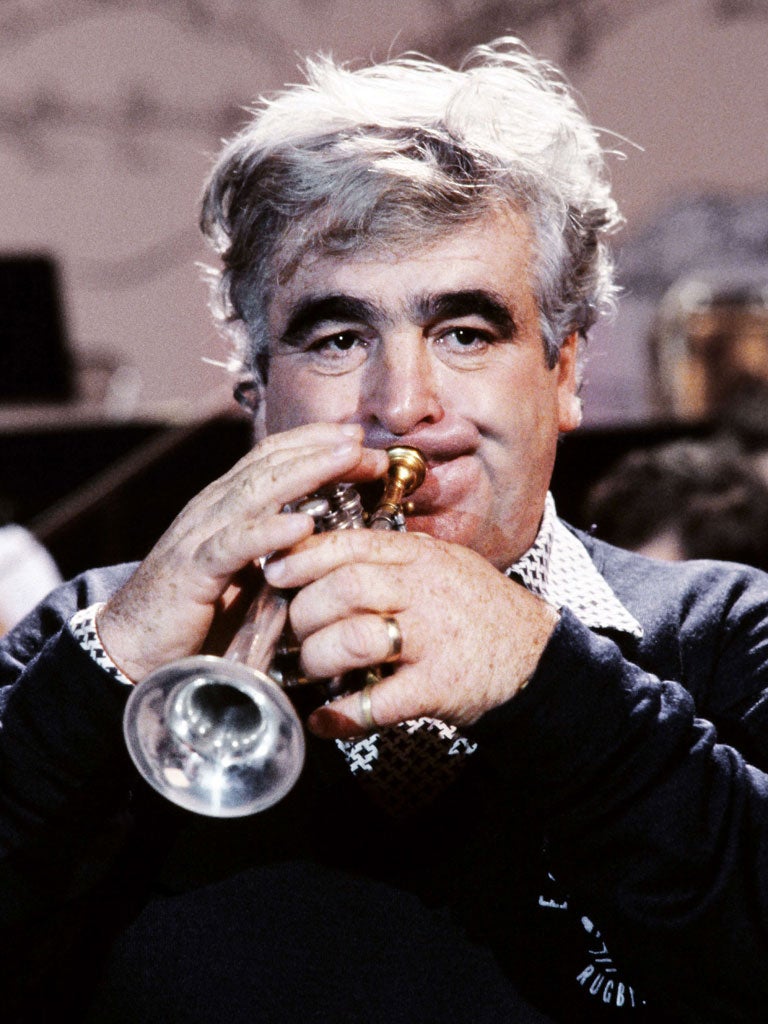
Maurice André did for the trumpet what Segovia did for the guitar, bringing the instrument from its humble origins into both the classical mainstream and popular culture. It had a parallel in his own life: he spent five years down the pits before escaping to music school. The trumpet demands perhaps more physical strength than any other instrument; André attributed his own resilience to those five years at the coal-face, "moving 17 tons of coal a day".
The importance of André's example is difficult to exaggerate. Paul Archibald, former professor of trumpet at the Royal Academy of Music and Royal College of Music, said: "The impact and influence that he had on generations of trumpeters was monumental. He defined the art of solo trumpet playing with his beautifully refined phrasing and his effortless technique." But as well as setting standards for the musicians who were to follow him, André enjoyed a huge popular following, appealing to listeners of every stripe and hue, and crossing musical boundaries with ease.
André was born to the trumpet: his miner father played it, in the colliery band, and for local events. Maurice had two years of school solfège before, aged 12, he began to play the cornet, which his father had won as a prize. He made startlingly swift progress, soon appearing alongside his father, who sent him for lessons with a friend, Léon Barthélémy, a teacher at the Conservatoire in Nîmes. André continued to work in the mines until a near-fatal accident forced him to take time off work – time he used with religious devotion, practising for three hours every morning.
Barthélémy suggested his student join the band of the Eighth Régiment des Transmissions at Mont-Valérien, and it was as a military musician that, at 18, André began studying at the Conservatoire de Paris – though playing in uniform and living in barracks. His principal teacher there, Raymond Sabarich, was demanding and uncompromising, even thumping André when he played a wrong note. The unconventional approach worked: after six months André won the Premier Prix d'Honneur for the cornet and the Premier Prix for the trumpet a year later.
To begin with, there was little demand for a trumpet soloist, and André had to settle for orchestral positions, playing with the Orchestre Lamoureux and the Orchestre Philharmonique de la Radio France, and thereafter with the Opéra-Comique. He also played in night clubs and theatres, but his breakthrough came in 1955 when, asked to join the jury of a music competition in Geneva, he chose instead to appear as a competitor, walking away with first prize.
He was soon making records, many for Erato. He notched up some 300 recordings, and enlarged the trumpet repertoire by raiding those of other instruments. One recording – of Vivaldi concertos with the Berlin Philharmonic and Herbert von Karajan – sold 1.5m copies but got off to a shaky start: when André got a call from Karajan's assistant, he assumed it was a friend winding him up.
It was with Baroque music that he made his reputation: two signature performances were of the Second of Bach's Brandenburg Concertos and the "Badinerie" from the Second Orchestral Suite. He played the high piccolo trumpet with an ease and elegance that astonished – it looked incongruous in his fleshy hands and applied to his round face beneath a thatch of white hair and two bushy black eyebrows. He looked cuddly, approachable, and the TV appearances that began in 1980 brought him an even larger public.
Although André joked that contemporary music reminded him of the noises he used to hear down the mine, composers were hardly going to leave such a resource unexploited, and Boris Blacher, André Jolivet, Jean Langlais and Henri Tomasi were among those who wrote for him.
With the work ethic he had learned as a youth, he had gruelling schedules, averaging 180 concerts a year at his busiest, in the 1970s. But concerts were a family affair: André's manager was his wife, Liliane, and he often appeared with his brother, Raymond, also a trumpeter, and later with his son, Nicolas, another trumpeter, and daughter Béatrice, an oboist. From 1967-78 he was a professor at the Conservatoire de Paris; his memoir Le Soleil Doit Pouvoir Briller pour Tout le Monde ("The Sun Should Shine for Everybody") appeared in 2007.
André put the length of his career down to the fact that he had never strained to play and so didn't tire his lips. He settled in the Basque country in the early 1990s and, though supposedly taking life easier, continued to practise for four or five hours a day, finding time also for painting and wood-carving. His farewell concert was in Béziers in 2008: he should have retired earlier, he explained, but some work on his teeth allowed him to keep going.
For Paul Archibald, the trumpet "was part of him and he sang with an intensity that was pure heart and soul ... He was much more than an instrumentalist. His musical personality was natural, honest and sincere and the integrity of his playing is an example to any musician."
Maurice André, trumpeter: born Rochebelle, Cévennes 21 May 1933; married 1956 (one son, one daughter); died Urrugne, Bayonne 25 February 2012.
Join our commenting forum
Join thought-provoking conversations, follow other Independent readers and see their replies
Comments
Bookmark popover
Removed from bookmarks