Mike Scott: Host of 'The Time The Place'
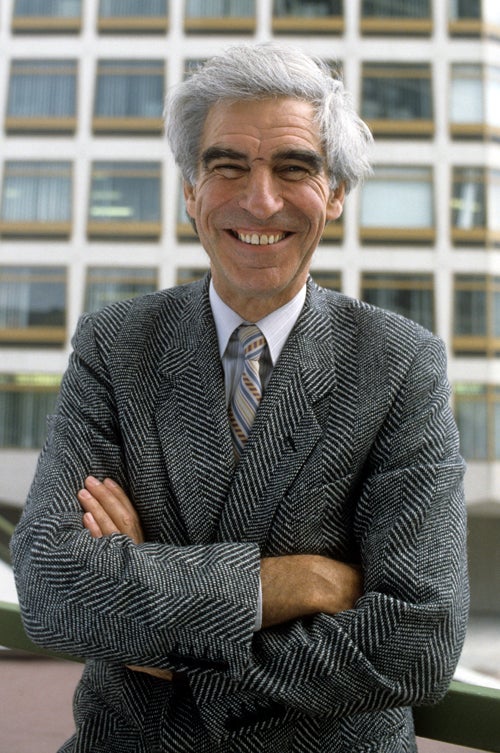
From working as a floor manager at Granada Television when it started broadcasting in 1956, Mike Scott scaled the heights to work as a director, producer and presenter, before becoming the company's programme controller. He then left the boardroom to appear in front of the camera once more, five mornings a week, as host of the live audience-debate show The Time The Place – a precursor to such no-holds-barred programmes as The Jeremy Kyle Show.
But one of Scott's early judgements as a programme-maker gave no indication of the success he would achieve with the ITV company that, in its original form, was franchise holder for the north of England and provided some of the network's most popular shows.
He was one of the first two directors assigned to a new serial that was unleashed on the nation in December 1960, but he had little faith in its surviving beyond the 12 episodes that would act as its trial run. "It is fortunate that nobody took much notice of my first response to Coronation Street," he later explained. "As a young director, I was asked to read scripts and opined that it would do well in the north-west of England but that it would never succeed in the rest of Great Britain. How wrong you can be!"
Following Derek Bennett, Scott directed episode three, when the lay preacher Leonard Swindley told Ena Sharples that it was "unseemly" for her, as caretaker of the Glad Tidings Mission Hall, to drink in the Rovers Return, only to receive the wrath of the hairnetted harridan in response. This set the tone for the early, gritty drama that made Coronation Street and its working-class terraces a television version of the socially relevant dramas that were already invading literature, theatre and cinema.
Scott's hunches became more astute and, while he was Granada's programme controller (1979-87), he oversaw the lavish productions Brideshead Revisited (1981) and The Jewel in the Crown (1984).
Born in London in 1932, Michael Scott was educated at Latymer Upper School, Hammersmith, before getting a scholarship to Clayesmore School, at Iwerne Minster, in Dorset. He had ambitions to be a film editor but, after doing National Service as a second lieutenant in the Royal Army Ordnance Corps, had to settle for a job as a soap salesman at Unilever, promoting products such as Lifebuoy, but he hated the work.
Eventually, his father – a timpanist in orchestras – secured him a job as a stage-hand at the Royal Festival Hall. It was the first rung on the showbusiness ladder, although he almost blew it when, during a performance of The Nutcracker, he had the responsibility of making snow fall on to the set. From high above the stage, he dropped the whole sackful of fake snow, which almost hit the leading lady. After spending the evening in the rafters, scared stiff about the consequences, he emerged to be told by the director: "You did the right thing. I would have killed you if you had come down earlier!"
Securing his Equity card, Scott became an extra in films such as the wartime drama Above Us the Waves and the sci-fi classic The Quatermass Xperiment (both 1955). But he moved behind the scenes again when, in 1955, he secured a job as a trainee cameraman with the Rank Organisation, working in a cellar under the old Gaumont State cinema in Kilburn, north London.
While there, he heard, through a thin wall, Denis Forman – one of the Granada Television founders – offering jobs at the soon-to-be-launched station. He landed the last one, as a floor manager at £10 a week, and began work shortly before the company's opening, transmitting to the north of England in 1956.
He moved on to become a director, responsible in that capacity for Granada's groundbreaking Rochdale by-election broadcasts in 1958, which successfully challenged the ban on television covering elections. He also directed drama series such as Knight Errant (1960) and the documentary A Roof Over Our Heads (1962), highlighting the extent of unfit housing in Britain.
In 1963, Scott became a producer and presenter of factual programmes. As host of the regional news magazine Scene at 6.30 that year, he announced the shooting of President John F. Kennedy to viewers in the North – half an hour before ITN did so nationally. He was a presenter of the film magazine programme Cinema (1964-68) and was also an interviewer at TUC and political party conferences. In current affairs, he was producer of Gosling's Travels (1974-76) and was one of the few presenters and on-screen reporters (1974-87) in the hard-hitting series World in Action.
He continued some of this work while presiding over Granada Television's output as programme controller, during a golden age for both the company and ITV. However, alongside an impressive array of programmes that at times outshone the competition from the BBC, there was one outright failure – the soap opera Albion Market (1985-86), set in a Salford street market.
Scott decided to relinquish his boardroom job to move back in front of the cameras between 1987 and 1998 for The Time The Place, hosting debates with a studio audience on taboo subjects such as teenage suicide and gay teachers. "The whole idea of this show had an air of unpredictability about it, which I found appealing," he explained. "That's what I love about live TV."
Anthony Hayward
Mike Scott had the supreme gift for a television presenter of being able to communicate with such relaxed, easy directness that it seemed there was no television screen between the performer and his audience, writes Derek Granger.
When I was producing Scene at 6.30 in the mid-Sixties, I remember that I would groan with frustration if Mike was having the day off, even though the team included such luminaries as Michael Parkinson and the witty ex-Guardian journalist Peter Eckersley. With his lean, rangy good looks and breezy affability Mike was an essential presence in the mix of the day's show, deft and quick-footed for the lighter items, sharp and probing for the more serious ones and invariably fizzing with ideas at the daily conference.
Mike's unfailing good nature made him the best of working colleagues and when, in the Seventies, he had been elevated to the position of Granada's programme controller, I always found him a wise and supportive friend, though always a sharp and truthful one, when I was grappling with large-scale drama productions.
I have warm memories of driving with him through Cheshire lanes in his vintage 1932 Lagonda, perhaps his most cherished possession, and even though the last decade his life, by the cruellest of ironies, was darkly clouded over by a progressive brain disease, his friends will remember the vividly winning personality of earlier days.
Michael John Christopher Scott, television presenter and executive: born London 8 December 1932; Programme Controller, Granada Television 1979-87; married 1956 Sylvia Hudson (one daughter); died London 30 May 2008.
Join our commenting forum
Join thought-provoking conversations, follow other Independent readers and see their replies
Comments
Bookmark popover
Removed from bookmarks