Mike Smith: Lead singer with the Sixties beat group the Dave Clark Five
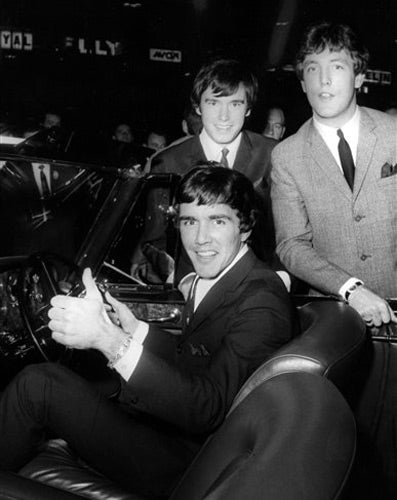
The Dave Clark Five was a phenomenally successful beat group in the Sixties, but many may have wondered why it wasn't called the Mike Smith Five. Smith was the group's lead singer, keyboard player and chief songwriter, but it was the drummer Clark's group: he chose the personnel and made the business decisions.
"We were the first group where the drummer was the front man," Clark said. "It was always the singer that was the front man but Mike stood there and played piano and keyboards. He had a great voice and he was the Sixties' Rod Stewart, and he contributed a tremendous amount to the Dave Clark Five." "I didn't care about the name," Smith once told me. "I was doing something that I enjoyed doing and it was something that was dead easy. My ego's never been that big, and maybe I lost out because of it. I've got no regrets and no recriminations: I had a great time."
Smith was born in Edmonton, north London, in 1943, and as a child was intrigued by his father's piano playing. He was taken for lessons and went through the various grades with ease. Then, in 1956, his world changed when Elvis Presley released "Heartbreak Hotel":
I could play Beethoven and Grieg but when I heard "Heartbreak Hotel", I thought that I would love to be able to play like that. I couldn't master it very well but then I had an accident and nearly cut off my right thumb. My music teacher said, "It doesn't mean you can't use your left hand" and I suddenly grasped how to play boogie woogie. When my right hand came out of plaster, I was ready to copy those early rock'n'roll records.
Smith was soon playing in rock'n'roll and skiffle bands in the area. After a few years, he had a residency at the Bush Hill Park Hotel, Enfield, with Lenny Davidson, who could emulate Scotty Moore's guitar licks from the Presley records. Dave Clark saw them and asked Smith to join him. Clark's band included Stan Saxon on vocals, Rick Huxley on bass and Denis Payton on saxophone. When Saxon, a busy plumber, left the group, Clark asked Smith to become lead vocalist and Lenny Davidson joined on guitar. The band was now the Dave Clark Five.
They began by recording demonstration records for the songwriter Mitch Murray and recording for Ember and Piccadilly Records. In 1963, they covered a Tamla-Motown record, "Do You Love Me", by the Contours. Their record, leased by Clark to EMI's Columbia label, made the Top 30, but it was a number one for Brian Poole and the Tremeloes. "We had lost out on 'Do You Love Me?' to Brian Poole," Smith recalled, "and so Dave thought we should do something original. He asked me to come up with something and I looked through my record collection for a suitable title." Smith alighted on Carl Perkins's "Glad All Over", and wrote a new song with the same title.
Clark asked the engineer Adrian Kerridge to make his drums sound thunderous and the relentless "thump, thump" came to be called the "Tottenham Sound". It was so powerful that the Dave Clark Five managed to topple the Beatles' "I Want to Hold Your Hand" from the top of the charts. Smith decided it was time to leave his routine office job. "Dave wanted me to write another one like 'Glad All Over' and I thought of 'Bits and Pieces' which was a phrase that everybody used. The record was banned by Mecca as kids were jumping up and down and ruining their dance floors."
Although "Can't You See That She's Mine" was their third Top 10 hit, it was the ballad B-side, "Because", that took off in the United States. The Dave Clark Five went on to appear 13 times on The Ed Sullivan Show and they became the biggest rivals in the US to the Beatles. A film about them, Catch Us If You Can (1965), directed by John Boorman and written by Peter Nichols, was very successful. During filming, Boorman thought that Smith wasn't pronouncing his words very well and came up with a novel solution. "He stuffed cotton wool in my ears," said Smith:
That made me speak better and also put my voice up a bit. I made the whole film with cotton wool in my ears. We did a promotional tour in the States, visiting nine cinemas in a day. On one occasion, I was walking up the side of the stage when the lights went out and I fell into the orchestra pit, breaking two ribs.
The Dave Clark Five topped the US charts with "Over and Over" at Christmas 1965. Although their critics accused them of recording mindless pop, they made some very good records. Smith sang soulfully on "Come Home", a Top 20 hit in 1965 which evoked the monotony of being on the road:
We were an old-fashioned band really. We weren't rebels, although we did have a few water fights, but that's the boredom getting to you. We used to look smart and I do think that we had the best show around. We had flashing lights in Dave's drums, which used to drive me mad, but they
were exciting and thrilling shows. People remember our shows because we were the first with lighting effects.
In 1968, the film director Franco Zeffirelli was making a modern Romeo and Juliet and he thought the Dave Clark Five could supply some songs. Smith said, "I had never read the play and when I did, I couldn't understand it at all," Smith said:
I did submit some songs but they decided against them. We recorded "Inside and Out" and if you listen to it, you will see that it is all about Romeo and Juliet. We did that with an orchestra and I was supposed to hold the last chord and it would be faded out. I suddenly thought that it would be great to go back in and fortunately, everybody followed me. It works well on the record.
When Smith left the band, he worked with Mike D'Abo from Manfred Mann and they recorded an album of original songs, Smith and D'Abo (1976), that paid tribute to the songwriters of the 1930s. Although the album was not a big seller, Manhattan Transfer recorded "Running Away from Love", while the Carpenters recorded another of their songs, "Happy". As a result, they came to work on the music for the album Evita (1976) and Smith sang "A New Argentina". Smith did not fancy being involved in the stage musical but he did work with his friend Willie Rushton, in D'Abo's musical Gulliver's Travels.
Smith made numerous commercials for clients including McDonald's, British Airways and Wrigley's chewing gum. He wrote jingles for radio and his television themes included Watchdog and For What It's Worth. He performed from time to time and released a CD of favourites, It's Only Rock'n'Roll (1990). In 2003, he had a bad fall which left him a tetraplegic.
Spencer Leigh
Michael George Smith, singer and keyboard player: born Edmonton, Middlesex 6 December 1943; twice married (one son); died Aylesbury, Buckinghamshire 28 February 2008.
Join our commenting forum
Join thought-provoking conversations, follow other Independent readers and see their replies
Comments
Bookmark popover
Removed from bookmarks