Mildred Nevile: Campaigner who fought tirelessly for the world's poor
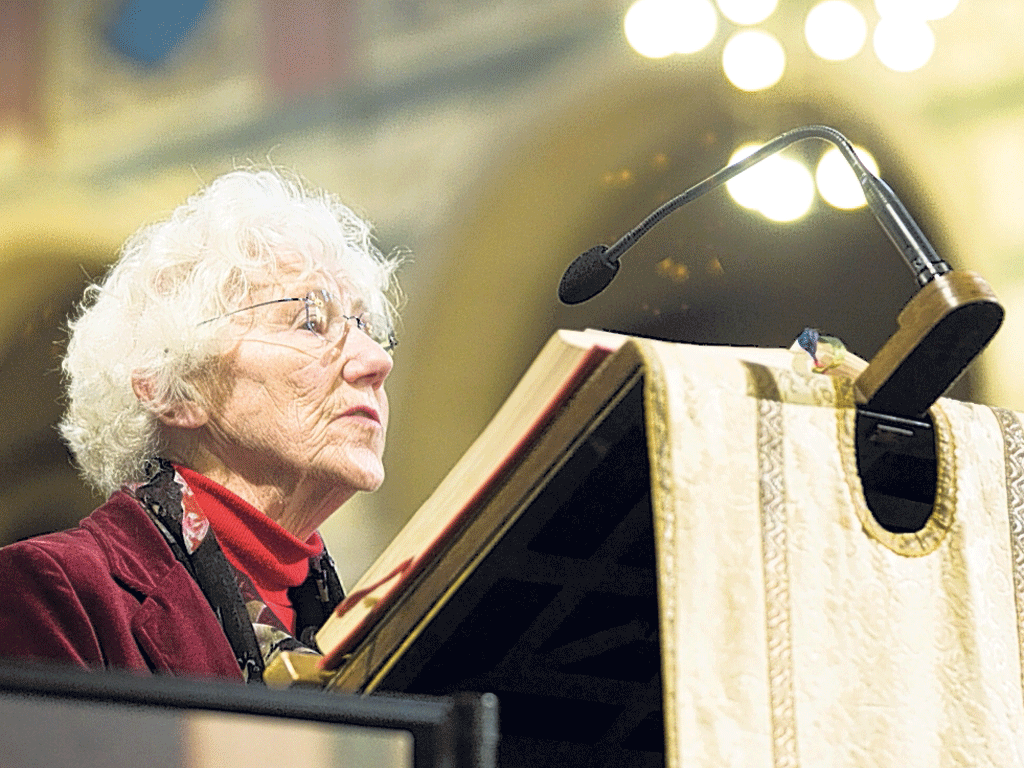
Mildred Nevile was one of the most influential members of the Catholic Church in Britain and her contribution to its development in the past 50 years was bettered by few, if any, female or male, clergy or lay. She was for decades the motive force behind the Catholic Institute for International Relations, or CIIR, which under her leadership did much to shape British and wider European attitudes towards the world's poorer countries. She hid her exceptional gifts of leadership behind an unfailing friendliness and modesty though the fact that she was a member of one of the most prominent of English families, settled in Lincolnshire since the Middle Ages, and had a diction many in the Royal Family might have envied, helped greatly her access to the highest in the land.
She was educated by a governess and did not receive a university education till her later life. She joined the Sword of the Spirit, the predecessor of CIIR, part-time in 1958. The Sword of the Spirit had been founded in 1940 by Cardinal Hinsley, Archbishop of Westminster, at a time when Hitler and Mussolini enjoyed some support among misguided leaders of the Catholic Church in continental Europe. Hinsley declared uncompromisingly that Britain had "taken up arms in the cause of justice and freedom." Before the Vatican short-sightedly moved to curb its ecumenical impulses, the new organisation attracted the support of Cosmo Lang, the Archbishop of Canterbury, Bishop Bell of Chichester and many other British churchmen.
In 1950 Cardinal Griffin, Hinsley's successor, relaunched "the Sword" as a body seeking to establish a just social order in Europe. By 1958 it was working with the United Nations Association and the Council for Education in World Citizenship in spreading knowledge of world affairs in general and in schools in particular.Nevile, a member of the Legion of Mary, had been active in welcoming and befriending foreign Catholic students in London, and took on that work and the promotion of the idea of young people volunteering for a period of work in poorer countries.
In January 1967 she took over as secretary general of a body which had two years earlier changed its name to something less martial. She proposed leaving its earlier concerns, such as disarmament, the Cold War in Europe and racism, to more specialised bodies and concentrating CIIR's effort on problems of world poverty and development.
Recalling her visit to the Far East in 1973 she wrote, "What the Vietnamese wanted and needed was solidarity: justice, not charity. I became aware that aid without solidarity can be very untruthful: destructive to the giver and probably to the receiver too".
The Institute operated in genteel poverty from Cambridge Terrace in Regents Park in a house leased to the Institute by landlords who wanted to keep out squatters. Nevile's successor Ian Linden recalled that when the boilers failed in really cold weather "staff would work in overcoats and try to type in gloves before in mid-winter finally retreating home". Despite such hardships, the atmosphere at CIIR was always one of unstuffy, cheerful optimism.
Under Nevile's leadership, with the resources of the Education Committee, of which I was a member, and the help of staff members such as Tim Sheehy and Julian Filochowski, CIIR was a very effective lobbying group on world poverty and launched a succession of expertly argued and powerfully presented pamphlets and comments on international topics of the day. CIIR's position of being a Catholic body, yet not an organisation controlled by or acting as a mouthpiece of the Catholic hierarchy, was a powerful one.
At the same time the Institute developed a programme to send British volunteers to developing countries, selecting them carefully and giving them expert back-up from London. CIIR concentrated its earliest attention on Latin America.
In 1978 the Institute published an English translation of a critique of the strategies of the Brazilian military dictatorship entitled São Paulo: Growth and Poverty, originally prepared for Cardinal Arns, the city's archbishop, by CEBRAP, the research institute to which Fernando Henrique Cardoso, later President of Brazil, was associated. It proudly carried on its front cover the condemnation of a notorious police chief and torturer: "I read this book every day in order to get angry." In 1977 and 1978 it persuaded the British government to halt a planned grant to the Bolivian tin mines because of the miners' atrocious working conditions and cancel sales of arms to the military regime in El Salvador.
Interest in Africa, particularly Southern Africa, suffering from Portuguese colonialism, apartheid and the racist policies of Ian Smith, also developed fast. Its publications on Rhodesia, prepared in collaboration with the International Commission of Jurists and the Rhodesian Catholic Commission for Justice and Peace, were banned by the Smith regime. CIIR was a discreet but important conduit for European, and notably Swedish, funds for the forces fighting apartheid.
Under Nevile's guidance CIIR (today known as Progressio) became a repository of expertise for a number of leading development agencies. She quit the Institute in 1985 at 59, having decided to leave herself time towards the end of her working life to take up other causes, including being a spiritual councillor, a role in which she was much in demand. She took a degree at Leeds University and was later awarded a Lambeth degree by the Church of England in recognition of her devoted work for ecumenism. She led Christian Concern for Southern Africa, in which British churches came together to oppose apartheid.
As Thatcherism began to take its toll of the poor and homeless in the late 1980s she threw herself into defending their causes, bringing various Christian initiatives for better housing policy in the Churches' National Housing Coalition. "She had a tremendous gift for getting the best out of people, particularly the young," remarked Robina Rafferty who worked with her on housing matters, "Whenever you worked with her you shared her sense of fun"
As she moved into her seventies she turned her attention to refugees, visiting many who had been deprived of their liberty as they sought asylum in Britain, and taking more than one temporarily into her own house. She was made an MBE, a recognition which clearly did not reflect her influence and the importance of her achievements. At the end of her days with cancer of the oesophagus she spent time at St Joseph's Hospice in Hackney.
Mildred Nevile, activist and campaigner: born 2 July 1927; MBE 1985 died 2 September 2012.
Join our commenting forum
Join thought-provoking conversations, follow other Independent readers and see their replies
Comments