Monty Sunshine: Clarinettist in the vanguard of the trad-jazz boom of the 1950s and early 1960s
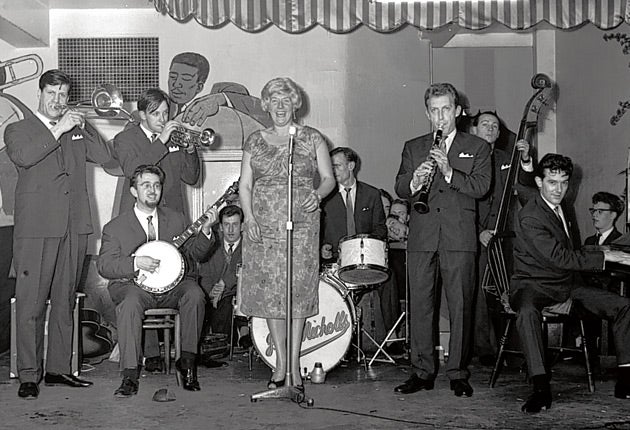
Monty Sunshine, the clarinettist on the million-selling "Petite Fleur", was at the forefront of the traditional jazz boom in the late 1950s and early 1960s. He had a delightful stage presence and remained modest. "How can any jazz musician get conceited?" he once asked me, "He only has to put on the records of the great masters to wake up to his true status."
Monty Sunshine's great-great-grandparents had come to England from Romania and had anglicised their surname to Sunshine. Monty Sunshine was born in Stepney on 9 April 1928; his father was a tailor who also played the violin. During the war, he was evacuated to Northampton and he later studied at the Camberwell School of Art. He heard Wally Fawkes playing jazz at the art school and switched his own allegiance from flute to clarinet. Sunshine was in the RAF from 1946 to 1950 and played in the Eager Beavers, a jazz band at RAF Wroughton.
Ken Colyer, a trumpeter and a zealot for early New Orleans jazz, formed the Crane River Jazz Band in 1949 and Sunshine joined them on his discharge. The band had a residency at the White Hart pub in Cranford and charged a shilling (5p) for admission. A review in Jazz Journal in December 1950 was condescending: "Before New Orleans music can be played, a complete relaxation and unself-consciousness, not normally an attribute of the white man, must be attained. All this may take 20 years, or a lifetime, but the boys are still hoping."
Colyer signed up as a merchant seaman in 1952, solely to abscond to New Orleans. He was arrested for working without a permit and jailed for a month. When he returned, he found that Sunshine was part of Chris Barber's Jazz Band. Barber had been trying to persuade a research chemist and trumpeter, Pat Halcox, to go professional, but without success. It looked like an ideal band for Colyer to join, but with his dominant personality, it became Ken Colyer's Jazz Band. At first, the band had a residency at Bert Wilcox's London Jazz Club at Marble Arch. This was in the crypt and the commissioners decided that jazz was inappropriate for a sacred building. They had success with the Decca album, New Orleans To London, which included a popular single, "Isle Of Capri".
Colyer had a fierce integrity, only being interested in early New Orleans music and loathing the band's banjo player, Lonnie Donegan, who deliberately provoked him. After many arguments, the rest of the band left Colyer, and as Chris Barber's Jazz Band, they welcomed Pat Halcox.
The band toured in a 1934 Humber Shooting Brake with the bass on top. If it rained, the water would come through the floorboards, and the venues were little better as few jazz bands played dance halls. Their potential was appreciated when they played the Royal Festival Hall in 1954, however. The critics attended following a rumour that Princess Margaret would be there. She didn't arrive but the band received excellent reviews, especially Sunshine.
In 1956, a track from one of Barber's albums became an international hit, "Rock Island Line", which led to Lonnie Donegan leaving the band. Chris Barber said, "Our band was a co-operative and he had the cheek to ask us for more money. I said, 'Lonnie, skiffle is bringing in the money now, but next time it might be clarinet solos – ha, ha.' Next thing I know, 'Petite Fleur'." Donegan prospered as a solo performer while the Barber band held on to its audience.
On holiday in Spain, Sunshine had heard an accordionist playing "Petite Fleur". He discovered it was a Sidney Bechet tune, recorded in 1952. When Barber suggested a clarinet solo for Chris Barber Plays, Volume 3 (1957), Sunshine recorded "Petite Fleur" in a small group with Dickie Bishop (on guitar, though it sounds like a zither), Dick Smith (bass) and Ron Bowden (drums). According to Barber, "Monty's turntable was going a little fast so he learnt it in A flat minor rather than G minor."
The Chris Barber Band was especially popular in Hamburg, which his fans renamed "Freie Und Barber-Stadt (Free Barber-Town)" instead of "Freie Und Hansestadt (Free Trade Town)". When "Petite Fleur" was issued as a single in Germany, it went to No 2, encouraging Pye Records to release it in the UK. It climbed to No 3 and then became a Top 5 record in America.
The band appeared on The Ed Sullivan Show and back home, they received a gold disc from Hughie Green. They had a Top 30 entry when Sunshine featured another Bechet composition, "Lonesome (Si Tu Vois Ma Mère)". Bechet, who was dying of cancer, sent Sunshine a photograph, which was signed, "To Monty, who put Petite Fleur in the Sunshine."
Barber's performance also featured Muddy Waters' blues music. Sunshine was unimpressed though, and said they were sounding like "a bad imitation of the Shadows".
As a result, Sunshine was sacked and replaced by Ian Wheeler. Undeterred, he formed his own band and worked with such stalwarts as Johnny Parker and Diz Disley. He had another shot at the "Petite Fleur" market with "Jacqueline" (1961). His version of "Creole Love Call" (1962) with multi-tracked clarinet was described by The Gramophone as "a trifle coarse maybe, but good enough for Trad fans."
Meanwhile, the Trad fans had turned to Acker Bilk. He had noticed the marketability of sweet-sounding clarinet records and, far more astutely than Sunshine, he built on the success of "Petite Fleur".
Still, Sunshine toured regularly, either as a guest artist or with his own band, sometimes using Beryl Bryden and George Melly as guest vocalists. His 1963, album, Monty Sunshine And His Band, emulated Benny Goodman and his Orchestra.
In 1972, he played with a reunion of the Crane River Jazz Band and from 1975, took part in reunions with Chris Barber. In 1987, he and Lonnie Donegan formed Donegan's Dancing Sushine Band.
Sunshine's name was a gift for album titles which included A Taste Of Sunshine (1976), Sunshine In London (1979), Sunshine On Sunday (1987) and by way of a change, Live At The Workers' Museum, Copenhagen (1997).
If Sunshine's health had held out, he might have found success as an elder statesman in this Jamie Cullum era. He said, "I've had youngsters tell me that they want to play the clarinet like me. I tell them not to aim so low."
Monty Sunshine, clarinettist: born London 9 April 1928: died 30 November 2010.
Join our commenting forum
Join thought-provoking conversations, follow other Independent readers and see their replies
Comments