Nawang Gombu: Mountain guide who became the first man to climb Everest twice
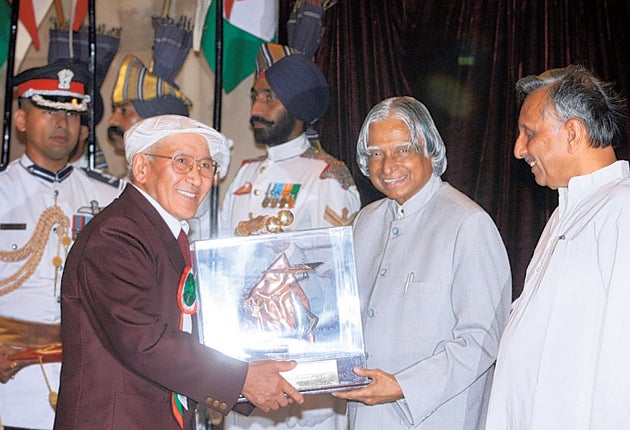
Nawang Gombu Sherpa was the youngest member of the 1953 expedition which made the first ascent of Mount Everest. He later reached the summit himself and subsequently became the first person to climb Everest twice. His entrée to the comparatively lucrative world of high altitude mountaineering was made possible by his uncle, Tenzing Norgay, who reached the summit in 1953 with Edmund Hillary.
Gombu's family came originally from the Karta valley, a few miles to the east of Everest, in Tibet, where his grandfather owned a substantial herd of yaks. In the early 1930s the yaks were lost, reducing the family to serfdom. Tenzing's elder sister, Lhamu Kipa, was working as a servant girl in the village of Tsawa when she fell in love with her employer's son, a young monk called Nawang. The couple married and in 1936 Lhamu Kipa gave birth to Nawang Gombu.
It may have been the disgrace of a landowner's son marrying a serf which prompted the family to migrate in 1939 across the Nepalese border to Sola Khumbu, the homeland of the Sherpas. However, during the 1940s they returned to Tibet and enrolled Gombu to study at Rongbuk, the world's highest monastery, at the foot of Everest's north face. Tenzing later recalled meeting the family here in 1947.
From the abbot, Trulshik Rinpoche (also a distant relative) young Gombu heard about the English climber George Mallory, who had disappeared high on Everest in 1924; he was also told by some of his fellow monks that there was a golden calf on the summit – the only reasonable motivation they could find to explain the Englishmen's incomprehensible attempts to climb the mountain.
In the absence of lay schools, Rongbuk gave Gombu an education; but he was a reluctant novitiate who decided that the Buddhist monastic life was not for him. He ran away and recrossed the frontier to Sola Khumbu and it was here, in the market village of Namche Bazaar, in the autumn of 1952, that he again met his uncle, Tenzing Norgay, returning from the second unsuccessful Swiss attempt that year to climb Everest.
By now Tenzing's mountaineering experience and international contacts had made him a prestigious figure in the Sherpa community. He had already been asked to act as sirdar – head Sherpa – for the British attempt on Everest planned for the next spring and he would be deciding who got which jobs. Gombu begged to be included and was promised a place on the team, with the warning that it would be very hard work.
So, at the age of 17, Gombu became the youngest employee of the 1953 British Everest Expedition. Even by Sherpa standards he was short; he was also quite plump. One of the British team members, Wilfrid Noyce, commented that Gombu was the only Sherpa he had ever met who asked a sahib to go more slowly. It should be pointed out that Noyce was phenomenally fit, and that Gombu soon got into his high-altitude stride, endearing himself to the team. The leader, John Hunt, noted how "little Gombu was smiling and cherubic, like an overgrown schoolboy ... always seeking helpful jobs to perform." And when the big day came to lift 17 loads of food, fuel, tents and oxygen to the South Col for the final summit attempt, Gombu was one of the Sherpas chosen for this vital job.
A few days later his uncle reached the summit with Edmund Hillary, earning international fame not only for himself but to some extent for his whole Sherpa people, whose traditional trading activities had been curtailed by the recent Chinese invasion of Tibet. For a young Sherpa like Nawang Gombu, who had now proved himself at high altitude, a career in expeditions was a potentially lucrative, if dangerous, alternative to subsistence farming. In 1954 he was one of four Sherpas chosen to accompany Tenzing to Switzerland for alpine training with Arnold Glatthard at Rosenlaui, in the Bernese Oberland. That year he also attempted the world's fifth highest mountain, Makalu, with an American expedition. Then in 1955 he had his first big success, making the first ascent, with an Indian expedition, of the 7,518m Saser Kangri, in the glacial region of northern Ladakh later disputed so rancorously between India and Pakistan.
In 1960 he returned to Everest on the first Indian attempt, getting to within 100 tantalising metres of the summit. Then in 1963 Uncle Tenzing wrote to James Ramsay Ullman, the author commissioned to cover the first American Everest expedition, recommending Gombu as sirdar. Gombu got the job and 30 April that year found the 5ft Sherpa back on the summit ridge, above the South Col, sharing a tent with the 6ft 4in American climber Jim Whittaker. The following day, at 1pm, the two men planted the Stars and Stripes on the summit.
Success with the Americans widened Gombu's horizons. He was welcomed with the team at the White House by President Kennedy and received the Hubbard Medal of the National Geographic Society, to wear alongside his earlier Queen Elizabeth II Coronation Medal. Later, from 1973-93, Jim Whittaker invited him to spend summers working with his guiding company on Mount Rainier, Washington. Back in Asia he had made his permanent home in Darjeeling and become Director of Field Training at the Himalayan Mountaineering Institute, operating in Sikkim on the flanks of Kangchenjunga.
In 1964 he reached the summit of Nanda Devi, the highest mountain wholly in India, and the source of the Ganges. The following year he returned to Everest with the first Indian expedition to climb the mountain. This time the top camp was placed astonishingly high, just 350 metres below the summit, enabling Gombu and Capt AS Cheema to reach the top at 9.30am. Gombu had become the first person to climb Everest twice.
His first wife, Dawa Phuti, died in 1957, while giving birth to his eldest daughter, Rita. He later married Sita Gombu, with whom he had a son and two daughters; one of them, Yangdu, now runs her own mountain trekking business based in Delhi. Gombu continued to climb well beyond middle age, making his last big expedition in 1989 to Kangchenjunga. The following year, when I met him for the first time, leading a party of schoolgirls through the foothills of Sikkim, his laughter rang through the rhododendron forest.
His sheer good nature and beaming smile endeared him to a wide international circle of friends and he remained particularly close to his American companions. Tom Hornbein, a fellow member of the 1963 Everest expedition, recalls "a kind of inner glow: just being in his presence, both in '63 and more recently on a visit to his home in Darjeeling, was a bit like standing by a stove and warming your soul; the heat being emitted was a vitality and joy and unabashed caring and kindness."
Stephen Venables
Nawang Gombu, sherpa: born 1936; married firstly Dawa Phuti (died 1957; one daughter), secondly Sita (one son, two daughters); died 24 April 2011.
Join our commenting forum
Join thought-provoking conversations, follow other Independent readers and see their replies
Comments