Nicol Williamson: Mercurial and brilliant actor whose career was undermined by his flaws
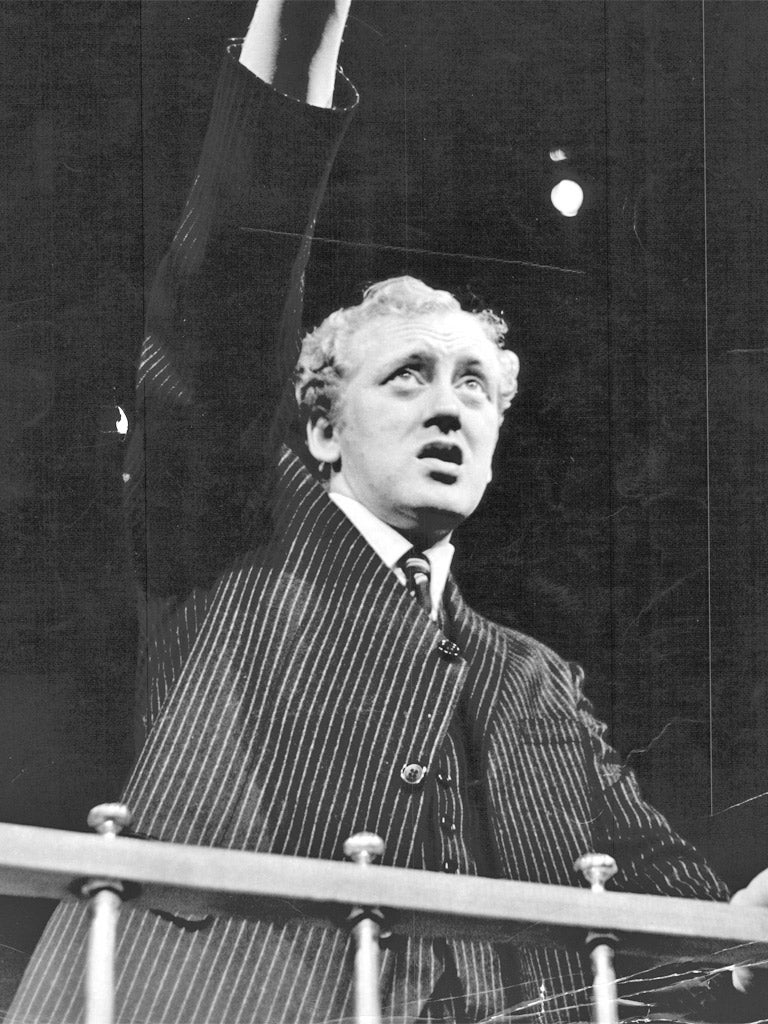
Nicol Williamson was the notorious bad boy of the theatre, his unpredictable behaviour, unreliability and blunt rudeness to those he did not respect – which may well have been the majority of those he met in and out of the theatre world – having to be weighed by the theatres that employed him for his undoubted brilliance as an actor, and a star appeal that never fully flowered because of the reluctance of film producers and theatrical impresarios to engage him. Twin devils seemed to co-exist in his lanky body, one that drove his private life to frequent excess and public exhibitionism, and the other in which a creative genius seemed to be about to explode. He was quintessentially a model for the 19th century decadent romantic, a Byron, a des Esseintes or a Rimbaud. As an actor he could be electric: John Osborne declared him to be "the greatest actor since Marlon Brando".
He was born and brought up in Hamilton outside Glasgow; it is difficult to imagine him as a boy in that quiet little town where the main cultural event of the year is the Salvation Army's Christmas carol concert. He started his career at the Dundee Rep in 1960, stayed there two years, then went to the Arts Theatre in Cambridge and transferred to the Royal Court from there with That's Us, staying on with the English Stage Company in a number of demanding roles. They included Jacobean and period drama and modern plays, the most successful of which was Osborne's Inadmissible Evidence, a palpable hit that transferred to the West End and had several later revivals, about a complex London barrister, but he was also well cast as Sebastian Dangerfield in The Ginger Man.
One of his greatest performances was as Vladimir in the 1964 revival of Waiting for Godot. Anthony Page, Nicol's preferred director, was in charge, but Beckett turned up at rehearsals and was unhappy about the way the production was progressing, the actor retaining his London barrister's accent for the author's reflective tramp. "Where do you come from? Is that your natural voice?" asked Beckett, and when told that Nicol was Scottish, asked if he could not use his natural non-London intonation. That evening Beckett looked pleased, more so as the days passed, and he commented, "There's a touch of genius there!" The opening night was a triumph, the audience electrified by his trumpeted scream of "I can't go on!" at the climax of the great final monologue.
From then Beckett was Williamson's God. When I invited him in 1965 to take part in a Beckett reading at the Shakespeare Memorial Theatre in Stratford on a Sunday night, he insisted on Beckett's personal direction, and we visited him at Ussy on the Sunday before. We had launched the previous day and Nicol's single-minded enthusiasm was such that he cancelled both his Saturday performances of Inadmissible Evidence, then playing at Wyndham's, next door to our restaurant, and sent on his understudy – who also had to play the whole week following, because Williamson, having returned from the rehearsal in France on the Monday, then disappeared for the whole week.
But the day before the Sundayperformance at Stratford, when I had made emergency changes in the programme, he appeared at my flat to rehearse, and took the audience by storm the next day, throwing the other readers into confusion by his innovations. Patrick Magee said that he would never again appear on the same stage as an actor so selfish.
With the RSC he performed Arden of Faversham at the New Arts Theatre and played Sweeney in the TS Eliot memorial production of Sweeney Agonistes. He became a charismatic actor in films as well, but his appearances, especially in commercial productions, became rarer because his temperament and arrogance did not appeal to directors.
His marriage to the actress Jill Townsend was of short duration, and problems rising from his divorce, his messy private life and his mounting debt to the Inland Revenue forced him to move to New York, where he quickly blotted his copybook by knocking down David Merrick, the most powerful man on Broadway at the time. There he repeated some of his British successes and performed in roles that included Hamlet and Macbeth, but always for short runs.
He was cast as the ghost of John Barrymore, appearing to help a young actor play Hamlet, commented voluably to the press on the weakness of the play and others in the cast, and at an early performance actually stabbed the other actor during a fencing episode. He strode to the footlights and announced, "Something's gone wrong. You'd better bring down the curtain." Most thought it was part of the play. The second act started after more than an hour's interval with an understudy, and Williamson playing normally, but the actors had summoned Equity and the play closed a few nights later.
Williamson's career was peppered with such incidents. He had a good natural tenor voice and could mimic any crooner perfectly, and if he heard an accent he could imitate it; years later he could still do Beckett's voice perfectly. He devised a number of one-man shows, songs, patter and extracts from plays and other literature, but, in spite of brilliant moments, they were not successful, and while he could excite an audience, he had little critical judgement in choosing and interpreting a text without outside help.
His films included: Inadmissible Evidence (1967), The Bofors Gun (1968), The Seven Per Cent Solution (1975), The Human Factor (1979), Excalibur (1980) – the film for which he is probably best known, as Merlin – Black Widow (1986) and several others of varying quality, including The Exorcist III. Other plays in which he appeared include The Entertainer (1983), The Lark (1983) and The Real Thing (1985).
In person he was entertaining but often embarrassing company, carrying role-playing to extremes and needing to dominate every assembly at which he was present, especially in his manic moods. When depressive he was pitiable and usually stayed on his own. But whoever saw his Vladimir and heard that despairing scream, embodying the whole anguish of the human condition, which is then followed by a resumption of the human need to regain a vestige of dignity, will never forget it. Metaphorically it also encompassed his life.
Although Williamson's death was only announced yesterday, his son Luke said that he had died on 16 December of oesophageal cancer.
John Calder
Nicol Williamson, actor: born Hamilton, Scotland 14 September 1938; married 1971 Jill Townsend (divorced 1977; one son); died Amsterdam 16 December 2011.
Join our commenting forum
Join thought-provoking conversations, follow other Independent readers and see their replies
Comments
Bookmark popover
Removed from bookmarks