Norman Ramsey: Physicist whose work led to the atomic clock and the MRI scanner
It is 1945: a young man signs a large stubby, white cylinder. Not long afterwards, the cylinder explodes in mid-air, incinerating in a split second 40,000people in the Japanese city of Nagasaki. Fast forward to the present day: a hospital patient lies with their head in a white cylindrical tunnel, and the very processes of their thoughts are illuminated in reds and blues and greens on a computer screen.
The signing-off of an atomic bomb and an MRI scanner: two images from the life of Norman Ramsey, one of the overlooked greats of 20th century physics. Although he worked at Los Alamos in New Mexico on an instrument of death (which, in shortening the war, may have saved more lives than it snuffed out), the techniques he developed also helped make possible a medical instrument of life.
To understand the scientific contribution of Ramsey, winner of the 1989 Nobel Prize for Physics, it is necessary to know something about atoms and light. An atom or molecule has a number of "energy levels", each corresponding to a different arrangement of its constituents – its orbiting electrons, for instance. Think of them as the rungs of a ladder. When an atom drops from one energy rung to a lower one, it spits out light with an energy equal to the energy difference between the rungs. Conversely, when an atom absorbs light of precisely the energy difference between any two rungs, it jumps from the lower to the higher rung.
Oh, and there are two other things it is necessary to know. One, the energy of light is synonymous with its "frequency", with sluggishly oscillating light carrying little energy and rapidly vibrating light a lot. Secondly, those frequencies/energy differences are amazingly, mind-bogglingly, constant for all atoms of a particular element. This led people to realise early on that the oscillating light emitted by atoms could make a timing device of unprecedented accuracy – an "atomic clock".
Here's the idea. Take a bunch of atoms – say, of caesium. Illuminate them with light whose frequency is changed in steps until the atoms jump from one energy rung to the next. Detect when this happens and, via electronics, use the information to change the frequency of the incident light. After repeating this "feedback" process many times, the frequency of the light will eventually become "tuned" to the exact vibration of the atomic transition – the super-precise "ticking" clock of an atom.
The problem was that atoms (and molecules) are complex. Their internal constituents jiggle about in response to the environment, in effect causing the rungs of the energy ladder to jiggle and the frequency of light the atoms emit to vary. In 1949, Ramsey overcame this show-stopper for a precise atomic clock by a clever technique. He hit the atoms with a short pulse of microwaves – a type of invisible "light". This put them in a special state known as "superposition", in which they effectively hovered between two energy rungs. Then, after waiting for a period longer than the pulse time, he hit the atoms with another microwave pulse. Crucially, during this intermediate period, the atoms were immune to some of the environmental jiggling effects.
In 1955, using Ramsey's technique, Louis Essen and Jack Parry, working at the National Physical Laboratory (NPL) in Teddington, built the world's first atomic clock. Since 1967, the second has been defined as 9,192,631,770 oscillations of the light emitted by a particular energy transition in atoms of caesium. If you think this is esoteric, atomic clocks are used as the time standards for the GPS satellites by which your mobile phone or SatNav pinpoints your exact location on the Earth's surface.
In 1962, Ramsey went on to build a super-stable "hydrogen maser" clock, which exploited the light produced when the tiny spinning top of an electron in a hydrogen atom flipped over. With pairs of such clocks, one flown around the world on an aeroplane and one left at home, it was possible to show that the time of a moving clock was slowed up by the effect of motion and speeded up by the effect of gravity, exactly in accordance with the predictions of Einstein's theory of relativity.
As for MRI scanners, which allow the imaging of human tissue in exquisite detail, they rely on reading out the precise frequency of light coming from hydrogen atoms in water in the human body. Once again, the debt is to Ramsey's method.
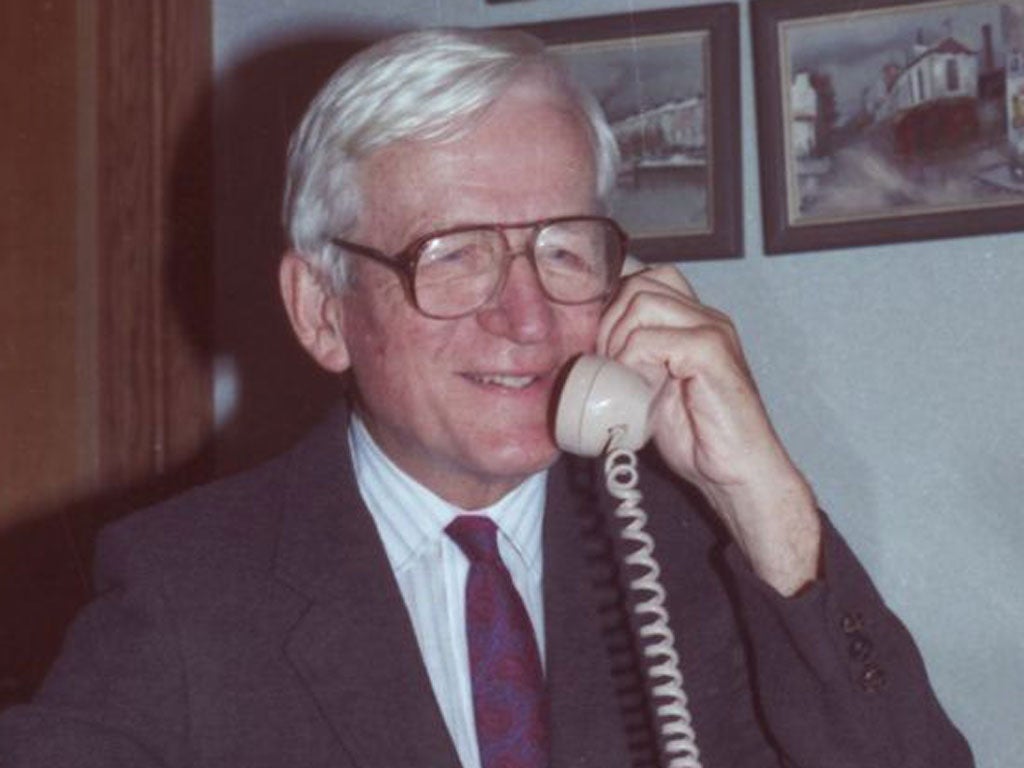
Norman Ramsey, born in Washington DC in 1915, the son of an army ordnance officer, worked with some of the giants of 20th century physics. He began studying engineering at Columbia University, soon switching to mathematics, then did a second degree, in physics, on a scholarship to Cambridge. There in the 1930s he rubbed shoulders with Lord Rutherford, discoverer of the atomic "nucleus" and JJ Thompson, discover of the electron. In the 1940s he worked on the Manhattan Project to build an atomic bomb with J Robert Oppenheimer and Richard Feynman. And he kept working, with energy and enthusiasm, until a great age, teaching at Harvard for 40 years.
Patrick Gill, an atomic clock expert at NPL, remembers Ramsey, in hismid-80s, coming to a week-longconference Gill organised at the University of St Andrews. "He'd already spent a week driving around Scotland with his wife – and there wasn't a single talk he missed," Gill says. "There is no doubt he was one of the greats of 20th century physics – the father of the atomic clock."
Norman Foster Ramsey, Jr, physicist: born Washington DC 27 August 1915; Nobel Prize for Physics 1989; married firstly Elinor (died 1983; four daughters), secondly Ellie; died 4 November 2011.
Join our commenting forum
Join thought-provoking conversations, follow other Independent readers and see their replies
Comments
Bookmark popover
Removed from bookmarks