Oleg Yankovsky: Actor revered in Russia and best known in the West for his work with Andrei Tarkovsky
One of Russia's most popular screen actors, Oleg Yankovsky even attracted the tag of sex symbol, though his serious-minded approach meant that he dismissed the appellation and was always careful to distinguish between "most popular" and "best".
With the family's roots in Poland, Yankovsky's grandmother was a childhood friend of Lenin, and his father a Soviet army officer. Nevertheless, his parents – friends of the purged Marshal Tukhachevsky - suffered under Stalin, and in the late 1930s, despite his mother burning many papers, they were deported to Kazakhstan. His father was later arrested and died in the Gulag. Even as a child, Yankovsky understood that some books were to be read "under the blankets".
It was only after Stalin's death that the family were allowed to move and in 1957 Oleg's older brother Rostislav, an actor, went to Minsk. Back in Saratov, Oleg intended to become a dentist but a casual visit to the local drama school where his brother had studied changed his mind. After marrying fellow student Ludmilla Zorina, he graduated in 1965 with an appearance in The Three Sisters before joining the Saratov Drama Theatre.
Yankovsky got his break in cinema when the company was touring Ukraine. In a restaurant, director Vladimir Basov saw his "typically Aryan looks" and cast him as a German in the epic wartime spy film The Shield and the Sword (Shchit i mech, 1968). Those refined features led to frequent casting as aristocrats or intellectuals: he was once described as "one of the few people in Russia who does not have to learn how to wear a tuxedo".
But he often brought an underlay of pain to his roles. A single glance into the camera is enough to reveal how his character has been changed by war in Two Comrades Were Serving (Sluzhili Dva Tovarishcha, 1968), while he felt one of his greatest role was the misunderstood innocent, Prince Myshkin in a 1972 staging of Dostoyevsky's The Idiot.
Yankovsky continued to enjoy the energy of a live audience and in 1973 Mark Zakharov invited him to join the Lenin Komsomol Theatre in Moscow. They worked together many times both on stage and television, including Yankovsky playing Jonathan Swift and, in an adaptation of Yevgeny Schwartz's wartime play To Kill a Dragon (Ubit Drakona, 1988), an ambiguously allegorical reptile. In 1979, despite his family's experiences, he played Lenin sympathetically in a stage adaptation of Shatrov's Blue Horses on Red Grass. Conversely he refused to play Stalin, feeling unable to bring any compassion to the role.
Several of his roles looked at love and infidelity: the tortured cuckold Pozdnyshev in Kreutzer Sonata (1987), and Viktor Komrovsky, Lara's lover in a TV Dr Zhivago (2006). In The Lover (Lyubovnik, 2002) a widower discovers that his young wife had been having an affair for 15 years, with the knowledge of her family, and that their son may not be his. His penultimate role was as Karenin in a television adaptation of Anna Karenina (2009). Such roles may have contributed to a reputation as a sex symbol but he was insulted by the term, seeing acting as being as serious as any other profession.
Another major influence was Andrei Tarkovksy, though they made only two films together, The Mirror (Zerkalo, 1975) and Nostalgia (Nostalghia, 1983). In the first, a multi-layered oneiric autobiography, Yankovsky played a loose depiction of the hero's father, the poet Arseny Tarkovsky, whose verses are heard on the soundtrack. The complex layering included casting various members of Tarkovsky's family and, as one of the children, Yankovsky's son Philip.
After this Yankovsky hoped to play Hamlet in Tarkovsky's staging but another actor was cast, causing a rift, healed by the offer of the lead in Nostalgia. A poet travels to Italy to research an 18th century Russian composer but, missing Russia and his wife, he is tempted by his voluptuous female translator. In a typically Tarkovskian scene of self-imposed suffering, Yankovsky's intensity embodies the director's idea that "one action can be experienced as if it is your whole life", allowing the film to end with a mysterious but ambiguous resolution of Italy and Russia.
Though these films gave Yankovsky a higher international profile, his few western films are not among his best. In Assassin of the Tsar (1991) he played a psychiatrist who is a look-alike of Nicholas II treating a man who thinks himself the regicide. Mute Witness (1994) is a thriller set in a Russian film studio, while Sally Potter's transatlantic gypsy melodrama The Man Who Cried (2000) divided critics.
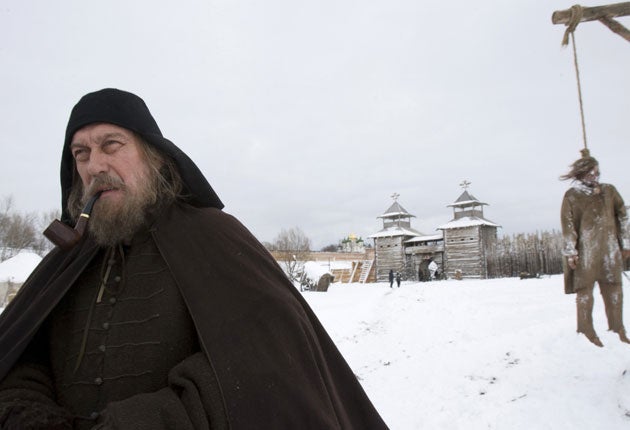
At home, he became President of the Sochi Film Festival and made his only foray into directing with Come to Look at Me (Prikhodi na Menya Posmotret, 2000) about a lonely woman's search for a partner. His final role, in Tsar, to be released next year, was as Metropolitan Philip, who countered Ivan the Terrible.
Despite the family's suffering, he understood post-perestroika nostalgia for Lenin and he looked back favourably to Soviet support of culture. In post-Soviet days he supported Yeltsin openly and, less enthusiastically, Putin.
A recent retrospective appeared under the banner "That Very Yankovsky", a reference to one of his most popular roles. Directed by Zakharov in the depths of Brezhnev's stagnation, That Very Munchhausen (Tot Samyy Myunkhgauzen, 1979) is a satire about a dreamer whose extraordinary tales crash against grey reality. Amongst its many popular epigrams is the hero's observation: "Why can you not understand: Munchausen isn't famous for flying, or not flying to the moon – but for never lying." Massively popular, Yankovsky won many awards. In 1991 he was the last actor to be given the title People's Artist of the USSR, and shortly before he died he was honoured by President Medvedev
John Riley
Oleg Ivanovich Yankovsky, actor: born Jezkazgan, Kazakh SSR 23 February 1944; married Ludmilla Zorina (one son, one daughter); died Moscow 20 May 2009.
Join our commenting forum
Join thought-provoking conversations, follow other Independent readers and see their replies
Comments