Peter de Francia: Painter and teacher who railed against the British artistic establishment
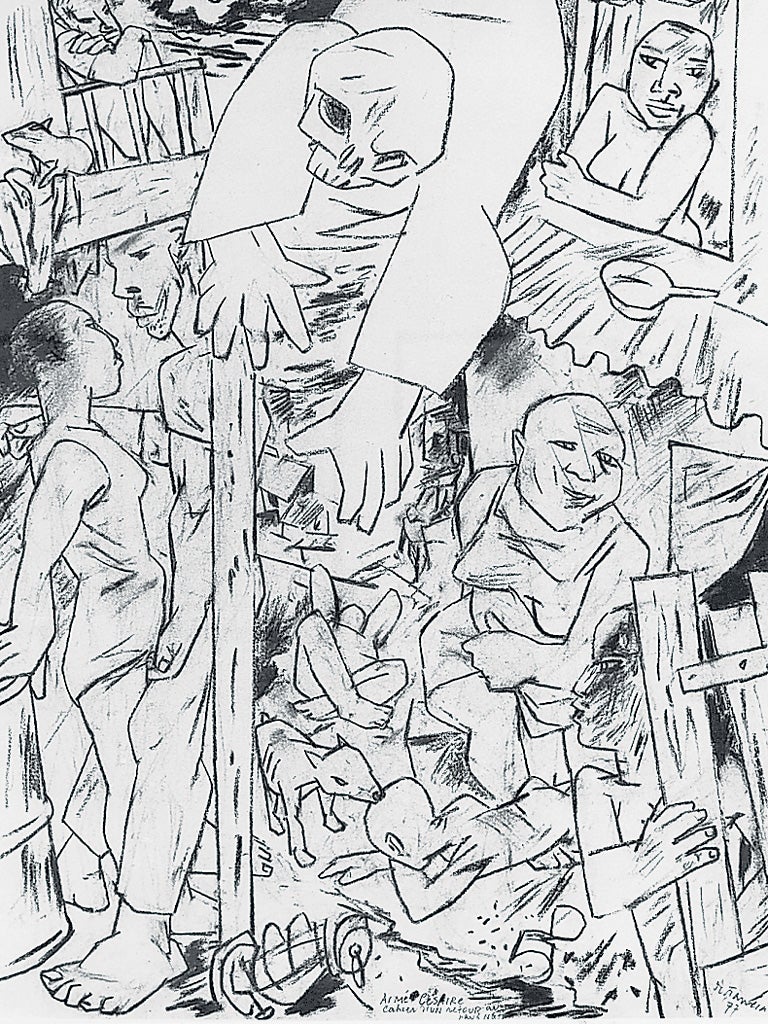
The most neglected of all the "Big Beasts" of British art, Peter de Francia, has died at 90. Will this at last trigger a re-evaluation , especially of his extraordinary Drawing-Cycles? Despite his 14 years as Professor of Painting at the RCA (1972-86) de Francia never became a household name. There is no monograph on his work, and there has never been a comprehensive retrospective, though in the past decade his art has been more visible than ever before, prominent at both Tates as well as in commercial galleries. Like so many other painters of my generation, I found in de Francia an inspiring mentor. His book on Léger, published by Yale in 1983, does convey some of his courage and generosity of spirit, but the fire and wit of his conversation are lost forever.
When de Francia arrived in England in 1940 he knew almost no one, and he would remain for more than 60 years a Displaced Person, fundamentallyopposed to all the British art establishment stood for. Brought up "mostly by servants" in Paris, he was the only child of a wealthy corporate lawyer ofGenoese descent and his English wife. He attended the Brussels Academyand, after four years in the army, the Slade, but his real education was in Italy, in the reawakening of neo-Realism and in the studio of the Communist Renato Guttuso, whose denunciatory drawings Got Mit Uns were a lifelong influence.
"The climate of discussion and debate in Italy was the only one in which I have ever felt at home," he said. "Later, when I was removed from it, or when it had become attenuated, I felt I had lost the mainspring of my existence. I have never thought so lucidly, or felt so near to reality..."
De Francia's beautiful early drawings, with their slow, rounded line, are mostly of Italian working people and modest in size, but his aspiration was always towards large-scale history-painting. He spoke of leaving Italy in 1949 as "the greatest mistake of my life"; England would never supply his subject matter. In drab London he eked out an existence as an art history lecturer at St Martins, and eventually at the RCA, but he was really an internal exile whose imaginative life was elsewhere. He read Le Monde in preference to any English newspaper; he dressed as a French railwayman in blue cotton; much of his best work was made in the village of Lacoste, where he'd acquired, for £50 in 1957, a stone-built house, his base for almost every subsequent summer.
De Francia never joined the British Communist Party: "I belonged to a generation who could not but be suspicious of the Soviets, yet I was immensely drawn to the ambitions of the Soviet Revolution. I have had to live with that contradiction, and still do." He shared a house in Hampstead with John Berger, attended the meetings of the Geneva Club, contributed to the first number of Universities and Left Review. But it was an atrocity in the Algerian War that gave him his "missing theme", and in 1959 his 12ft The Bombing of Sakiet was exhibited at Waddingtons.
Recently restored by the Tate, it does shine out as perhaps the most convincing "protest-picture" of its era. But de Francia didn't show again in London for 17 wilderness years, in which his art greatly altered. He had met both Beckmann and Grosz in New York in 1950, while his identification with the late figure compositions of Léger was evident in his impassioned essay on The Great Parade, published in the RCA's "Painters on Painting" series in 1969. Those three artists all pointed towards linearity, and it was in large-scale complex charcoal drawings, rather than paintings, that de Francia now found his mature expression. He loved charcoal for "the wonderful way you can go between tone and line. If I was shut up for the rest of my life with a room full of charcoal, and two rooms full of paper, I'd be perfectly happy".
These drawings can be divided between the satirical Disparates, emblems of human folly and absurdity (in the tradition of Bosch and Goya) and some more tender and affirmative vein, Arcadian distillations of peace and freedom. In one beautiful sequence of 1976, his elderly neighbours, the Beylacs, gnarled among their olive trees, become symbolic types, "the last vestiges of a totally vanished society".
RB Kitaj had admired de Francia and his work since his student days and now selected six drawings for an Arts Council exhibition, "The Human Clay", which came to the Hayward Gallery. A further group at the New Art Centre a few weeks later, marked out his special territory – each drawing a kind of abbreviated, and half-mocking, History-Painting. My own favourite of all his works are the Drawings to Césaire, two of which were purchased by the Museum of Modern Art, New York. In later cycles , often with a horizontal format , he assembles burlesque deities reminiscent of his beloved Daumier . ("He is my Father", de Francia once declared to me, his voice choked with emotion.) The Minotaur, that dangerous , touching, disruptive bull-man at the heart of the Labyrinth , is an unmistakable self –mythicisation.
A strikingly handsome figure who loved the company of intelligent women, de Francia resisted domesticity, happy to live alone among his books and pictures in his comfortless rented Georgian house off the Old Kent Road. But he did have a long-standing consort in Joanna Drew, as well as a very distinguished range of faithful old friends and ex-students of all nations, keen to serve him. His temper was legendary, he could be confrontational and abusive (private views were seen as opportunities to deal out punishment to the excommunicated) but he commanded great affection. In his final years, housebound by diabetes and incipient blindness, he was enormously helped by Alix MacSweeney; they married in 2004.
Peter de Francia, artist, writer and teacher: born Beaulieu, France 25 January 1921; married firstly and secondly (marriages dissolved), 2004 Alix MacSweeney; died London 19 January 2012.
Join our commenting forum
Join thought-provoking conversations, follow other Independent readers and see their replies
Comments
Bookmark popover
Removed from bookmarks