Pina Bausch: Dancer and choreographer whose seminal work gave an unsettling view of the human condition
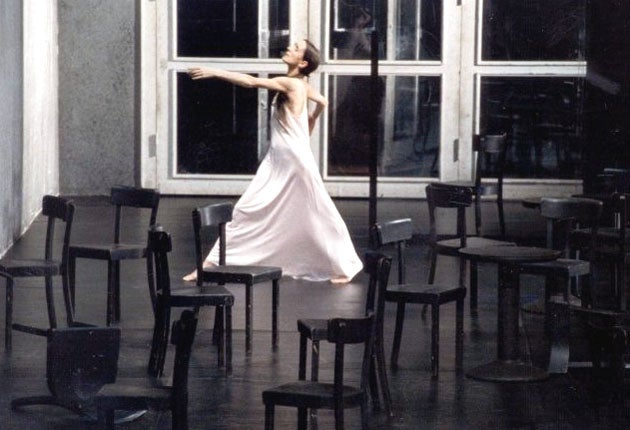
The choreographer Pina Bausch, who died on 30 June, was unquestionably the leading exponent of dance theatre in Europe; arguably the world. The infrequent London appearances of the company she headed were invariably characterised by sold-out houses and an audience of followers and practitioners of all the arts; an indication of how her admirers and her influence extended far beyond the often hermetic world of dance.
Philippine Bausch was born on 27 July 1940 in Solingen in the German state of North Rhine Westphalia, the third child of August and Anita Bausch. Her parents owned a café attached to a small hotel. The little girl learned to amuse herself sitting quietly under the café tables watching the customers or entertaining them with impromptu dances.
Early on her parents sent the child to ballet classes, where, she recalled in an interview, "I loved to dance because I was scared to speak. When I was moving I could feel".
Her talent as a dancer was evident and in 1955 she entered the Folkwang School in Essen which was then headed by the great choreographer and dancer Kurt Jooss, who had returned to Germany after wartime exile in England. This was clearly a happy time and Bausch flowered under Jooss's influence.
"He was like a papa, in a way," she said. "Very, very kind. Very, very warm with a lot of humour, very much joy for things, people. He knew so much about history, music. His school was special, with an opera department, acting, pantomime, graphic arts, photography, all together."
On graduating from the Folkwang School she was awarded a scholarship to study at the Juilliard School in New York where one of her teachers was the English choreographer Antony Tudor. As well as teaching classical ballet, Tudor also gave "production" classes, described as being akin to Method acting as taught at the Actors Studio. The dancers were exposed to guest teachers, including exponents of Japanese and East Indian dance.
Tudor also taught ballet composition classes in addition to choreographing for the students. In one piece, A choreographer comments, which was based on academic ballet steps and the idiosyncrasies of the individual students, the tall thin Bausch – her fellow student, the dancer and choreographer Paul Taylor, described her as "one of the thinnest human beings I've ever seen" – demonstrated the tiny travelling step pas de bourrée wearing high-heeled shoes and an egret feather in her headdress.
In 1962 Bausch returned to Germany and joined the newly founded Folkwang Ballet, headed by Jooss. During that time she danced the heroine Caroline in Tudor's Lilac Garden and also appeared at the Festival of Two Worlds in Spoleto with Paul Taylor's company in a duet Taylor made for her and Dan Waggoner.
She began to choreograph in 1968. Her first piece, Fragment, used music by Bartok. A second piece the following year showed enough promise for her to be appointed artistic director and choreographer of the Folkwang Ballet, in addition to continuing as a dancer. During that time the company toured Europe and America, making a London appearance as part of the English Bach Festival. The four works that Bausch choreographed contained some of the elements that would feature in her later works; singing from the dancers, brutality, terror, mourning, dreams and nightmares.
That same year, 1973, Bausch was engaged as director and choreographer of the state theatre in nearby Wuppertal. She presented her first programme the following year; a mixed bill including Jooss's best known ballet The Green Table and Rodeo, by the American Agnes de Mille. She also mounted a danced and sung version of the Gluck opera Iphigenie en Tauride.
The first seasons were difficult. Local audiences found her works unappealing, as did some of the dancers. But in 1974 she met the designer Rolf Borzik, who became her partner both personally and professionally, and with his support she began to crystallise her unique form of dance theatre.
German dance theatre grew out of that country's tradition of expressive dance. Bausch's work, especially her later pieces, could include speech, social dance, repetition, dramatic, comic or surrealist situations, nudity, cross-dressing, brutality or tenderness, all adding up to an often uncomfortably perceptive commentary on the human situation. You might be annoyed, upset or even distressed by a work by Bausch; it's unlikely that you would be bored.
The settings are extrordinary. For her Rite of Spring, premiered in 1975, the entire stage is covered in peat which clings to the dancers' sweating, semi-naked bodies. Nelken features a stage planted with the carnations of the title which are gradually trampled by the action. And Sadler's Wells had to strengthen the stage to support the tons of earth which formed 20ft high ramparts for Viktor.
In 1980 Borzik died; a considerable blow for Bausch. Later that year she produced one of her loveliest and most approachable works; 1980 – a piece by Pina Bausch. This was also the year when she met the Chilean poet and academic Ronald Kay. Their son, Rolf Salomon, was born the following year.
By now the company was touring widely and Bausch began to collaborate with theatres and festivals internationally. The company would base itself in a city while dancers and choreographer absorbed the atmosphere and looked for ideas to spark the creative process. She worked this way in Holland, Italy, Spain, the US, Hong Kong, Japan and India. The dancers were asked searching questions, required to improvise and to imagine themselves in different situations. Continuing elements are red lipstick and towering high-heeled shoes for the women, cross-dressing for men and partial or total nudity for any or everyone.
Bausch recruited a truly international company, and it is a tribute to the constant challenge of her pieces and the process of their creation that so many of her dancers remained with her for so many years. Only two of her works have ever been performed by a company other than her own. In 1997 she mounted The Rite of Spring for the Ballet of the Paris Opera, and in 2005 that same company added her 1975 production of Gluck's Orpheus and Eurydice to its repertory.
At the request of Pierre Boulez she directed a production of the Bartok opera Duke Bluebeard's Castle for the 1998 Aix Festival. She had used that work for a dance piece as long ago as 1977. In 1982 she appeared in Federico Fellini's film E la nave va. Seven years later she directed her own film, The plaint of the Empress. Performances by the company were a key element in Pedro Almodovar's Speak to Her, and at the time of her death she was preparing a film project with the director Wim Wenders.
Among the honours awarded to Bausch are the UK's Laurence Olivier Award and Japan's Kyoto Prize, while in 2008 the city of Frankfurt am Main awarded her its prestigious Goethe Prize. Her last premiere in Wuppertal took place only on 21 June. She died on 30 June, five days after being diagnosed with cancer.
Judith Cruickshank
Philippine (Pina) Bausch, dancer and choreographer, born Solingen, Germany 27 July 1940; one son; died Wuppertal, Germany 30 June 2009.
Join our commenting forum
Join thought-provoking conversations, follow other Independent readers and see their replies
Comments