Professor Dennis Green: Cambridge scholar at the forefront of German medieval studies in Britain and abroad
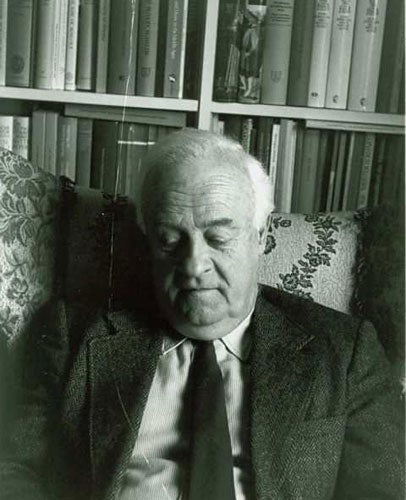
The distinguished German scholar Dennis Green was a Cambridge institution for more than half a century and an internationally recognised figure in the field of medieval language and literature.
Apart from a year at St Andrews at the outset of his career, Green was a Cambridge figure through and through, a Fellow of Trinity College for nearly 60 years and the holder of two chairs at the university. He was one of the last representatives of a Cambridge tradition, dating back to the late 19th century, in which the study of literature proceeded from philology, from language in its widest sense and manifestations. A formidable linguist (it was never quite established how many languages he spoke or read, but they included Portuguese and Romanian and he taught himself Chinese during the Second World War in order to sharpen his mind), he was at home in all the medieval languages and literatures, Germanic and Romance. His later books on irony, orality and authorship drew on this wealth of sources.
Green came up to Cambridge just before the war to read Modern Languages as a Scholar of Trinity, but he interrupted his studies to serve in the Royal Tank Regiment, rising to the rank of major and taking part in the Normandy landings. He occasionally hinted that he may also have been engaged in intelligence work (he was once arrested for speaking Dutch with a German accent). The discipline and order of military life never deserted him, and his career had elements of a planned campaign to reach the heights of his subject. In May 1945, for instance, he organised military transport to Halle to enable him to acquire a complete set of Niemeyer medieval texts in exchange for rations.
Taking a starred first, but unable to study in war-ravaged Germany, he decided to do his doctoral research in Basel with Friedrich Ranke, joining a small but select band of British Germanists with qualifications from German-speaking universities. A brief period as a lecturer in St Andrews followed and in 1949 he was elected to a Research Fellowship at Trinity, then to a university lectureship in Cambridge.
The Carolingian Lord (1965), a semantic study of forms of address for sovereign authority in Old High German, was a succès d'estime that established him firmly at the forefront of German medieval studies in Britain and abroad. It made him the frontrunner for the chair of Modern Languages at Cambridge which the university established in 1966. With this went the headship of the bizarrely named Department of Other Languages, a miscellany that included Dutch, Portuguese, Hungarian and Modern Greek. It made Green noticeable on a variety of fronts and gave him a presence not least in the Faculty of Modern and Medieval Languages as well as in his own Department of German. It strengthened his ties with various linguistic cultures which he then proceeded to defend in faculty forums with energy and tenacity.
The position also coincided nicely with the scholarly reputation that enabled him to take up numerous visiting posts, in Europe, the US and Australasia. This suited his insatiable wanderlust, his love of foreign travel that saw him box the compass on the Silk Road, at Machu Picchu, in St Petersburg or in New Zealand. When he was elected vice-president of the International Association for Germanic Studies (IVG), he enjoyed the association's meetings all the more for their being held in Vancouver or Tokyo.
Green's base nevertheless remained in Cambridge, where he was a demanding and even formidable teacher but also a valued mentor for those willing to keep pace with him. In 1978, he was elected to the Schröder Chair of German, succeeding Leonard Forster. As a head of department he ran a tight ship, making sure that German held its own at faculty level. He could be severe, but there was an underlying fairness with it. He retired in 1989, the year in which he was elected a Fellow of the British Academy.
His retirement ushered in a wave of scholarly productivity. He had already produced a volume of essays (1978) and a monograph (1982) on Wolfram von Eschenbach's Parzival, thereby consolidating the significant base of Wolfram scholarship inside British medieval studies. In Irony in the Medieval Romance (1979) he had branched out into comparative areas which enabled him to draw on his full resources as a textual and literary scholar and cover essentially new ground.
Medieval Listening and Reading (1994) examined issues of orality and literacy in the Middle Ages as they affected questions of authorship and audience. With Language and History in the Early Germanic World (1998) he returned to his scholarly roots while writing for a wider audience. He then moved into areas made relevant by modern critical theory with the monographs The Beginnings of Medieval Romance: fact and fiction 1150-1220 (2002) and Women Readers in the Middle Ages (2007). A few weeks before he died he had completed the proofs of a monograph on women and marriage in medieval romance; on his desk he left some draft chapters for a book on authorship in medieval literature.
A college man by instinct, Green was of methodical and regular habits as a scholar and as a private person. He was not, however, averse to the delights of conviviality (he was the longest-serving member of the Trinity wine committee) and witty conversation.
Roger Paulin
Dennis Howard Green, German scholar: born 26 June 1922; University Lecturer in German, University of St Andrews 1949-50; Fellow, Trinity College Cambridge 1949-2008; University Lecturer in German, Cambridge University 1950-66, Head, Department of Other Languages 1956-79, Professor of Modern Languages 1966-79, Schröder Professor of German 1979-89 (Emeritus); FBA 1989; married 1947 Dorothy Warren (died 2006; one daughter; marriage dissolved 1972), 1972 Margaret Parry (died 1997), 2001 Sarah Redpath; died Cambridge 5 December 2008.
Join our commenting forum
Join thought-provoking conversations, follow other Independent readers and see their replies
Comments