Professor Peter Townsend: Campaigner for social justice who co-founded the Child Poverty Action Group
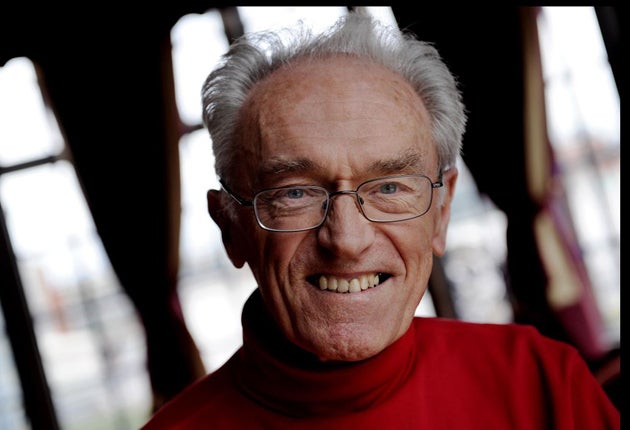
With the death of Peter Townsend, one of the global giants of social science and a leading campaigner for social justice, poor and excluded people everywhere have lost a tireless champion and complacent governments one of their sharpest critics.
He will be mourned by the thousands of students he inspired, including this one, and, perhaps, by a small fraction of those who have benefited from the social reforms he advanced.
In an academic career spanning six decades he authored definitive studies in each of his major fields: the definition and meaning of poverty, ageing and later life, disability and health inequalities. In each field the landscapes of both the scientific and policy debates were transformed by his work. The production of Peter's mammoth book, Poverty in the United Kingdom, published in 1979, took 10 years and topped 1,200 pages. It will always be the standard reference on poverty. The reach of his analytical skills, with no diminution in their power, was breathtaking and he produced more than enough for a handful of very respectable academic careers. Not only was he able to write prodigiously, a skill developed in student journalism at Cambridge in the late Forties and early Fifties, but also beautifully in a classic style that made the forensic dissection of evidence sparkle with clarity. He had a legendary capacity to write in almost any setting.
Every aspect of Townsend's career was underpinned by a deep moral commitment to combating poverty and inequality and, in policy terms, to arguing for equality instead of minimum standards: distributional justice for all, not welfare for a few, as he put it. His commitment to equality made him one of the 20th century's foremost radical campaigners, in the tradition of Tawney and Booth. This led to numerous skirmishes with governments, especially Labour ones who he believed should know better than to penalise the poor while allowing the rich to prosper unhindered by progressive taxation.
His moral conviction determined his scientific trajectory but Townsend's dedication to studying "very carefully the life of the poorest and most handicapped members of society" as he wrote in 1958, often excluded him from the academic mainstream. A co-founder Professor at the University of Essex, who was critical of his focus on the poor, ignored how Peter used poverty to pinpoint fundamental flaws in the, national and global, distribution of resources which affect everyone and either diminish or enrich our lives. Many who rejected his conclusions were quoting them as received wisdom a few years later. Appropriate recognition came eventually as a founding member of the Academy of Social Sciences, a Fellow of the British Academy, together with a string of honorary degrees.
The chasm Townsend leaves as a campaigner is as great as the scientific one. He was a member of the Fabian Society for more than 60 years; co-founder of the Child Poverty Action Group in 1965, was its chair for 20 years and Life President since 1989; and, following the Thalidomide scandal in 1973, co-founded the Disability Alliance, which he chaired for 25 years and remained active in until his death. His dedication to these causes was extraordinary and required huge stamina and a commitment to meetings, public engagements and writing pamphlets that few, if any, could match. This pressure-group activity and his research have led to social reforms that have affected millions of people – from the introduction of the Attendance Allowance and other disability benefits to measures to reduce child poverty and health inequalities.
Townsend was a public intellectual bent on telling the truth to power and convinced that a more equal society was achievable. In this role he excelled his mentor, Richard Titmuss, who tried to discourage his move from LSE to Essex in 1963. Subsequently, he went to Bristol University, which established the Townsend Centre for International Poverty Research in his honour and, then finally, back to LSE in 1998, where he briefly headed the Centre for the Study of Human Rights and retired from teaching last year.
Late in his career Peter developed a strong interest in human rights – the subject of his last and, he said, best work, completed days before his death – a perspective he was introduced to by his third wife Jean Corston, a Labour Party organiser, MP and now a peer. He was in love with Jean from the moment he saw her until his death. Her family brought two stepchildren into his life (and a dog called Arrow) to add to his four sons from his first marriage and one daughter from his second. Close proximity to his grandchildren was an emotional high point of recent years. They all survive him and, along with a legion of friends and colleagues, are shocked that this exceptional life has come to an end.
In the years from 1964-70, when I worked as his parliamentary private secretary, I could count on the fingers of one hand the number of occasions when I saw the cabinet minister Dick Crossman struck by anxiety and self-doubt before a speech, writes Tam Dalyell. One was the evening of Wednesday 23 November 1966, which he recorded in his diary: "I had to give the final lecture of the autumn Fabian series in the Caxton Hall this evening. Two of the previous lectures had been given by Brian Abel-Smith and Peter Townsend, who had launched a tremendous attack on the government for its failure to abolish poverty. I spent four hours last night sweating away digesting their lectures and preparing a really rumbustious reply. I delivered this to a packed audience. Richard Titmuss, along with Abel-Smith and Townsend, was sitting just in front of me and the audience was pretty strongly on their side and obviously agreed with their accusation that the government was losing its sense of direction and betraying its principles."
In the late 1950s, when Crossman was given the responsibility by Hugh Gaitskell for devising Labour's national superannuation scheme, the trio had been his closest brains trust. Townsend, in particular, felt betrayed. and his anger at what he saw (unfairly in my view) as the betrayal of the poor, galvanised him into becoming their most effective public champion for decades to come.
Professor Peter Townsend, sociologist, social policy analyst, campaigner: born Middlesbrough 6 April 1928; Research Fellow, then Lecturer in Social Administration, London School of Economics, 1957–63; Professor of Sociology, Essex University, 1963–81; Chairman, Fabian Society, 1965–66; Chairman, Child Poverty Action Group, 1969-89, then President; Pro-Vice-Chancellor (Social Policy), Essex University, 1975–78; Professor of Social Policy, Bristol University, 1982–93; Visiting Professor of Sociology, Essex University, 1982–86; Director, School of Applied Social Studies, Bristol University, 1983–85, 1988–93; Professor of International Social Policy, LSE, from 1999; married 1949 Ruth Pearce (four sons), 1977 Joy Skegg (one daughter); 1985 Jean Ann Corston (one stepson, one stepdaughter); died Dursley, Gloucestershire 8 June 2009.
Join our commenting forum
Join thought-provoking conversations, follow other Independent readers and see their replies
Comments