Professor Walter Ledermann: Highly respected mathematician with an eclectic range of interests
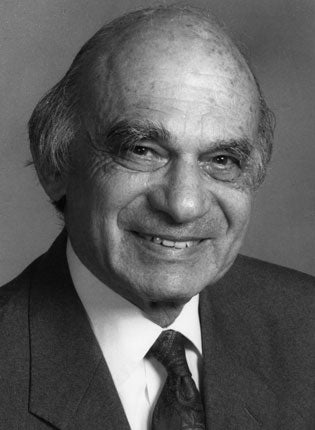
"A sweet and gentle little man” whom students found “charming, friendly, understanding and delightful” and whose lectures “were masterfully presented”.
These quotations, taken from the web, were written by an American student who attended Walter Ledermann’s lectures at the University of Notre Dame, Indiana, in summer 1962.
Anyone who had the good fortune to know or to have been taught by Walter Ledermann will only echo them. He was not only a much respected mathematician and an outstanding lecturer and author, but a man who, by nature, inspired affection.
Ledermann was born in Berlin in 1911 to Jewish parents who were completely assimilated Germans. He soon witnessed great changes, that with an undiminished memory he could recall to the end of his life: the war in which his father, a doctor, served, the overthrow of the Kaiser and the civil war in Berlin which was temporarily ruled by a “workers’ council”. After that came the years of hyperinflation when his father lost his life savings. It was then that Walter, aged 11, who had begun to learn to play the violin two years earlier, began to have lessons from a tutor who set for his fee “the equivalent of a loaf of bread”, but quickly raised that by insisting that the bread should be white – a luxury at that time.
Music was, indeed, to permeate Ledermann’s life and from the age of 12 he became a member of various chamber ensembles. This interest persisted wherever he was living and continued until a few months before his death. In his memoirs, Encounters of a Mathematician (Lulu Press, 2009), he mentions many who played with him, including Klaus Fuchs, the notorious atomic spy. He also soon developed a keen interest in orchestral music and opera. Walter and his father obtained complimentary tickets for the rehearsals or concerts of the Berlin Philharmonic thanks to one of his father’s patients. At these and the three Berlin opera houses he could enjoy performances led by conductors such as Wilhelm Furtwängler, Bruno Walter, Georg Szell, Otto Klemperer and Erich Kleiber. As an enthusiastic schoolboy Wagnerite he attended 14 performances of Die Meistersinger in one year. Later, in 1931, he used the money he obtained from giving tutorials to attend the Bayreuth Festival in order to hear Toscanini conduct Wagner.
At that time Jews were allowed to visit Wagner’s house, but Ledermann still found the atmosphere tense and unpleasant. By then, however, he had found his great professional interest, mathematics.
At the Leibniz Gymnasium, because of his great promise in classics and mathematics, he received his leaving certificate at an earlier age than normal and this allowed him to complete the course at Berlin University before the Nazis would have forced him to abandon his studies. At university he was influenced by many outstanding scientists and mathematicians, in particular by Issai Schur and Heinz Hopf. Soon, however, it became clear that he would have no chance of surviving in Nazi Germany and he was fortunate to obtain a scholarship that students at St Andrews had established to support a Jewish refugee from Germany. In January 1934, he left for Scotland where his elder brother was already training to be a doctor. His father and he decided to spend his last night in Berlin at the Staatsoper where Furtwängler was to conduct Tristan und Isolde. The start of the opera was delayed and after a few minutes the reason became apparent, for Hitler then took his place in the old imperial box. Ledermann still thought it was an ideal way to be granted this musical treat even though he had to share it with Hitler, Goebbels and Goering.
Happily he was soon to find new friends and to enjoy much Scottish hospitality. Here his violin and viola assisted and he quickly became adept at playing reels and Strathspeys at the students’ hops. Professor H.W. Turnbull, a leading algebraist, accepted him as a research student and the Turnbulls, together with Dan Rutherford and other Scottish academics, were always caring and helpful.
By the summer of 1936, Ledermann had been awarded his Ph.D; his future, however, now seemed uncertain for there was no prospect of employment at St. Andrews. Turnbull suggested that he should speak to Edmund Whittaker at Edinburgh. Whittaker provided Walter with a small bursary and introduced him to A.C. Aitken, who became not only a great mathematical influence but also a caring friend who assisted him secure a post as, in his words, “a tame mathematician” for Godfrey Thomson, the leading educational psychologist. This proved an inspiring and creative collaboration that generated the mathematical work for which Ledermann obtained an Edinburgh DSc in 1940.
A brief spell as a temporary lecturer at Dundee was followed by his return to St. Andrews in 1938. Early in 1940 he became a British citizen and so escaped internment. Instead, he and Erwin Freundlich, the eminent astronomer and fellow refugee, taught navigation to the RAF. It was Freundlich who in 1945 introduced Walter to Ruth (Rushi) Stadler, a psychotherapist and accomplished pianist, whom he was to marry the following year.
However, there was no work for Rushi in St. Andrews and so the two decided to move, preferably to a city with a flourishing cultural life.
At St. Andrews much of Ledermann’s teaching was in applied mathematics – a subject for which Berlin had not prepared him. His wish to join Manchester, where Sidney Goldstein and Max Newman were attempting to establish one of the foremost mathematics centres in the country (and where Barbirolli was making similar attempts with the Hallé Orchestra), led him to apply for a lectureship in applied mathematics there. Unsurprisingly he was not appointed, but shortly afterwards Newman wrote to inform him of a vacancy in pure mathematics and, without any further interview, he was appointed.
Lecturers had to share offices and Newman, in an attempt to promote cross-fertilisation of knowledge and interests, ensured that there was a frequent changing of room-mates. Thus, Ledermann’s research papers at that time show an eclectic range of mathematical interests: two papers with Harry Reuter on Markov processes, two with Kurt Mahler on the geometry of numbers, two with his fellow Berlin student, Bernard Neumann, on algebra, and several with Peter Hilton on topology. Yet Ledermann will probably be primarily remembered for his work in algebra, his book, Introduction to Group Characters (1977), and the manner in which this develops the work of his teacher, Schur.
By 1960 many of Walter’s colleagues had moved elsewhere and the Ledermanns decided to move nearer London. Walter was invited to join the newly opened University of Sussex and he moved there as Reader in 1962; and in 1965 was promoted to professor.
He retired in 1978, and in 1997 the Ledermanns moved to London to be nearer their son, Jonathan, and his family, but until 2002 he still frequently returned to the university to lecture or give tutorials. He continued to publish research papers well into his eighties.
To generations of undergraduates who never met Ledermann his name will be familiar as the author or editor of their textbooks. When he arrived from Germany he noted the absence of the pocketbooks to be found in abundance there and he and Dan Rutherford approached Oliver and Boyd with a proposal for a series of such books on mathematical topics. The publishers accepted the proposal but thought that people would not like to see a German name on the cover and so Dan and Alec Aitken were named as editors.
Ledermann’s contribution to this series, Introduction to the Theory of Finite Groups (1949), was enormously successful both mathematically and in publishing terms.
Later Ledermann decided that cheaper books directed at mathematicians, engineers and others were required and he established his Library of Mathematics (Routledge and Kegan Paul). This grew to more than 20 volumes and Ledermann took great satisfaction that on publication his Complex Numbers was running neck to neck for sales with Lady Chatterley’s Lover in the Manchester University bookshop. Later still, and this time catering for more advanced users of mathematics, Ledermann was chief editor of the eight volume Handbook of Applicable Mathematics (Wiley).
In 1944 Ledermann was elected a Fellow of the Royal Society of Edinburgh, from 1971-77 he was a Vice- President for the London Mathematical Society; he edited that Society’s Journal (1968-71) and Bulletin (1973-77).
He received an honorary doctorate from the Open University in 1993.
Geoffrey Howson
Walter Ledermann, mathematician: born Berlin 18 March 1911; married 1946 Ruth Stefanie (Rushi) Stadler (one son); died London 22 May 2009.
Join our commenting forum
Join thought-provoking conversations, follow other Independent readers and see their replies
Comments
Bookmark popover
Removed from bookmarks