Rafael Escalona: Singer and composer who inspired 'One Hundred Years of Solitude'
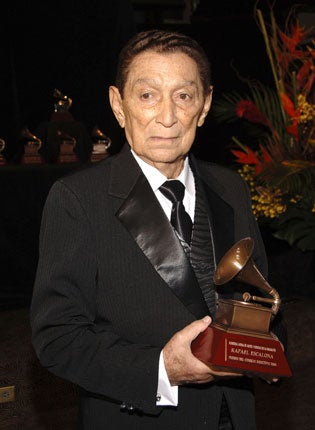
The singer and composer Rafael Escalona was a national icon in his native Colombia, known as "el maestro" of vallenato folk music from the northern Caribbean coast. His ballads, sung to the traditional backing of European accordion, African-style caja, or bongo drum, and Native Indian bamboo guacharaca percussion, inspired many internationally known Latino singers, including Julio Iglesias, Gloria Estefan and his fellow Colombians Shakira and Carlos Vives. Escalona also made a lasting impression on another compatriot (and close friend), Gabriel García Márquez. The author mentioned Escalona as a resident of the fictional town of Macondo in his Nobel Prize-winning novel, One Hundred Years of Solitude, and said that Escalona, and his music, had been an inspiration for the book.
"In a way, the novel is a 400-page vallenato," García Márquez once said, comparing Escalona's blend of true story and the fantastical with his own "magical realism". Towards the end of the book, García Márquez wrote: "In the last open saloon... an accordion group was playing the songs of Rafael Escalona, the bishop's nephew, heir to the secrets of Francisco el Hombre." The latter figure (Francisco the Man), a legend in vallenato music, was said to have been a musician who beat the devil in a duel of accordions.
García Márquez and Escalona were the driving forces behind the annual Vallenato Legend Festival in Valledupar, the capital of Colombia's northern Cesar province, where the singer grew up. Escalona's songs and the 40-year-old festival, in which vallenato composers and musicians compete for the title of el Rey [King] de Vallenato for the year, helped to bring the form to the attention of the entire Spanish-speaking world and beyond, strongly influencing such albums as Gloria Estefan's 1995 Grammy-winning Abriendo Puertas [Opening Doors].
It was in 1992 that Escalona became arguably the most popular citizen of Colombia, after national TV began a long-running soap opera, Escalona, during which the singer (played by Carlos Vives) serenaded countless beautiful women with such romantic vallenato ballads as "El Testamento" [The Will] and "La Casa en el Aire" [The House in the Sky]. The handsome Vives went on to become one of Colombia's most successful musical exports, blending vallenato with rock and pop.
Such was Escalona's status in his homeland that the Colombian President, Álvaro Uribe, knowing that the singer was gravely ill, insisted on being told immediately if he died. When he was so informed during a meeting of business leaders in the city of Cali, he halted the meeting for a minute of silence. A former president and close friend of the singer, Ernesto Samper, was on his way to visit him when he died of heart failure after being diagnosed with prostate cancer.
Rafael Calixto Escalona Martínez was born in the northern village of Patillal, in Colombia's Cesar department, on 27 May 1927. He was the seventh of nine children of the army colonel Clemente Escalona Labarces, a veteran of Colombia's so-called Thousand Days' War, an armed conflict between supporters of the two big political parties from 1899-1902. García Márquez used elements of Col. Escalona's life for the character of Col. Aureliano Buendía in One Hundred Years of Solitude.
Although his family were part of the Colombian élite, young Rafael was fascinated by the local peasant's often mystical folk tales and the accordion music of travelling troubadours. He later admitted that he never learned to play the accordion because the instrument, although brought to Colombia by wealthy European colonialists, was associated with Colombia's peasant class.
He was a cotton farmer when he became friends with the new governor of Cesar province, Alfonso López Michelsen, and, after López Michelsen was elected president of Colombia, was appointed as his country's consul in neighbouring Panama. When he returned to Colombia, he concentrated on recording his ballads and became known not only as a musician but as a parrandero y mujeriego (party-goer and womaniser).
Despite his fame, Rafael Escalona died poor. In an interview shortly before he died, he said he had sold the rights to his songs for around $68,000 dollars in return for a loan. "Unfortunately, all I'll be able to leave my family will be this," he said, pointing to his bedside respirator.
He is survived by his partner Luz Marina Zambrano and, according to his youngest son Rafael Jnr, at least 23 children by numerous previous compañeras.
Phil Davison
Rafael Calixto Escalona Martínez, singer and composer: born Patillal, Colombia 27 May 1927; married 1951 Marina Arzuaga Mejía (marriage dissolved); died Bogotá, Colombia 13 May 2009.
Join our commenting forum
Join thought-provoking conversations, follow other Independent readers and see their replies
Comments