Richard Widmark: Actor whose first film performance earned him an Oscar nomination
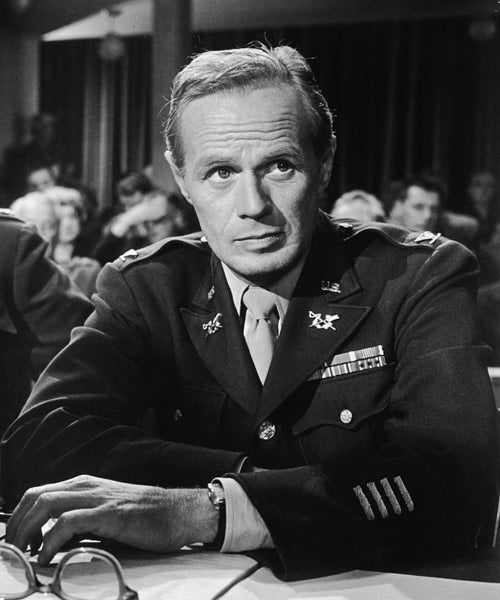
Although Richard Widmark's small Midwestern home town shares its name with one of the most luminously exquisite of all Hollywood productions, F.W. Murnau's silent Sunrise, and although he himself in time came to seem a familiar, even indispensable, fixture of the post-war American cinema, his original ambition was to be a lawyer, and he made his screen début at the relatively mature age of 33.
He was raised in Chicago, and enrolled at Lake Forest College as a first-year law student. It was there that, mostly because of his wiry, athletic physique, he found himself more and more involved with its dramatic society; so much so that after graduating in 1936 he remained at the college as an instructor in speech and drama.
In 1938 he moved to New York, working steadily on radio – in, most memorably, Orson Welles's Mercury Theatre on the Air – and at the same time managing to land a handful of secondary roles in Broadway plays, almost all of them complete flops, but including one directed by the already famous Elia Kazan. Kazan must have been impressed, for he used his influence to have Widmark tested by 20th Century-Fox and immediately put under contract.
It's probably true to say that, with the exception of Welles himself, no American actor has made quite so vivid and haunting an impression with his very first film performance. Henry Hathaway's Kiss of Death (1947) was, for the Forties, an uncharacteristically vicious, almost Tarantino-like little shocker whose nominal leads were Brian Donlevy and Victor Mature. But neither of these stolidly inexpressive performers stood a chance when confronted with Widmark's maniacally giggling, psychopathic hitman, the highlight of whose existence was gleefully shoving poor, crippled Mildred Dunnock headlong down a flight of stairs. He was nominated for a Best Supporting Actor Oscar – possibly on the strength of that scene alone.
Naturally, having discovered a performer with such a chillingly sadistic line in villainy, the studio was loath to cast him in any other register; and Widmark was condemned for several years to play variations on the role, notably in William Keighley's semi-documentary thriller The Street With No Name (1948), Jean Negulesco's tawdry, velvety melodrama Road House (also 1948) and Joseph L. Mankiewicz's No Way Out (1950), in which Widmark played to the hilt a slimily racist hoodlum of whose machinations Sidney Poitier becomes the helpless victim.
Widmark's range was always an awkwardly narrow one. He was fairly hopeless at comedy, no jeune premier, and not credible for an instant as a charming, personable leading man in the kind of indistinguishable, blandly routine fare which would trundle along Hollywood's assembly line year after year.
Yet this was, after all, a halcyon era for the American cinema, and Widmark was perhaps luckier than most. Two other roles of 1950, for example, stand out; that of a small-time wrestling promoter pursued by gangsters through a weird, warped and expressionistically lit London in a film with one of the classic noir titles, Jules Dassin's Night and the City (it was remade in 1992, much less effectively, with Robert de Niro in the Widmark role, just as Kiss of Death has been remade with the inferior Nicolas Cage); and that of a harassed doctor contending with a lethal outbreak of bubonic plague on the New Orleans waterfront in Kazan's Panic in the Streets.
Like many contract stars, however, Widmark was also forced into a dispiriting number of less stimulating films – films which would tend, in his case, to emphasise the least attractive side of his screen personality, a sort of sneering macho boorishness which would cause his delivery of dialogue to degenerate into a perpetual snarl and his never particularly comely facial features to assume a series of disfiguring grimaces.
This side was much to the fore in Lewis Milestone's unambiguously jingoistic war movie The Halls of Montezuma (1951); in Red Skies of Montana (1952), a wearily routine yarn about parachuting forest fire-fighters directed (as if it mattered) by Joseph M. Newman; and in Richard Brooks's Take the High Ground (1953), where he played a drill sergeant so convincingly tough, foul-mouthed and obnoxious he was as intolerable to the film's spectators as to the poor young Marines in his charge.
In fact, Widmark tended to be strongest when working with a director of real distinction (which is not necessarily the case with every actor). He was excellent in a pair of punchily violent Samuel Fuller thrillers, Pickup on South Street (made in 1953, at the very height of the Cold War, its rabid anti-Communism – Fuller is a right-wing maverick and doesn't care who knows it – was transformed in several European dubbed versions to an anti-narcotics theme) and Hell and High Water (1954), about the mission of an American submarine into Arctic waters.
And he seemed agreeably mellowed in two late westerns by John Ford: Two Rode Together (1961) in which he played a cavalry officer assigned to accompany an excursion to rescue a group of pioneers captured by Comanche Indians (on the movie's release in France, its title had somehow got mangled en route, ending up as "Two Rode to Get Her", a perfectly accurate encapsulation, nevertheless, of its plot); and the self-consciously elegiac, belatedly pro-Indian Cheyenne Autumn (1963). It has to be admitted, on the other hand, that he was ludicrously ill-cast as the idiot Dauphin in Otto Preminger's dull, misconceived adaptation of Shaw's Saint Joan in 1957.
Although he was to make another 20-odd films before his eventual retirement from the cinema in 1990, turning up in an incoherent ragbag of titles including Sidney Lumet's Murder on the Orient Express (1974; he was the arch-meanie of a murder victim), Stanley Kramer's The Domino Theory (1977) and Irwin Allen's The Swarm (1978, a preposterously "has-been studded" disaster movie which has secured a niche in every cinephile's Pantheon of the pits), his last truly stand-out performance was in the title role of Don Siegel's razor-sharp thriller Madigan (1968), as a maverick police officer for whom the ends justify even the most dubious of means (such a character was not yet the cliché it would soon become).
So successful was the film (an obvious precursor of Siegel's own, and still more phenomenally popular, Dirty Harry, starring Clint Eastwood) that Widmark, who had declined numerous offers to appear on television, was at last persuaded to reprise his role in a long-running television series of the same name.
Widmark was a deeply private man, seldom photographed at gala premieres and the like, and little is known of his personal life: unusually for a Hollywood star, his first marriage, to the screenwriter and former actress Jean Hazlewood, lasted for 55 years, and he was never alleged to have been an "item" with any of his feminine co-stars. But even if not precisely of, as they say, the first magnitude, his reputation is secure – if for no other reason, because he shoved Mildred Dunnock downstairs.
Gilbert Adair
Richard Widmark, actor: born Sunrise, Minnesota 26 December 1914; married 1942 Jean Hazlewood (died 1997; one daughter), 1999 Susan Blanchard; died Roxbury, Connecticut 24 March 2008.
Join our commenting forum
Join thought-provoking conversations, follow other Independent readers and see their replies
Comments
Bookmark popover
Removed from bookmarks